Common obstacles to more effective meetings
Be honest. Do you dread or relish the thought of business meetings? If you’d prefer to put your head down and focus on your work instead of sitting through a seemingly-pointless meeting, you’re not alone. Most meetings are an immense waste of time and money, according to a recent, in-depth study conducted by Doodle–the online scheduling service.
In the study of 19 million meetings and over 6,500 interviews with working professionals across the U.S., U.K., and Germany, Doodle found that the majority of the meetings observed were poorly organized and came with a high cost. According to the report, inefficient meetings will cost businesses a projected total of $541 billion in the U.S. in 2019.
This is a massive blow to business efficiency and the well-being of employees, as the same report found that poorly organized meetings also meant negative consequences for attendees:
- 44% of respondents said ill-organized meetings led to insufficient time to complete the rest of their work
- 38% of respondents said poor organization leads to a loss of focus on projects
- 31% of respondents said that unnecessary attendees slowed the progress of the meeting
The good news is that meetings can be improved to be much more productive and lucrative. I’ve outlined five fixes that will help make your meetings better, more successful, and fruitful for your overall business as well as all meeting attendees.
The good news is that meetings can be improved to be much more productive and lucrative.

The following are five common obstacles that can prohibit effective meetings and how to combat them:
1. Unclear purpose
Clear objectives drive a successful meeting. When the goal is vague, it is difficult, if not impossible, for the objectives to be reached or solved. How can you arrive at your destination if you don’t know what it is?
Before planning your meeting outline, you must first ask yourself, “What is the purpose? Are we making decisions or developing new concepts or both? Are we seeking advice from the team or asking them to help with the decision?” The answers will produce different needs, and therefore, different meeting structures.
Identifying the best structure to achieve your goals will foster maximum productivity. Stay clear and focused on the purpose throughout for optimum efficiency.

2. Inadequate agenda
Outline your meetings with the overall outcomes in mind rather than just speaking to an aimless bullet point list of subjects. Most people fail to consider the overall arc or experience they are creating for attendees in a meeting.
When you are transparent about the outcome you would like to create, you can aim the meeting’s activities in service to the desired results. In other words, if you design the agenda toward the desired outcomes, you will know where you are headed, and if your roadmap is off track. You’ll also be able to measure the success of the meeting’s progression—is the conversation or activity producing the results that you need?
When you are transparent about the outcome you would like to create, you can aim the meeting’s activities in service to the desired results.
Identifying the purpose and sought-after outcomes of the meeting also allow you to outline and synchronize a timely flow. How long do you need to discuss each talking point? How much time do you need for open discussion? Setting times on the agenda will help keep you focused and on track, less wasted time, and irrelevant content!
It’s also important to note that when you are concentrated on outcomes, you’ll be more aware of when it’s safe to spend more time on a subject and when to be the time cop and stick to your plan.

3. Cold start
Most of us run from meeting to meeting, barely finding enough time to make a pit stop in the bathroom, scarf down a sandwich, or gather ourselves before the next one begins, while some of us can stroll into meetings much more leisurely and focused.
The fact is, we aren’t always coming from the same space when we walk in the door. This can significantly affect the meeting’s overall flow and success, especially when the meeting immediately kicks off and dives into the topics at hand before establishing a more even playing field for attendees.
Reserve the first part of the meeting for a reflective moment, where everyone can reset and gear up for what’s ahead.

What can this look like? There may be a handful of people who are in a clearer or more available headspace who end up dominating the conversation while others idly sit back, unsure of what to say or when to say it. Allowing some “bootup time” before the conversation begins can be of great benefit. Reserve the first part of the meeting for a reflective moment, where everyone can reset and gear up for what’s ahead. This could even be in the form of a silent 5 to 10 minute group meditation.
According to one study, the inclusion of workplace mindfulness, including meditation, significantly reduced employee burnout and perceived stress, improved mindfulness, and individual well-being, and increased team environment and personal performance.
Another bootup option is to present the group with a provocative and relevant prompt, followed by quiet time to marinate on it and explore it alone before the meeting kicks off. This space of individual preparation can help everyone gear up and be more involved in the group discussion ahead.
4. Wrong attendees
Sometimes leaders equate inclusivity with productivity. This isn’t always the case. When you are intentional about who needs to be in a meeting, meetings then become leaner and more focused. At Voltage Control, we have a rule: “All meetings are OPTIONAL. DON’T ATTEND if you don’t think you can contribute to the meeting in a meaningful way, or the attending won’t improve your ability to do your job.”
That is to say, only include employees who will provide value and diverse insight to the topics at hand, rather than inviting people out of habit. This isn’t “exclusivity” but an honest strategy. At their core, lean meetings move faster and are more inclusive by design.
When you are intentional about who needs to be in a meeting, meetings then become leaner and more focused.
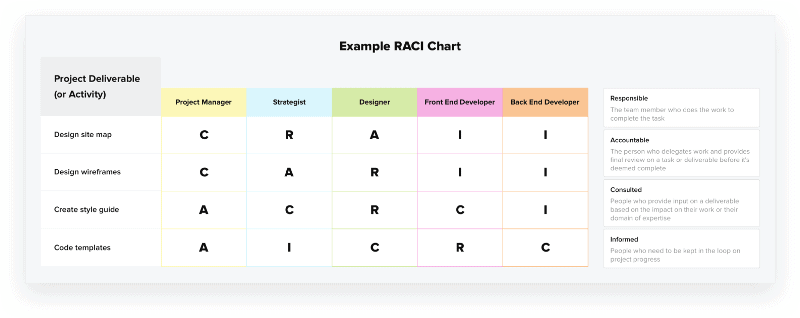
A useful tool to help establish who should attend specific meetings is a RACI chart. RACI stands for:
- Responsible: who should perform this activity or do the work?
- Accountability: who is primarily accountable and has the power to vote yes or no?
- Consulted: Who needs to provide feedback and contribute to the project or activity?
- Informed: Who needs to know of the decision or action decided upon?
A RACI chart, then, is used to assign all employees roles and responsibilities for each decision, project, or meeting. Below is an example provided by teamgantt: You can utilize a free RACI chart template to break down and identify your own needs and strategically decide who to include in specific meetings to make them more intentional and direct.
5. Outdated purpose
It’s crucial to take a look at your regularly scheduled meetings—daily, weekly, and monthly—and reevaluate their practicality. Have you already accomplished the purpose of these meetings, or are you continuing to host them out of habit or ritual? If it’s the latter, it’s a waste of precious time and resources. If you are still working to achieve individual goals, how can you restructure your meeting to be more productive?

Meetings are also a direct reflection of company culture. For example, what does it say about your company if regularly held meetings are irrelevant, unproductive, unpredictable in length or content, or don’t encourage employees to be and do their best? Each session, small and large, should have clear intention and purpose to foster overall success for company performance and culture. Trim the fat where needed.
Thoughtfully reflecting on the target, agenda, accessibility, and necessity of each planned meeting will significantly benefit the business and team. It will also help to preserve valuable company resources.
For more practical skills to get work done in meetings, check out this article on “Conducting Room Intelligence.”