A conversation with Jeff Gothelf, speaker, coach, consultant, and co-author of Lean UX.
This is part of my series on thought leaders in the innovation space.
Jeff Gothelf’s path to top product strategy consultant may have started with wanting to take his girlfriend on some nice dates. Jeff was a self-declared broke musician looking to make extra money for dinners with his new girlfriend (now his wife). “I was a computer geek as a kid, so the internet (aka Web 1.0) was where I headed immediately. Back then, if you could spell HTML, you could get a job. The rest is history…”

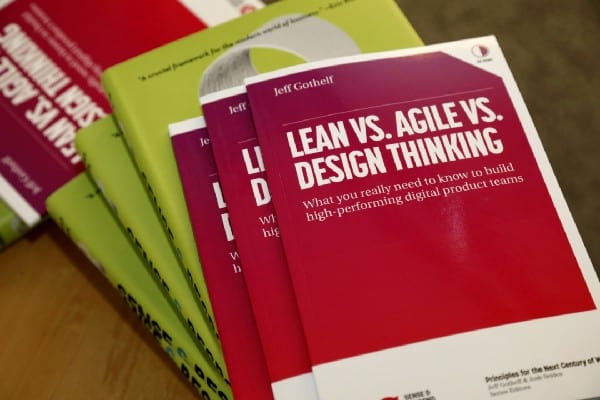
Today, Jeff is a well-known coach, speaker, author, and consultant who helps organizations build better products and works with executives to build the cultures that build better products. As well as Lean UX, he’s the co-author of Sense and Respond and Lean vs Agile vs Design Thinking. Recently, he co-founded Sense & Respond Press, a publishing house for modern, transformational business books.
He was nominated for a Thinkers50 award for innovation. Over his 20 years in technology, Jeff has worked to bring a customer-centric, evidence-based approach to product strategy, design, and leadership at a wide range of companies, like Neo Innovation, TheLadders, Webtrends, and AOL. He regularly keynotes conferences, teaches workshops, and works directly with client leadership teams across North America, Europe, and Asia.


A Lesson from the Circus
Before he got into tech, Jeff’s first “real” job was in the circus. He was graduating from James Madison University in Harrisonburg, Virginia with a degree in Mass Communications and a specialization in Audio Production. As the circus was about to come through town, they reached out to the school for an audio engineer recommendation. The job had Jeff’s name written all over it. With a little encouragement from his parents, Jeff joined a literal three-ring circus. “I put my junk in storage on Sunday. I had a motorcycle, a Bob Marley poster, and a mattress. That was it. On Monday, I’m in the circus.”
As the sound and lighting guy for Clyde Beatty Cole Brothers Circus, Jeff spent six months on the road. “I hung out with clowns. The human cannonball was my friend. We traveled around — every two days we were in a new place. I slept in the back of a semi with seven other dudes.”
“The circus opportunity helped me, or motivated me, to jump in the deep end and learn how to swim once I got there.”
Along with the great stories, Jeff left the circus with a life lesson that is still relevant to him today: “I think the main thing that it’s taught me is to just try. When the opportunity came to write my first book, [the publisher] came to me and said, ‘You’re the Lean UX guy. Do you want to write the Lean UX book?’ I’d never thought about writing a book. To me, it seemed like an insurmountable task. Like a mountain to climb and I’m not a mountain climber. But the circus opportunity helped me, or motivated me, to jump in the deep end and learn how to swim once I got there.”



What’s the Motivation?
In addition to his fascinating backstory, Jeff and I spoke about the prevalence of innovation labs at companies today. I was curious to know what he thought about how they worked or how they could be better. “The idea of an innovation lab is seductive and interesting, but almost every company gets it wrong. It can’t generate the kind of big innovative leaps they’d hoped for with these labs.”
Patience is one factor that Jeff identifies as an issue: “Organizations put the money into the lab, but they don’t have the patience of a VC firm. They’re not going to wait five to seven years for a good idea to return on that investment. They want something in three months or six months. So they start to get antsy, and the labs get a lot of pressure to generate something, and then they shut down.”
“What’s the motivation for them to take their excellent entrepreneurial ideas, spirit, and activities and do this without some kind of an equity stake?”
Another pitfall that Jeff talked about in regards to innovation groups at large companies is motivation: “You take smart people and build a team or a business unit around them. But what’s the motivation for them to take their excellent entrepreneurial ideas, spirit, and activities and do this without some equity stake?” I think it’s an important point and one that’s not often discussed. What rewards do employees reap at big companies for trying to push break-through ideas?
At a previous consulting company, Jeff and his team even created a concept that would try to tackle this issue: “Innovation Studio was a well-funded, patient in-house ‘lab’ that was adequately staffed, funded, and had a clear idea of what to do with the successful and unsuccessful ventures it housed. Most importantly, it brought in staff who had strong ideas and would end up with equity in their ideas should they be deemed successful. The lab would provide guidance, coaching, and the skillsets (design, engineering, product management, etc.) necessary for the best chance of success. In the end, it was all about incentive structures. I haven’t seen it done this way before.”


Expressed vs. Latent Customer Needs
Jeff is firmly customer-centric in his perspective. He defines innovation as: “Creating a new way to deliver value to customers that differentiates you from the competition.” And he feels that customer-centricity — “solve a real problem for a real customer in a meaningful way” — is the innovation silver bullet.
“Our job, as the makers of products and services, is to discover and understand customers’ latent needs.”
With this in mind, Jeff and I dug into the debate around whether or not we can trust customers to know or articulate what they need and want. (Maybe this should be called the Henry Ford debate since it often stems from Ford’s supposed quote: “If I had asked people what they wanted, they would have said faster horses.”)
Jeff said: “Customers know what they need to do. They know what they’re trying to achieve. They know what problem they’re trying to solve, what task they’re trying complete, and what their goal is. Our job, as the makers of products and services, is to discover and understand those latent needs.”
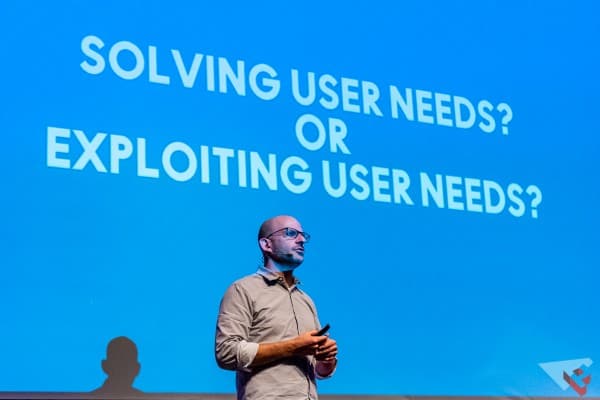
As designers, we need to identify what is below or behind the needs that customers express. “An expressed need is something like: ‘I need to apply for a mortgage.’ The latent need is: ‘I need to find a home that I can afford, a mortgage that allows me to live the kind of life I’d like to give my kids…’ Good product people get to the latent needs through the various and manifold activities of customer discovery.”
“Good product people get to the latent needs through the various and manifold activities of customer discovery.”

Once you pinpoint the customer’s latent need, there’s certainly finesse in how you develop products to answer those needs. “How you solve those problems is product design and development work. There are people, like Steve Jobs, who were particularly good at this. They are very good at dreaming up amazing new ways to solve existing problems. They are either in charge of the company, willing to roll the success of a company on these ideas, or, were in a position of enough influence where they were able to get their ideas to see the light of day. But at the root, all of these ideas are solving real problems for real customers.”
He continued: “Customers have no idea that they want a touch screen necessarily. But what they do know, is that they’d like to carry fewer devices or they’d like to communicate more efficiently, or they’d like to be able to do certain things that their current devices don’t allow them to do. So there’s a conflation of customers not knowing what they want and being outstanding product people and innovators.”

Leaders Who Get It
Jeff stresses the importance of leadership and cultural change for organizations that want to work in new and innovative ways. “Many organizations attempt to implement ‘agile,’ ‘lean startup,’ or ‘lean UX’ in their ways of working, but don’t realize that without a cultural and leadership mindset shift, these things would never yield their full benefits.”
That’s why Jeff does significant coaching work with leaders. He’s most excited when he gets a chance to work with “leaders who get it.” He said, “When I meet leaders at companies who truly want to change how THEY work and THEN how their company works, I am excited to find ways to collaborate with them.”
“When I meet leaders at companies who truly want to change how THEY work and THEN how their company works, I am excited to find ways to collaborate with them.”
When it comes to leadership, Jeff’s less concerned with teaching the methods of lean, agile, or design thinking. He’s more interested in how the mindset behind these concepts lives at the top level of an organization.
“The reality is that [leaders] don’t care necessarily about sprints, retros, burn down charts, and velocity. But agility? If you can teach them what agility means, how to lead with agility, or how to lead an agile organization, then you stand a shot of getting the methodologies implemented and the teams working differently.”
“There has to be a realization that this means that how you lead and how you manage is also changing.”
Jeff believes that it has to be top-down. For innovation to take root in a company, leadership must provide support, have a deep understanding of what something like “agility” means, and be willing to change themselves. “There has to be a realization that this means that how you lead and how you manage is also changing.”
“Changing the way that you manage, changing the way that you lead, changing the way that you incentivize an organization to outcomes is the key to all of this.”
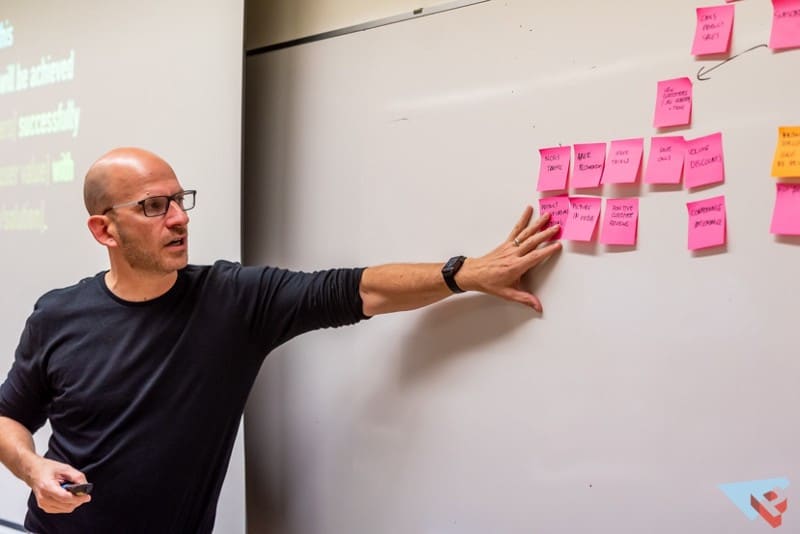
Jeff just launched a Professional Scrum with UX course. He created with Josh Seiden and in conjunction with scrum.org. “It’s a new certification course that does a good job of bridging the gap between user experience, design, and scrum — how do you reconcile these things together. It was over a year’s worth of work with lots of iterations and test classes.”
If you want to read my other articles about innovation experts and practitioners, please check them all out here.