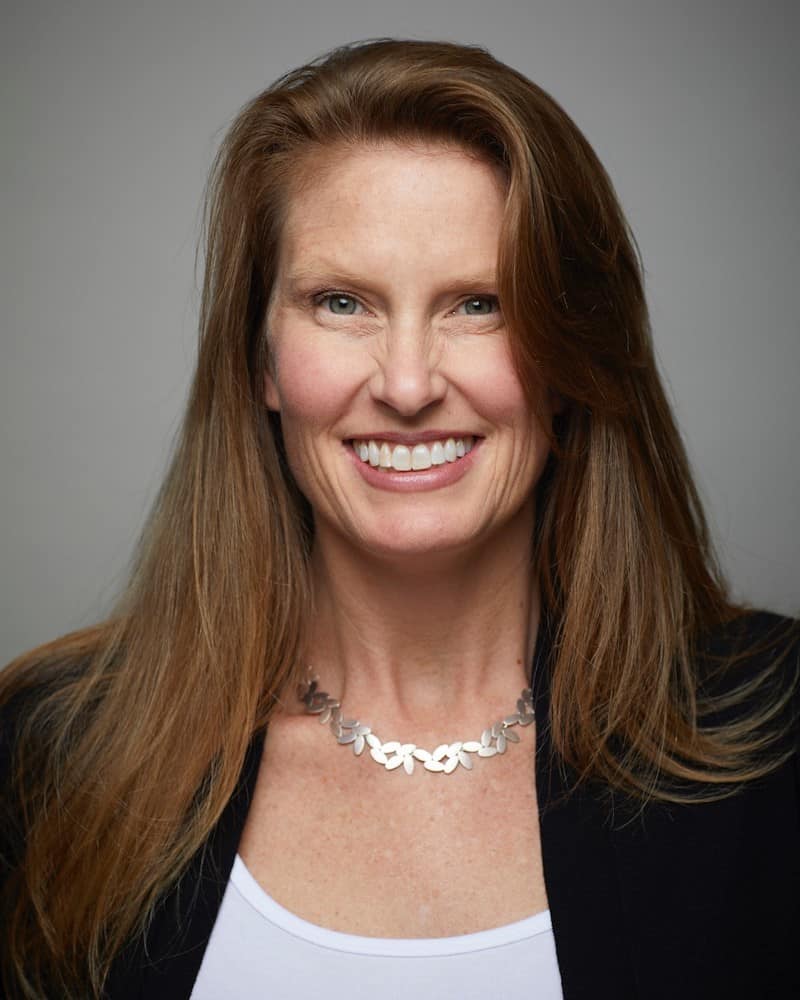
A conversation with Jamie Gardner, co-founder of merilu & partner at X Sector Labs
This is part of my series on thought leaders in the innovation space.
Jamie Gardner grew up in a traditional environment. Her father was a nuclear engineer, and her mother was a nurse. When she started school, she studied business and followed her parents’ risk-averse approach to life. Her entry into innovation came when, at the age of 30, she met her future husband, who led product development at Apple. “He took me to these exciting events where artists and engineers created the most imaginative experiences. I had no idea this creative world existed, and I fell in love with it.”
As she began studying the design field, she developed a passion for creating a professional expectation that designers donate 2% of their services to nonprofits. “I learned that great design and creativity was accessible to anyone and could change lives. I wanted to harness design to change business-as-usual attitudes towards solving complex social problems, so I dove into learning all I could about it.”
Anyone Can Innovate
One of the most critical things Jamie’s foray into the innovation taught her is that you don’t have to be a design expert to innovate: “I believe the key is mindset. With the right scaffolding, anyone can innovate.”
“With the right scaffolding, anyone can innovate.”
That scaffolding involves a willingness to get past the surface challenges to make the time and space to experiment. As a partner at X Sector Labs, Jamie works with a variety of organizations and populations that share a common problem: lack of resources and capacity to innovate. They’re reticent to do anything that takes time away from their day-to-day work: “They feel so strapped that they can’t spend time experimenting because they don’t have enough time and resources to deliver on what they have already committed to.”
Through her consulting work bringing business, government, nonprofit, and philanthropic organizations together, Jamie focuses on creating a safe space for experimentation. She works to instill the mindset that it’s ok to try new things and not get everything right the first time around. “We want to help organizations recognize that experimentation within this safe space is not adversely impacting the population they’re serving. They don’t want to get it wrong.”
Jamie’s specialty is bringing people from different sectors together to solve problems. Often the groups that Jamie works with come into the conversation with different languages, perspectives, cultures, values, and many assumptions about each other. “My approach involves getting them to remove their hats, remove the hierarchy. We’re all human. We’re all on the same playing field. Let’s connect as humans and forget about our titles and the structures we work in.”

Psychological Safety
To achieve this openness to experimentation, Jamie focuses on fostering a sense of psychological safety. “If people trust you, their willingness to explore can be without bounds. Without it, you’ll go nowhere.” Jamie leverages improv to get groups laughing. She’s found that it opens people up and calms their nervous system. “I have a passion for neuroscience and the impact that has on our physiology. I try to tap into that to create more oxytocin so that we feel connected and decrease cortisol, which is what creates the fight, flight, or freeze response when you don’t feel safe.”
“If people trust you, their willingness to explore can be without bounds. Without it, you’ll go nowhere.”
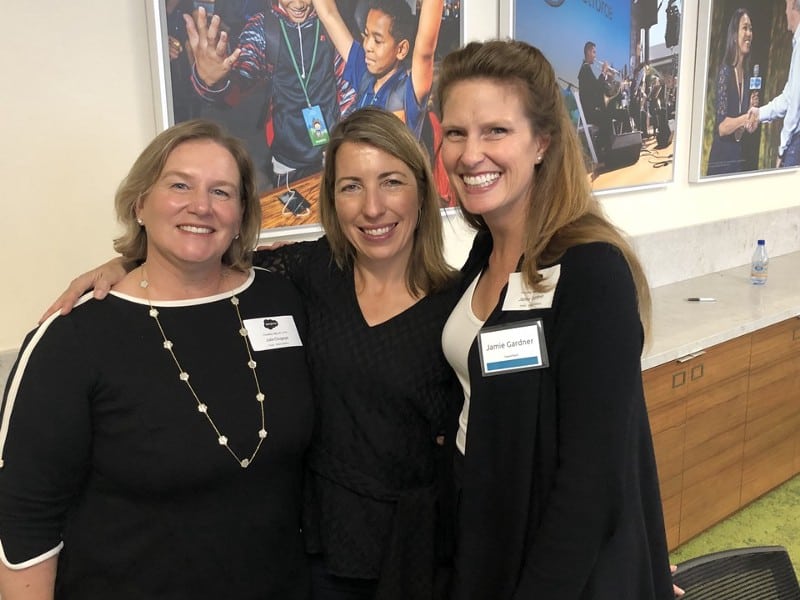
Beyond improv exercises, Jamie designs details into her activities like name badges that don’t identify a person’s title or their organization. Her goal is to help people connect as humans instead of seeing each other through a power-based perspective.
Breaking down assumptions is a big part of the power dynamic. Working with for-profit and nonprofit leaders, Jamie has observed that there’s the hypothesis that for-profit leaders are only in it for money and they’re only engaging in order to sell their products or services, not actually solve a problem. Conversely, many business leaders assume that nonprofit leaders don’t know how to run a business. Jamie builds trust to break down those assumptions: “I get them to align on the shared vision of why we’re all here, what problem we’re here to solve, and what assumptions we have about each other, and what assets each participant brings to the table.”
Developing that sense of trust is particularly important in the work she does helping state governments figure out how to improve mental health services in their communities. “This group sees the topic that we’re addressing and the population that they work with as extremely sensitive. They feel so protective of that group, making sure that no one does harm to them. It’s tough to get them to let go and trust the process.”
Jamie likes introducing tools like Charles H Green’s trust equation to help diverse groups understand how trust is formed to facilitate the process. Leveraging what each stakeholder has in common, Jamie starts many of her meetings by establishing a north star purpose. “I am a certified coach in conversational intelligence, which leverages emotional intelligence to build solid relationships. It acknowledges that everything happens in conversation with another person. I’m learning how to help people who enter into conversations from a place of fear and skepticism, move to a place of trust so that they’re willing to co-create.”
“I’m learning how to help people who enter into conversations from a place of fear and skepticism, move to a place of trust so that they’re willing to co-create.”
Through her trust-building work, Jamie emphasizes making the invisible visible. Even the concept of trust is something that differs from person to person. Jamie finds that working with teams to define trust uncovers different ways of looking at it. “You have to create time and space to recognize those differences, but then adopt the mindset that it’s okay to think about it differently and grow together.”

Patience
A bias toward action can sometimes make groups reticent to have the upfront conversations, like defining trust, that can seem trivial at first. Jamie observes that it’s easier for groups to align when things are high level. It’s often messier and more complicated when digging down into the details. Building trust upfront makes it much smoother getting through the harder parts.
“It always comes down to some compromise. Are we going to make this a small innovation or a great innovation? Who’s going to fund the testing? Who is going to experiment? Who’s going to give feedback? All of those are small choices that have to be made but have large implications. When you get into those decisions, it can get more complicated. That’s why it’s so important to build that recognition of the purpose and build trust. It’s all necessary upfront. But you also don’t believe it until you do it.”
One of the biggest challenges for developing trust, shared purpose, and psychological safety is the speed at which the world moves, particularly when it comes to innovation. “Everyone wants immediate answers, and few are patient enough to let the relationships grow, and the experiences build. Real innovation doesn’t happen right away.”
Jamie is exploring how to get people to stick with the hard work of innovation and go through those bumps in the road. “These cross-sector leadership collaborations are a great example of why you have to have discussions upfront to build those relationships before you get into the hard spots. Otherwise, they fall apart. I remind my clients that world peace isn’t solved in a day.”
External & Internal Backbones
For groups who want to break through personal barriers to build trust and make progress, maintaining momentum relies on a key role — the backbone — or, what Jamie calls an innovation champion. This person maintains momentum by holding all the pieces together and making sense of them.
“If you have a whole bunch of people in the room who have different perspectives and values, who can help translate what’s happening into those different languages?”
This backbone role is a concept with a parallel in the social impact space where collective impact initiatives bring together different constituents to solve a significant problem often facilitated by a backbone organization. Jamie describes the role of the backbone organization through the metaphor of solving a puzzle. “When you build a puzzle, everyone has a different approach or style to building it. But someone has to layout the board, the puzzle pieces, organize them, and keep people coming back to the table to make sure the picture’s fitting together.”
As an external facilitator, Jamie often serves as the backbone for a group. But she’s observed that it’s often helpful to have someone internal to the organization as her counterpart. “I can keep things moving at the pace that works for me. But because I’m not in the organization or working with the people who are being affected by the work, I can’t see how it’s impacting them. And so that internal person needs to be the seer for that space.”
Having the insight that an internal backbone can provide is useful for maintaining momentum, but it should be tempered with an innovation process that doesn’t go too far in adapting to its participants. “In design thinking and innovation process, there’s this tension of how to have it well-curated but also flexible and adaptable enough to meet everyone’s needs. Often in these situations with people who don’t feel comfortable with the process, I used to try to adapt the process to meet their needs. What I found was when I deviated from the process for just a few outliers, that ended up creating more confusion for the whole group. This is where the psychological safety comes in. If I can build their sense of trust in the beginning, the participants become better engaged in the process as it exists instead of wanting to resist it”
Empowering Communities of Practice
One of Jamie’s projects is working with the state of California to create am innovation incubator so that mental health providers can devise solutions for people in need of mental health services. The incubators, through a public/private partnership, are aimed to help county representatives go into their communities and understand their mental health needs from a human-centered design perspective. Then a community of practice is created among the counties, nonprofits, and businesses willing to help address the community needs. It’s supported by the incubator for the entire process — ideation, experimentation, iteration, and launch. Knowledge-sharing is also key to the program: “The idea is that we service the county through this experience. They start building their internal capacity to be able to do this themselves so that eventually they don’t need the incubator to do it.”
Open Innovation Centers
Jamie’s excited about the open innovation centers formed by big consulting firms and corporations, places like Deloitte’s Greenhouse, Cisco’s CHILL, and IBM’s Partner Innovation Centers. “I come from the world of big business enterprise where everything’s very data-driven, and these big blue-chip companies are built on that. It’s been fascinating to see how these institutions are shifting to understanding the need to be more innovative. I have a personal bias that it takes both traditional management and design thinking to innovate. I’m watching how they’re innovating from within by changing their internal processes and the way people approach problems, not just how they are offering this service to their clients because it’s a sexy thing to do.”
Jamie’s advice to people entering the innovation space goes back to mindset and having the right scaffolding in place. “It’s about how you approach problems and having a willingness to make mistakes, to grow and learn, and to adapt earlier rather than later. I want to encourage more people to give it a shot. You don’t have to know the answer to figure it out. Jump in, and you’ll figure it out along the way. But also it does help to work with innovation coaches who can guide you through it.”
If you want to read my other articles about innovation experts and practitioners, please check them all out here.