A chat with Daniel Stillman, Master Facilitator and Conversation Designer
Daniel and I will be hosting a Facilitation Master Class on May 22 as part of Control the Room: The 1st Annual Austin Facilitator Summit. Daniel will also be speaking at the Summit the next day. Learn more and get your tickets here.
I love the way that Daniel Stillman describes his work— “I design conversations for a living.” Daniel is a facilitator, workshop leader, coach, mentor, writer and designer who helps people work together better. Daniel initially studied Physics before getting a Masters in Industrial Design at Pratt. He’s been a design strategist, a UX lead and has founded and exited startups.
Today, he teaches design thinking to organizations, “helping them be more mindful and intentional at work.” He’s worked with companies as varied as Pfizer and Google. He’s also the host of the podcast The Conversation Factory where he interviews facilitators, leaders, and creatives about how conversations happen inside organizations.

Origami & Design Thinking
What can a simple paper elephant tell us about design thinking? Last year, Daniel published the book The 30 Second Elephant and the Paper Airplane Experiment: Origami for Design Thinking. As a kid, Daniel loved origami and he’s found a way to bring that unique passion into his current work. In his book, Daniel introduces four origami exercises that he uses to teach teams about core design thinking skills. “What I love about teaching with origami is that you always have a piece of paper nearby. You can do these simulations at any time.”
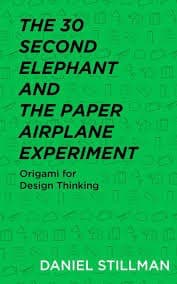
The book grew out of his desire to show people how design thinking works, rather than tell them: “I’ve been trying to teach design thinking to non-designers for a while and it’s my philosophy that people learn better through experiences than they do through slides. They say a picture’s worth a thousand words and I think an experience is worth a thousand slides.”
For example, the elephant exercise referenced in the book’s title can be a lead-in to conversations around prototyping: “It shows people that you can make something that is elephant-like in 30 seconds, but you cannot make an entire elephant. This gets to the question of what does a prototype ‘prototype’?” The origami exercises also “teach people about how precision of language and facilitation are important, and give them an experience of being frustrated by inaccurate or not detailed enough directions.”
Innovation & Lack of Time
Daniel’s origami lessons show us how we can teach certain design thinking concepts in a short period of time. The concept of time was a major thread throughout our conversation. Daniel has seen how lack of time can be an enemy of innovation in the companies and teams he works with. “Trying to innovate inside the day-to-day means a lot of pushback on the kind of time and effort required to develop the deeper insights that drive innovation.”
Innovation requires long-term, not short-term, thinking, something that is contrary to how most companies work. As Daniel says: “Organizations are optimized for scale, not disruption.”
“Innovation requires risks and uncertainty, and a little bit of faith. Those values are not in the DNA of most organizations”
Setting aside time for team members to concentrate on innovation projects can be daunting: “It is hard to do third horizon thinking because most people’s calendars are divided up into 30-minute chunks. One of the biggest reasons why innovation is hard is because it takes time, and not just time during the day. It takes time during a week. It takes time during a month, and that looks like a sinkhole, right?”
He continued: “When you teach people innovation, it winds up looking like an extra job. I’ve done projects with a team of people from across the organization and you’re trying to work on a problem and it’s basically like they’re back in school. It’s homework and they have to give up their time to be in the session with you. Everything I’m doing is in addition to everything that they already have to do. Everybody’s already operating at 100%.”
“When you teach people innovation, it winds up looking like an extra job.”
In other words, even though organizations want to innovate, they rarely give people “relief” from other duties in order to focus on it. Daniel noted that taking responsibilities off of their employees’ plates is, “not easy for organizations to do, but it comes with a price for their innovation plans.”
The Importance of Coaching
One way that Daniel has approached time constraints and how it impacts organizational innovation is through what he calls “stretching the container.” By this, he means extending the period of time that he is engaged with an organization so he can make sure the work they started carries on after he’s “gone” and teams go back to their regular day jobs.
Daniel has learned the importance of extended coaching periods by seeing the opposite at work: “I’ve been hired to do lots of two-day innovation workshops which are innovation theater. (I would love to have a second podcast or a book about innovation theater; I’ll get everybody to write a chapter about their favorite techniques for making it seem like you’re doing innovation but nothing is actually happening. People could just do the opposite of everything in that book and then they’ll be successful.)”
While teams can be resistant to ongoing coaching (“Oh, no, we don’t need your help for that. That’s really our thing.”), Daniel combats this by building it into his process. It’s not optional. He’s found that even something as simple as follow-up calls at 30 and 60 days can keep teams on track and moving toward their goal: “Ask them for their rose, thorn, and bud. What’s something good that’s happening? What are some challenges? What’s on the road ahead?”
No Prototype, No Meeting
Another topic that we discussed that relates to freeing up time relates to the age-old problem of too many meetings. Daniel’s a big believer in the concept of “No Prototype, No Meeting.” He shared how his old professor and friend, Allan Chochinov, Chair of the Multidisciplinary MFA in Products of Design Graduate Program at the School of Visual Arts in New York City, once designed a Chrome plugin with his students called No Meetings; once you installed it, you were literally unable to schedule a “meeting.” You had to write something else, like “gathering,” “reflection,” or “critique.” Even these small shifts in language can push teams to have more action, prototyping, and design and less talking.
“I think a lot of people are going too high fidelity with their prototypes…You can still get a lot of good feedback with a low fidelity prototype.”
Building a culture that values low-fidelity prototyping is something else that Daniel champions. “I think a lot of people are going too high fidelity with their prototypes. They’re making them real in digital form, whereas I’ve had so much benefit from showing paper prototypes to customers. You can still get a lot of good feedback with a low fidelity prototype. A lot of people who are trying to ‘innovate’ wait to get resources like a designer, strategist or UI designer to make something good so they can show it to real customers and get credit for doing it ‘right.’”
Blended Approach to Innovation
I asked Daniel for his recommendations for the ideal structure for a successful corporate innovation program and he talked about a “blended approach.” He identifies several necessary elements, starting with education for the general population in day-to-day innovation and improved collaboration. At the same time, he thinks it’s key to have a core innovation team working on longer-term, big ideas.
Another important element is to have “a scalable sprint mindset for problem-solving with a core group of trained catalysts who work in the organization.” The benefit of catalysts who come from inside the organization is that they “understand the context, politics, and roles of the company better and can help explain how they should be using these concepts better in their work.”
However, he has seen challenges with such catalysts, especially when they are self-selecting: “Often, the people who have the most enthusiasm are junior in the company and they don’t have as much authority to do anything at scale. They don’t have the same leverage inside of the organization, so enthusiasm is not necessarily enough. You want somebody who actually has some juice in the organizational structure.”
Fast and Slow Time
Daniel has seen both the positive and negative impact of time compression in innovation. He thinks both speed and slowness are essential at different moments and depending on your goals. We often talk about time compression in terms of classic design thinking activities like brainstorming and other ideation techniques. And, as Daniel points out, there are certainly benefits to working quickly: “Time compression means that people can’t think as much and we want to lower their inhibitions. We don’t want people to let their inner critics in, and we think that writing down five ideas and tapping into their subconscious instead of their conscious mind will happen through that time compression.”

“Slowing a conversation down allows somebody to feel what they’re feeling and to be in the present moment and for other people to absorb it.”
On the flip side, speed is not the solution to everything. Daniel talked about slow speed: “Slowing a conversation down allows somebody to feel what they’re feeling and to be in the present moment and for other people to absorb it. I’m a big fan of everybody writing something down and swarming it up on the wall silently because it’s a really efficient way of mapping what is going on. But that’s really different than having a round conversation where everybody talks. Everyone speaks, everyone only speaks once, we speak when we’re ready and hear what everyone has to say about a topic. Those are slow, meditative conversations, and they can get to some of the emotional challenges that people have when doing something new.”
Group Work
We ended our conversation by me asking what Daniel is most excited about right now. His answer was “group work.” This is because he believes that “group alignment is the only way to develop the momentum to move projects forward.” This topic will likely be teased out in the new book he is working on right now, which is about conversation design. The book will explore the principles of good conversations, what techniques work and why they work and “how do we apply it to all the conversations we have to design whether it’s one on one conversations or group conversations or community conversations.”
This is part of my series on thought leaders in the innovation space. Check out the other articles here.
If you enjoy Daniel’s perspective and you live near Austin, we’ll be hosting a Facilitation Master Class on May 22 as part of Control the Room: The 1st Annual Austin Facilitator Summit. Daniel will also be speaking at the Summit the next day. Learn more and get your tickets here.