The post Marching Backwards into the AI Future appeared first on Voltage Control.
]]>Table of contents

Mapping people’s jobs to be done to find AI’s bigger opportunities
Most organizations are adopting AI the same way. They look at the workflows they already have and ask which steps a model could take over. The focus tends toward automating low-level tasks: draft the release notes, summarize the support tickets or produce more content for the blog. Each is reasonable, and plenty will pay off.
But it’s a narrow way to meet a technology as big as AI.
As Marshall McLuhan observed, we look at the present through a rear-view mirror and “march backwards into the future.” Early TV looked like stage shows with a camera pointed at them. Early websites looked like printed brochures. Automating today’s workflows with AI is the same move. We take a new capability and pour it into the shape of the old one.
AI is more than an automation tool. It’s a paradigm shift, and we may not be equipped to grasp where it leads. That’s an uncomfortable thought, and it’s also hard to act on. Leaders asked to redesign how a company works can’t put “prepare for a paradigm we can’t imagine” on a roadmap. So they default to what’s concrete, which is the workflow in front of them.
To be clear: optimizing today’s workflows is a fine near-term step. The risk is stopping there. If all you do is make the current machine run faster, you may not notice when the machine itself stops being the right one.
Mapping the ecosystem
Breaking away from legacy thinking takes a view broader than individual workflows. The bigger opportunities sit in the domain the organization operates in: the people it serves, the partners and competitors around it, and the other services those people rely on to get things done. Some of the most significant shifts will come from value moving across players.
Mapping today’s domain won’t reveal the paradigm that’s coming. Nothing will. What it does give you is stable footing. A map of what people want to achieve and the players around them gives you something durable to reason from as everything else shifts. It also helps you spot change early, because you’ll see where it lands.
The aim is to see how value flows. The job of an organization is to create value and then capture some of that value. A map of the broader ecosystem shows where value gets created for people in a domain and where it ends up. Some of it is captured by the players in the system, and some of it leaks away.
An ecosystem map shows the relationships between entities that make up an experience, including offerings outside your walls and even those of competitors. As products and services become more interconnected, the idea of a standalone offering fades. What matters is how well your services fit with one another and, more importantly, how well they fit into people’s lives.
Consider this example created by Paige Roche and Trevor Connolly, leading service designers. It shows the objectives a customer has when purchasing a car, in blue on the top, and how that aligns with the primary functions of a car dealership, in black on the bottom.
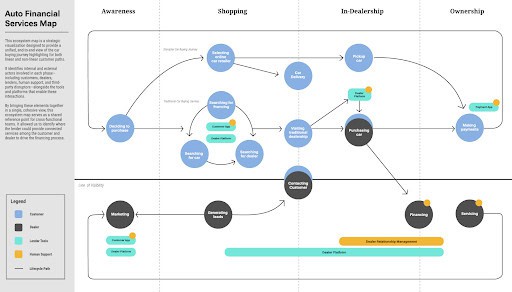
This simple visualization orients a team to the bigger picture of buying a car. They may zero in on, say, the circular process in the “Shopping” phase that oscillates between searching for financing, searching for a car, and searching for a dealer. Today the customer stitches those three searches together alone, going back and forth until they line up. An AI agent could work all three at once and bring back a car, a loan and a dealer that fit together. The loop disappears.
Framing the map around jobs to be done
The Jobs to Be Done (JTBD) framework sharpens the picture. Most teams describe their work in terms of activities and solutions, such as “optimizing SEO with more content on the blog.” That framing locks in the current approach. Ask what job that activity serves, say attracting new customers, and the conversation changes.
From a JTBD perspective, we focus on the objective the individual seeks to achieve. That detaches our thinking from current solutions. It also gives the ecosystem model a longer shelf life, because jobs framed around intent stay stable while technology churns.
Cornelius Rachieru, managing partner at the strategic design consultancy Ampli2de, builds ecosystem maps from the bottom up: first the actors in a domain, then the jobs each is trying to get done, clustered into groups, and finally data lenses relevant to the business.
The figure below shows Rachieru’s model for retirement. Retirees sit at the center. Around them are clusters of jobs like meeting housing needs, getting daily assistance, accessing medical care, getting around and enjoying social activities. Rachieru’s lenses are about service gaps and cost. For AI, a few others are worth adding.
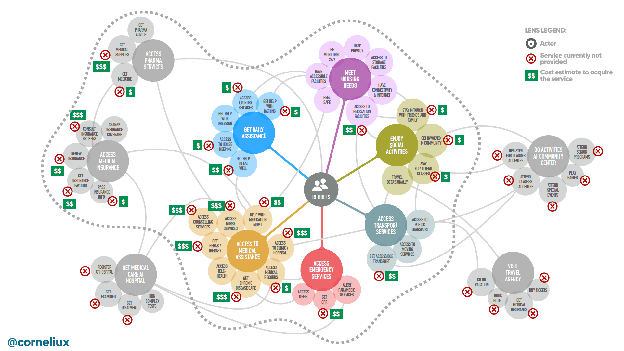
Notice what the map doesn’t show. There are no departments, tools or workflows, and no single company sits at the center. It shows what people are trying to accomplish and where the system currently fails them. That’s the level where AI’s bigger opportunities live.
Reading the map through lenses
Adding “lenses” is a key diagnostic aspect of ecosystem mapping. The diagram itself provides no answers outright. Instead, layer specific facets of information on top to provide different insights.
Once you have an ecosystem map, the tempting question is “Which parts can AI take over?” That’s the automation question again, asked at a larger scale. A better question is: “How might AI help us create more value for customers?” Asked against a map of jobs, that question gets specific quickly. The lenses below are ways of answering it.
- Value creation. For each cluster of jobs, ask how much value it creates for the people at the center today, and how much more it could create. Some clusters matter enormously to people but are poorly served. That’s where new value is waiting. Then ask who captures that value now. Where a player captures value mainly by sitting in the middle, that position is exposed, and it may be yours.
- Coordination friction. Look for places where getting a job done depends on handoffs between people, teams or companies. This is where AI changes the economics most.
- Cost to serve. Some gaps exist only because filling them with people costs too much. The retirement map already shows this with its cost overlay. Ask which of those gaps would start to make sense if the cost of delivery fell sharply.
- Cluster boundaries. Some clusters are separate only because of how an industry happens to be organized. The person getting the jobs done doesn’t experience them that way. Ask which boundaries exist for the provider’s convenience rather than the customer’s. The car shopping loop mentioned earlier is a case in point.
Each answer becomes a provocation. What if this gap cost a tenth as much to fill? What if these three clusters were one service?
The answers to such questions force strategic decisions. You can’t pursue every job at once, so a team has to decide where to focus. That decision sits at the overlap of two questions: what matters most to the people you serve, and what matters most to the business right now. Having the whole ecosystem in front of you lets a team have that conversation together instead of defaulting to whatever is already on the roadmap.
From there, sort the provocations by how soon they could matter and how sure you are about them. In practice, you might end with three kinds of moves:
- Act now: near-term changes, often workflow automation, chosen because they point in a direction the team has agreed on.
- Experiment: one or two small tests aimed at a gap or a merged cluster, cheap enough to learn from either way.
- Watch: signals that a bigger shift is arriving, such as a new entrant appearing in an adjacent cluster or costs dropping sharply somewhere on the map.
The watch list is the easiest to skip and probably the most important. It’s how you recognize the future when it shows up instead of seeing it only in hindsight.
A word of honesty: this is a proposal. Ecosystem mapping and JTBD are each well established, but using them together to rethink a business for AI is something I’m putting forward, not a proven playbook. If you try it, I’d like to hear what happens.
It’s the facilitation, not the map
The ecosystem map is a model to rally around. Its value comes from the conversation it makes possible. Put a jobs ecosystem map in front of a cross-functional team with no structure and you’ll mostly get a tour of everyone’s existing assumptions.
The insights come from facilitation. That means asking where the friction really sits, which gaps people have quietly accepted as permanent, and which clusters only look separate because of how the industry happens to be organized today. Good facilitation makes it safe to question the parts of the business that feel fixed. It also keeps the group at the level of jobs instead of sliding back into the solutions they already know.
The point is to make the invisible visible, so a team can hold a broader, more expansive view of what’s possible. Your first move may very well be workflow automation. The difference is that you’ll choose it on purpose, as a step in a direction, rather than because it was the most obvious thing in front of you. You’ll also have a reference point. When the larger shift starts to show up, you’ll be far more likely to recognize it, because you’ll know where on the map to look.
McLuhan wasn’t telling us to stop looking in the rear-view mirror. We can’t help it. His point was to be aware that we’re doing it, and to keep glancing at the road ahead.
Jim Kalbach is an author and speaker on customer experience, strategy, and design. He is the author of Mapping Experiences and The Jobs To Be Done Playbook. Connect with him on LinkedIn.
The post Marching Backwards into the AI Future appeared first on Voltage Control.
]]>The post The Unexpected Journey appeared first on Voltage Control.
]]>Back in my early days, before the term ‘facilitation’ was even a blip on my radar, I was deeply immersed in the world of design and innovation. Design, to me, wasn’t just about crafting sleek interfaces or eye-catching visuals; it was a full-contact sport. I firmly believed that design needed to be a public act, a collaborative effort that engaged everyone from product managers to engineers. This belief nudged me into what would become my first foray into facilitation. Without even realizing it, I was taking the lead in discussions, eager to sway hearts and minds to bring collective visions to life. It was in these moments, standing in front of colleagues and guiding conversations, that I began to understand the essence of facilitation. It was raw, unrefined, and entirely intuitive. But it was a start.
Reflecting on those early experiences, one stands out vividly. While at LexisNexis, I was given the latitude to dive deep into mapping experiences. This wasn’t just any task; it was a challenge that threw me into the deep end of facilitation. Tasked with leading a mapping exercise for our European business unit, I orchestrated a session for stakeholders flying in from all corners of the continent. The stakes were high, and the audience was diverse. Yet, as I navigated through this intricate dance of ideas and insights, something clicked. The success of that session and the many that followed across the globe, from Australia to the Netherlands, was a testament to the power of effective facilitation. These were my formative years, where the seeds of facilitation were unknowingly sown, setting me on a path I never anticipated.
A New Chapter Begins
As my career progressed, the realms of design and facilitation began to intertwine more visibly. My move to Citrix was a notable milestone, not just for the shift in my professional landscape but for the deepening of my involvement in remote collaboration. Here, the essence of facilitation permeated through my work, albeit still in an informal capacity. I found myself at the forefront, not just as a designer but as a facilitator of ideas and conversations. This dual role was becoming a part of my identity, propelling me towards a greater understanding of what it meant to lead discussions that mattered.
The real turning point came with my engagement with Mural and, subsequently, Voltage Control. My collaboration with Mural opened new avenues, connecting me with a broader community passionate about facilitation and collaboration. It was during this time that I stumbled upon the treasure trove of literature on facilitation. Books like “Game Storming” and “The Art of Gathering” by Priya Parker became my guides, enlightening me about the structured world of facilitation I had been navigating through instinct alone. These discoveries were eye-opening, revealing a structured discipline where my self-taught skills could find validation and growth.
A Catalyst for Learning
Voltage Control emerged as a beacon in my journey. Their partnership with Mural, coupled with their reputation for deep dives into the facilitation process, intrigued me. The more I learned about Voltage Control’s offerings and their community-driven approach, the more I realized the gaps in my understanding. This was a world where my ad-hoc experiences could be honed into something more profound and impactful. The decision to engage more directly with Voltage Control and consider their certification program was a natural next step. It promised not just to fill the gaps but to elevate my practice to a level I had only begun to imagine.

The decision to join Voltage Control’s certification program wasn’t made in isolation. It was the culmination of a series of serendipitous events and realizations. The moment Douglas reached out with an invitation to participate, the decision felt like a natural progression of my journey. The seeds of curiosity sown during my time with Mural and my explorations into the literature of facilitation had prepared me for this step. It was as if all the paths I had walked were converging, guiding me toward a future I was meant to embrace.
Colleagues and Confidence
Knowing that individuals I respected and admired, such as Mark Tippin and Emilia Åström, had gone through the program and emerged with positive experiences provided a sense of reassurance. Their encouragement was a catalyst, pushing me to seize this opportunity not just for the knowledge I would gain but for the professional growth that would inevitably follow. This wasn’t just about filling gaps in my understanding; it was about joining a community of practitioners dedicated to elevating the art and science of facilitation.
Deciding to embark on the Voltage Control certification journey was, in many ways, a leap of faith. Faith in the program’s ability to refine and expand my facilitation skills, faith in my capacity to grow and adapt, and faith in the idea that this path would lead me to become a more effective leader, designer, and facilitator. The anticipation of what lay ahead was both exhilarating and daunting. Yet, the clarity of my decision was undeniable. This was the next step I needed to take, not just for my career but for my ongoing quest to unlock the full potential of collaborative design and innovation.
Immersive Learning
The certification program at Voltage Control was unlike anything I had experienced before. It was an immersive journey that stretched over three months, challenging and enriching in equal measure. The curriculum, meticulously designed by Eric, was both comprehensive and engaging, blending theoretical insights with practical application. This wasn’t just about acquiring knowledge; it was about embedding it into practice. The structure of the program—with its mix of synchronous and asynchronous learning, coupled with assignments that fostered collaboration with fellow participants—created a dynamic learning environment that kept me engaged and motivated throughout.
One of the most significant revelations for me was the depth and breadth of facilitation as a discipline. The program offered a panoramic view of the facilitation landscape, covering everything from the fundamentals to advanced techniques. It was enlightening to explore topics like the importance of warm-ups, the art of debriefing, and the nuanced role of a facilitator in guiding discussions and nurturing collaboration. These sessions weren’t just educational; they were transformative, challenging me to rethink my approach and adopt a more structured and intentional stance toward facilitation.
The Power of Reflection
Perhaps the most unexpected aspect of the program was the emphasis on reflection—both personal and professional. The process of developing my facilitation portfolio was a journey in itself, prompting me to pause and reflect on my past experiences, successes, and lessons learned. This exercise was not just about showcasing my work; it was an opportunity to introspect and consolidate my learning, providing clarity and direction for my future endeavors. It was a stark reminder of the power of reflection in fostering growth and self-awareness.
The certification program was a crucible of growth, pushing me beyond my comfort zone and expanding my horizons. It was here that I discovered not only the depth of my passion for facilitation but also the potential for impact beyond the confines of my previous experiences. The program didn’t just equip me with new tools and techniques; it instilled in me a newfound confidence and a deeper understanding of the transformative power of effective facilitation.

Post-certification, my toolkit for facilitation has not only expanded but also diversified. The program introduced me to a range of methodologies and practices that I had previously been unaware of or hadn’t fully appreciated. This broader arsenal has significantly enhanced my ability to adapt to different contexts and needs, ensuring that I can offer more tailored and effective facilitation solutions. Whether it’s incorporating more thoughtful warm-ups, leveraging pop-up rules to navigate unexpected challenges, or crafting more impactful debriefs, my approach has become more nuanced and impactful.
A Deeper Appreciation for Purpose
One of the most profound shifts in my perspective has been a deeper appreciation for the importance of purpose in facilitation. The discussions around the significance of setting a clear purpose for each session, and the exploration of various process design elements, have fundamentally altered how I approach my work. This newfound understanding has enabled me to design and lead sessions that are not only more engaging and effective but also more meaningful for all participants. It’s a shift that has not only improved the quality of my facilitation but also the outcomes of the collaborative efforts I lead.
Looking ahead, the capabilities and insights gained from the certification program have opened up new avenues for impact. Facilitation, I’ve come to realize, is more than a skill set for leading meetings or workshops; it’s a foundational competency that underpins effective leadership, innovation, and collaboration. As I continue my work at Mural, these capabilities are proving invaluable in helping me navigate the complexities of remote collaboration, drive product innovation, and foster a culture of inclusive and effective teamwork. The program has not just transformed how I facilitate; it’s reshaped how I lead and contribute to my organization.
A Catalyst for Continuous Growth
The journey through Voltage Control’s certification program has been a catalyst for a broader transformation in my professional life. It has sparked a continuous quest for growth, encouraging me to keep exploring, learning, and applying new facilitation techniques and approaches. This mindset of continuous improvement and the drive to further hone my facilitation practice are what I see as the most lasting impacts of the program. As I look to the future, I’m excited about the opportunities to further integrate these capabilities into my work, exploring new ways to leverage facilitation as a tool for driving change and innovation.
The journey through the world of facilitation has been nothing short of transformative for me. As I stand at this juncture, reflecting on the path behind and the horizon ahead, I’m filled with a sense of purpose and possibility. The future, as I see it, is ripe with opportunities to apply my newfound capabilities in ways that extend far beyond the traditional boundaries of facilitation. My role at Mural, coupled with the insights and skills honed through the Voltage Control certification, positions me to pioneer innovative approaches to collaboration, leadership, and organizational development.

The next chapter of my journey is dedicated to elevating the art and science of collaboration within Mural and among our global community of users. Armed with a deeper understanding of facilitation, I’m exploring new ways to enhance remote and hybrid work environments, making them more engaging, productive, and inclusive. The goal is not just to improve how teams work together but to transform the very fabric of collaboration, making it a source of competitive advantage and creative breakthrough.
Beyond the immediate realm of my professional duties, I envision a future where the principles of effective facilitation are woven into the cultural DNA of organizations worldwide. My ambition is to be at the forefront of this movement, advocating for the role of facilitation as a critical skill for leaders, innovators, and change-makers. By championing a culture of facilitation, I aim to catalyze a shift in how problems are solved, decisions are made, and visions are realized across industries and communities.
For Future Explorers
To those standing at the threshold of their facilitation journey, my message is one of encouragement and excitement. The path of learning and growth in this field is rich with challenges and rewards. Embrace the journey with an open mind and a committed heart. The skills you develop and the insights you gain will not only enhance your career but also amplify your impact on the world around you. The future of work, leadership, and innovation is inextricably linked to our ability to facilitate meaningful conversations and collaborations. I invite you to join this exploration, to discover your own path, and to contribute to the evolving landscape of facilitation and beyond.
The post The Unexpected Journey appeared first on Voltage Control.
]]>