Co-creation ensures that you develop mutual value for all stakeholders.
This is part of my workshop recipe series where I’ll be sharing methods for facilitating successful workshops. I’ll break down the essentials of a Design Sprint, Innovation Workshop, Leadership Retreats, Executive Summits, and more. Check out the others here.
Today, many companies have a need for significant digital transformation — whether it’s a long-standing institution looking to revamp legacy products or to create an entirely new digital experience. For companies struggling through digital transformation, some are finding success in co-creation practices.
Co-creation is not a cure-all, but it is a powerful tool that will supplement a solid innovation strategy. The problems that companies face right now often require that diverse business units and organizations work together to deliver the most viable solutions.

A lesson from The Beatles
I’ve always been a fan of how John Lennon and Paul McCartney collaborated so effectively as musicians. Paul may have had the beginning of an idea that inspired John who further inspired Paul and so on. It’s remarkable how out of all the times they got together they never walked away without a song.
In business, we often talk about collaboration and how critical is for our teams to succeed. It’s important, but it’s also challenging to foster the trust and understanding required for collaboration. (Additionally, the difficulty increases with the number of participants.) This is why facilitation and collaboration methods such as Design Thinking, Thinking Wrong, and Game Storming have become so popular.
Co-creation is critical to including everyone’s thoughts, visions, and ideas while ensuring that we can develop mutual value…The key is that the outcome is jointly created and mutually valuable.
Most business problems require that multiple departments and divisions work together effectively. Additionally, we may have to connect internal and external teams. This means we can’t rely only on team-based collaboration techniques: we must explore methods suited to heterogeneous groups. That’s where co-creation comes in.

Co-creation gathers everyone’s thoughts, visions, and ideas; it also ensures that we can develop mutual value. It can include anyone in a company’s ecosystem — customers, other companies, experts, communities, and even internal teams that don’t normally create together. The key is that the outcome is jointly created and mutually valuable.

3 Powerful Elements of Co-Creation:
1. Requisite Diversity
Co-creation allows us to accommodate the diversity required to succeed in today’s complex environments. It accommodates everyone’s perspectives and backgrounds and ensures that you surface assumptions and make informed decisions based on all the criteria.
2. Advocacy
Co-creation also allows for true buy-in across this diverse set of stakeholders. Through the process, everyone understands the tradeoffs and why decisions where made. Therefore, when the co-creation sessions are over, the entire stakeholder group will be true believers who will advocate for the plan with their constituents.
3. Mutual Value
When we focus on a solution that is mutually beneficial to all the parties involved, it’s not about negotiation. Co-creation means we are amplifying and distributing value as equitability as possible. A common misconception is to view this as democratic and therefore problematic because not everyone has the context to make the proper decisions.
This is not a surrogate for understanding viability, considering logistics, and determining the likelihood for success. Instead, this work is about creating alignment and understanding across a team, building trust, growing capacity to make decisions together, and fully supporting the decisions made.
Once teams build their capacity to make sticky decisions, they can more effectively execute on their decisions. This means faster learnings which allows them to iterate much more quickly. Even when they make a poor decision, they own it together and learn quickly because they are executing more quickly.
When I encounter teams that are struggling to get the results they need, I explore if co-creation tools can help them get where they need to go.
If you think co-creation might help your team or project, I suggest you start with a simple method — called the “9 Whys” — for exploring and illuminating your shared purpose.
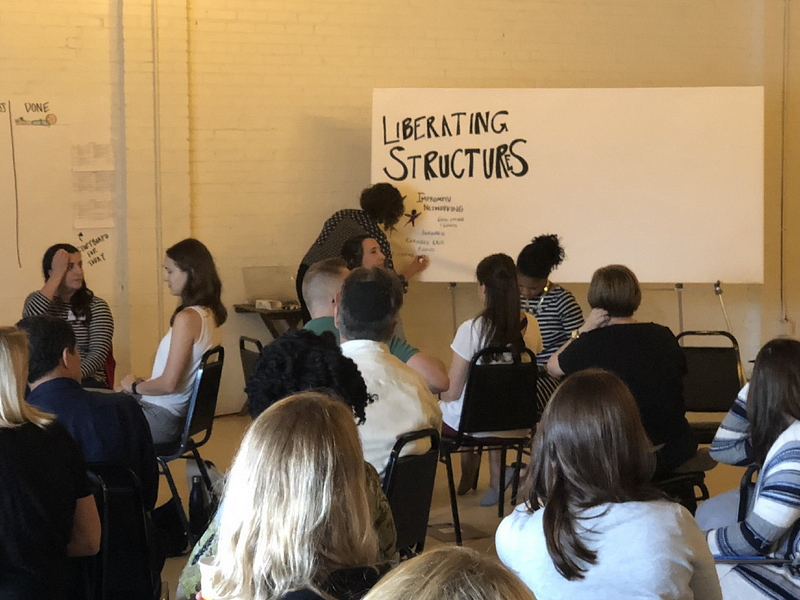
Using 9 Whys for Co-Creation Sessions
9 Whys is a technique from Liberating Structures, which is a menu of 33 activities or “microstructures” that you can use in meetings or workshops. This particular activity can help you quickly reveal a compelling purpose and move forward with clarity.
Method Steps
- Craft an opening question using the template “What do you do when working on ____” or something custom.
- Break the group into pairs.
- Each pair selects one person to be the interviewer.
- First, the interviewer asks the opening question.
- Next, the interviewer seeks a deeper answer by repeating versions of the question: “Why is that important to you?” 5 min
- After 5 minutes, switch roles and repeat the previous step.
- Each pair shares the experience and insights with another pair in a foursome. 5 min
- Invite the whole group to reflect by asking, “How do our purposes influence the next steps we take?” 5 min