Reflections, Award Winners, and Key Takeaways
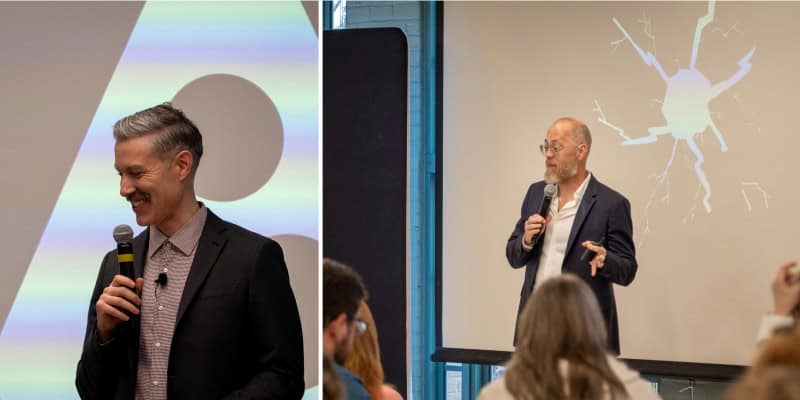
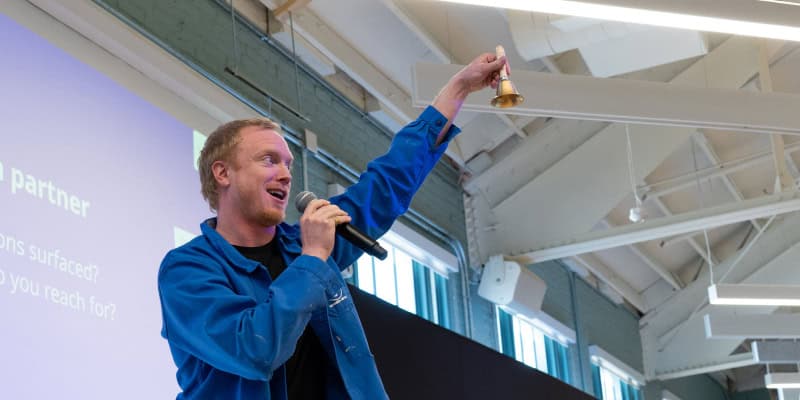
When Douglas took the stage to open the 8th Annual Facilitation Lab Summit, he did so with a question rather than an agenda: What becomes possible at the edge?
It was the right question for the moment. Over two days, facilitators from across the country gathered to explore what it means to work at the boundaries — where pressure meets reality, where comfort gives way to growth, and where the most meaningful facilitation happens. Douglas framed the experience with a line from Leonard Cohen: “There’s a crack in everything. That’s how the light gets in.” That metaphor of cracks, edges, and light anchored everything that followed.
A note on this year’s summit: AI was present in ways it hadn’t been before. Sponsored by Miro, the event showcased how AI tools are reshaping the way we design and deliver experiences — at one point, an AI-generated landing page summarizing a live session appeared in real time. It was impressive, and it raised a question that ran quietly beneath the entire two days: if AI can generate the content, the agenda, even the design, what is left for us? The answer that emerged, session by session, was clear. What’s left for us is presence — the human capacity to read a room, hold tension, and choose what happens next. People won’t remember the activities. They’ll remember how they felt.
Day 1: Edges, Emergence, and the Courage to Stay
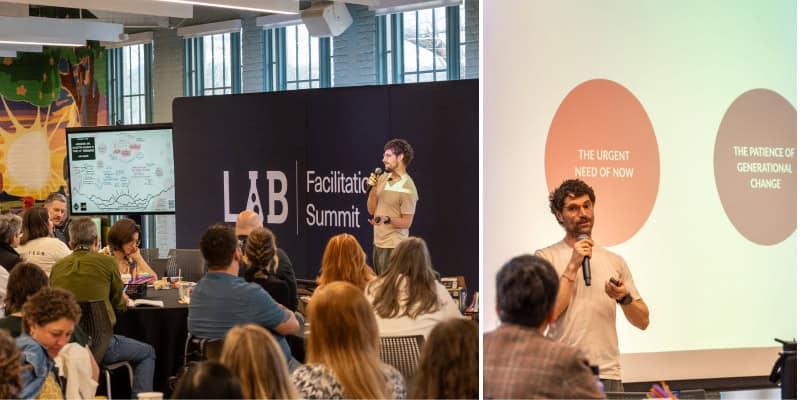
Unlocking Collective Brilliance in Turbulent Times — Dan Walker
Dan Walker opened the summit with a session on unlocking collective wisdom in service of a more just and joyful world. His central reframe — from conflict resolution to conflict engagement — set a tone of productive discomfort that would carry through the day. He explored the tension between the urgency of now and the patience required for generational change, surfacing the idea of manufactured urgency: how constant pressure can become an excuse to avoid deeper work.But what stayed with the room was his insistence on centering joy. In conversations about turbulence and justice, joy can feel almost out of place. Dan pushed back on that. Sustaining ourselves, he argued, is not indulgent — it is strategic. We are only good to the work if we remain part of it. He offered a phrase that lingered well past his session: “It is a gift to be raggedy.” Imperfect, in-process, unfinished. Maybe that’s not something to fix. Maybe, as the summit’s framing suggested, it’s simply where the light gets in.
Recalibration and the Paradox of Authentic Facilitation — Renita Smith
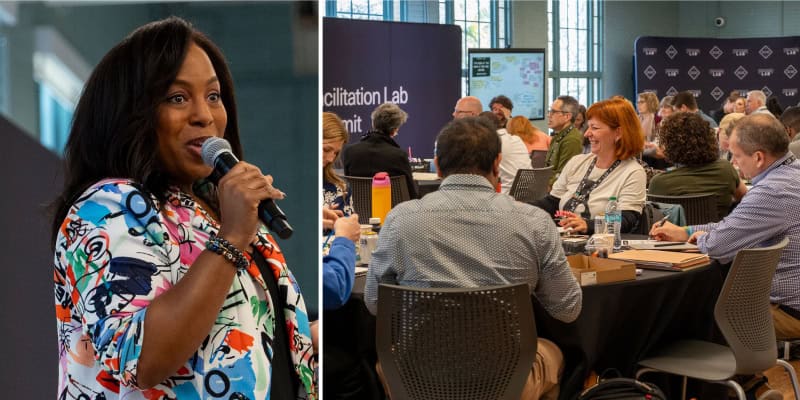
Renita Smith explored one of the deepest tensions in our practice: staying true to yourself while holding space for what the room needs. Using the metaphor of Hamilton’s set design — a stage that must expand and contract to hold the story while staying out of the way — she offered a simple but powerful framework for navigating that tension:
Expand — with presence, authority, and direction when clarity is needed.
Contract — with silence, witnessing, and the release of ego when emergence is happening.
Her practical framework: Notice. Name. Invite. Notice what your senses are picking up. Name what the room already feels. Invite courage, because your courage becomes the room’s permission.
Navigating the Unknown — Chris Lunney
Chris Lunney guided participants through sense-making using a deceptively simple model: head, heart, and hand. The heart as compass. The head tracing the map. The hands affecting reality. He reminded us that “in nothingness, there is potential” and encouraged tiny experiments — small, trackable actions taken without judgment, treated simply as data.
In a summit that had already surfaced the pace of technological change, this session deliberately slowed things down, creating space to feel alignment before rushing into action.
Facilitating Innovation at the Edge of Certainty — Shannon Hart
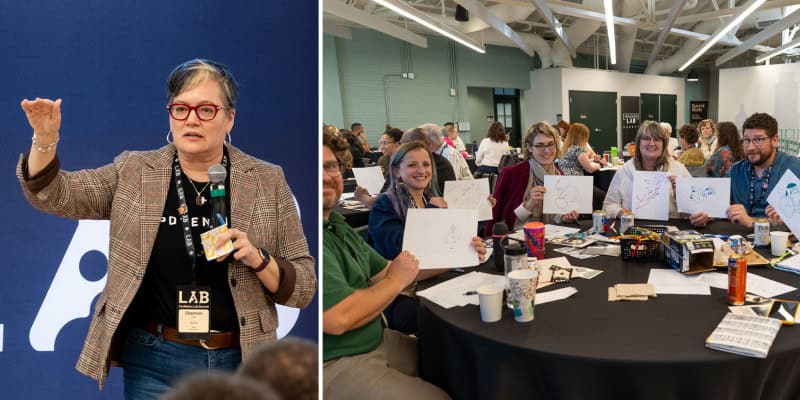
Shannon Hart re-energized the room in the afternoon, literally — participants stood, moved tables, and took the conversation outside. Her session challenged one of facilitation’s most embedded assumptions: that consensus is always the goal. In some cases, she argued, consensus actively hinders innovation. The facilitator’s role is not to drive the group toward agreement, but to create the conditions where something new can emerge.
Her key guidance: slow the rush to certainty, protect the quiet sparks who need more time to process, and stay in the “groan zone” longer than feels comfortable. Creating the conditions — not controlling the outcome. That phrase closed out Day 1 and echoed into the evening, where many attendees extended the conversation over dinner long after the sessions had ended.
“Edges — the places where comfort zones, group dynamics, and real change meet. I’m thrilled to NOT be going to ‘a work conference’ but that Geocaching HQ values truly practicing a growth mindset, and is supporting me attending a deeply engaging, purposeful gathering put on by Voltage Control.”
Kelli Taylor, Program Manager, Geocaching HQ
Day 2: Voice, Light, and the Rooms We Create
DJing the Room — Joe Randel
Joe Randel opened Day 2 with a session that quickly became one of the summit’s most talked-about. Framing facilitation through the lens of DJing, he laid out two foundational tracks.
Track 1: Find your voice. Preparation. Repertoire. Practice. Interpretation. Two facilitators can run the exact same design and produce completely different experiences. The difference isn’t the framework — it’s the voice behind it. In a world where AI can generate the agenda and the slides in seconds, voice becomes our competitive advantage: tone, timing, humor, instinct, the lived experience we bring into the room.
Track 2: Read the room. Preparation gives you options. Presence tells you which one to choose. The room is alive. Your plans aren’t.
He then described three types of transitions every facilitator navigates: Cut — close the moment and move forward with clarity. Blend — weave what’s emerging into what comes next. Let it end — stay with what’s unfolding, even if it disrupts the plan. Participants practiced these with real scenarios, and the result was illuminating: each facilitator chose differently. No single correct answer. Voice shapes choices.
Illumination — Brian Buck
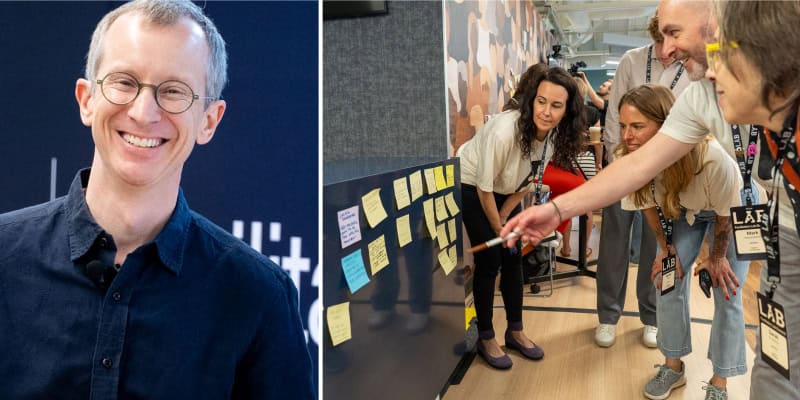
Brian Buck extended the summit’s central metaphor through an exploration of facilitation identity, offering three distinct orientations:
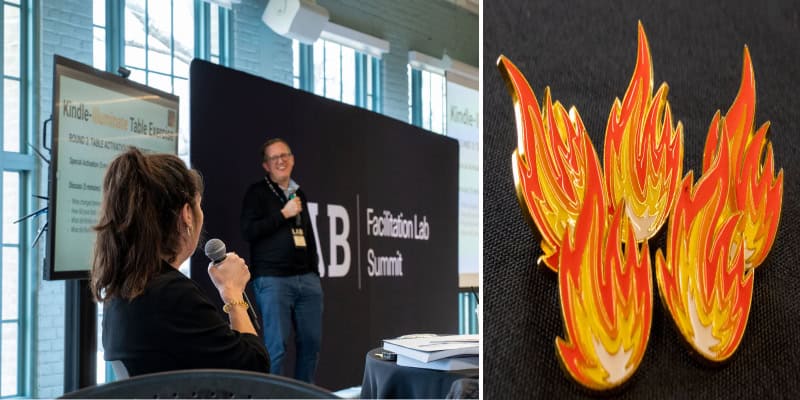
Ember: Tend my fire.
Kindle: Tend the firebox.
Illuminate: Tend the spark.
He described his own practice as “presence illumination” — not about answers, but about the human beings who carry them. The invitation he left with participants: what might be illuminated through your presence in the room?
The Body Knows — Robin Neidorf
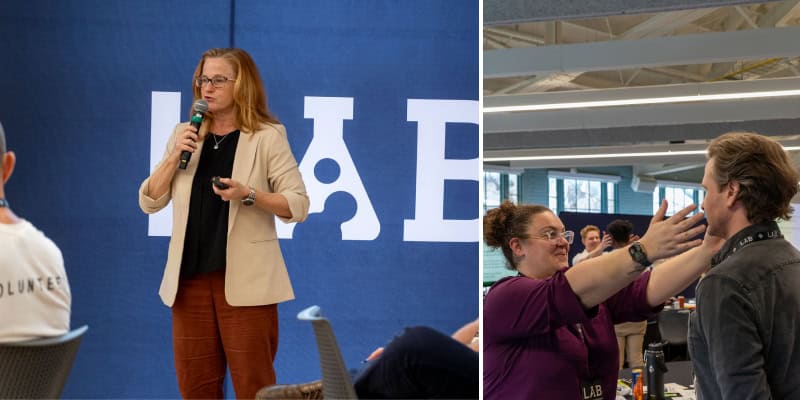
Robin Neidorf brought the afternoon into the body. Working with yoga as her central metaphor, she guided participants through partner exercises sensing energy fields and, in one of the summit’s more memorable moments, through silent eye contact in groups of two, three, four, and five — experiencing firsthand how group size shifts the energy of a room.
Pairs felt vulnerable. Triads felt creative but slightly unstable. Groups of four felt productive. Five introduced diffusion. It was a visceral, embodied demonstration of something facilitators often sense but rarely examine directly. Many participants said afterward they wouldn’t think about breakout group formation the same way again.
Safety at the Edge — Trudy Townsend
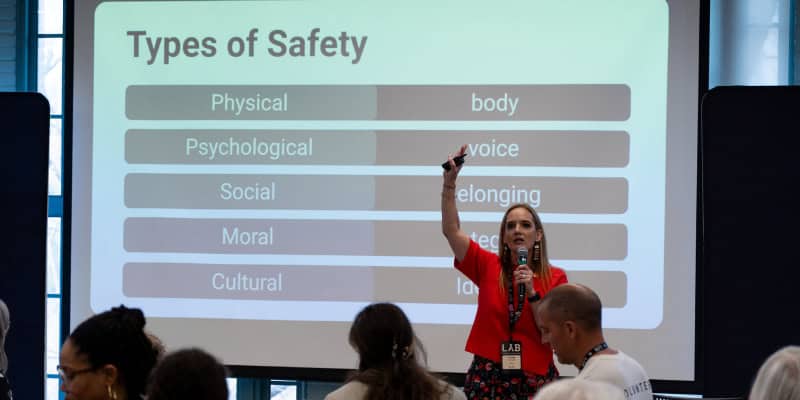
Trudy Townsend centered the afternoon on trauma-informed facilitation, grounding the conversation in a layered definition of safety: physical, psychological, social, moral, and cultural. Her core argument was direct — facilitator regulation shapes the room. It is our responsibility to show up regulated, and to remain present enough to hold the space we’re creating.
She also centered empowerment through agency: ask people what they need. Safety isn’t assumed; it’s co-created. And the edges we hold as facilitators are not always theoretical. Sometimes they are deeply embodied realities for the people in the room.
Closing
Eric closed the summit with the poem he returns to each year, ending on the line: “Your edge of darkness is an edge of light.” He reframed edges not as cliffs, but as shorelines — places to stand, to look out from, and to stay long enough to see what might emerge.
The room responded with a standing ovation. It was a fitting close to two days that consistently asked facilitators to do what we ask of others: stay at the edge, hold the discomfort, and trust that presence — not tools, not templates, not technology — is what makes the work meaningful.
“Watching the pen move across the paper while AI worked in the background felt like a quiet negotiation between speed and depth. No one named it explicitly, but you could feel it in this ongoing dance between high tech and high humanity.”
Daniela Ruiz, 2026 Facilitation Lab Summit Attendee
Summit Awards
We were proud to honor members of the Facilitation Lab community whose work exemplifies the transformative power of facilitation. The 2026 award recipients are:
Community Award — Reshma Khan This award recognizes alumni who have gone above and beyond to foster connection and collaboration within the facilitation community. Reshma embodies what it means to meaningfully bring people together — in Kenya and worldwide. She has been instrumental to the growth of our Facilitation Lab community over the past year, building bridges across geography and background with quiet, consistent dedication.
Impact Award — Cat Rodriguez The Impact Award honors facilitators whose work has made a meaningful difference in the lives of others — through organizational change, team empowerment, or addressing societal challenges. Cat has brought extraordinary impact through her work at the Anti-Defamation League and beyond, embodying what it means to hold courageous space for the justice conversations we must have.
Growth Award — Brian Buck The Growth Award celebrates alumni who have shown remarkable personal and professional development since completing the certification program. Brian has made extraordinary leaps in both his internal and external growth. As he has built from within, he has simultaneously built externally at Progressive — charting a path toward a facilitation center of excellence that creates growth at scale.
Innovation Award — Chris Lunney This award celebrates alumni who have demonstrated exceptional creativity and forward-thinking in their facilitation practice. Chris has led much of our work bringing facilitation into this AI future — guiding and modeling what it looks like to collaborate with AI as a teammate, and asking the essential questions along the way.
These four facilitators represent the best of what our community is becoming — and we were honored to celebrate them.
Key Takeaways
- Presence — not tools or design — is the facilitator’s deepest competitive advantage in an age of AI.
- Conflict engagement, not resolution, allows groups to do more honest and generative work.
- Joy and sustainability are strategic, not indulgent.
- Voice shapes experience. Two facilitators, same design, completely different rooms.
- Safety is layered, co-created, and often more embodied than we assume.
- Creating the conditions matters more than controlling the outcome.
Join the Community and Stay Connected
Although the summit has ended, the journey doesn’t have to stop here. Continue engaging with facilitators from around the world through our Community Hub. Share resources, exchange ideas, and keep the momentum going!
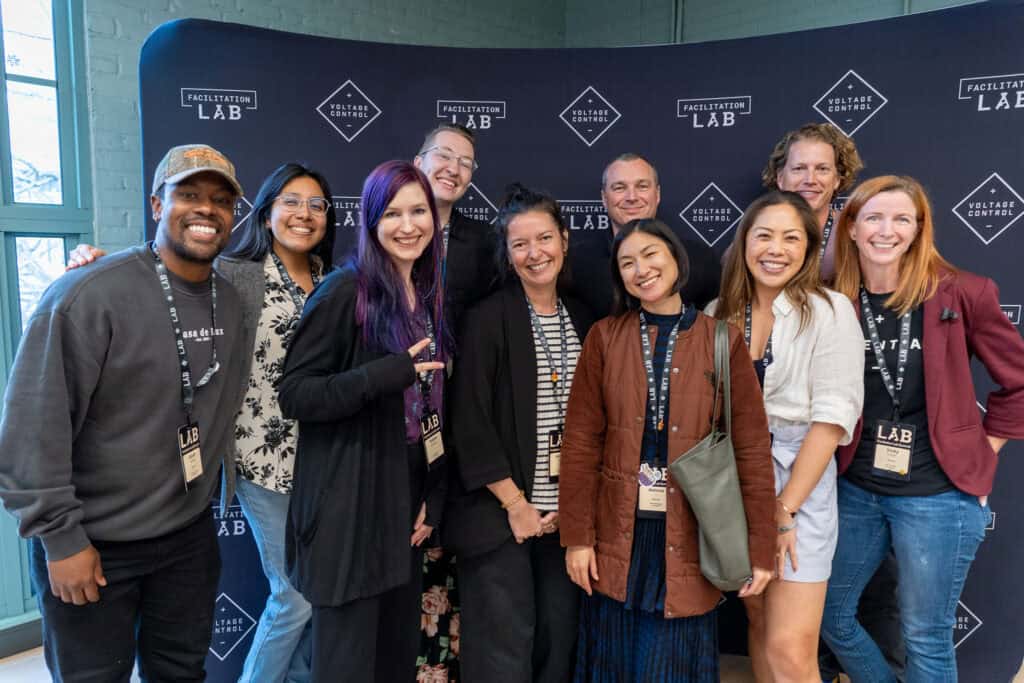
“This was an impressive summit with so many amazing speakers and attendees. This was a thoughtful, thought provoking and practical experience.”
2026 Faciltation Lab Summit Attendee
Looking Ahead to the 2027 Summit
Stay tuned for early bird tickets and announcements for next year’s summit. We’ll see you at the edge.
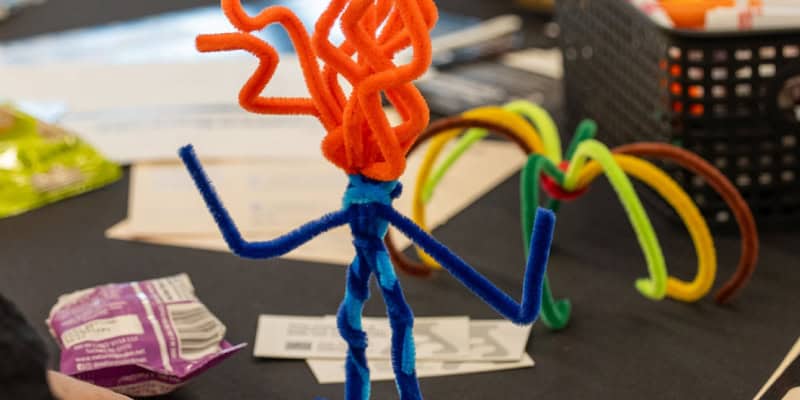
Thank you to everyone who made Facilitation Lab Summit 2026 a success. We can’t wait to see you next year as we continue to inspire, engage, and transform through the power of facilitation.