How Liberating Structures, purposeful meetings, and Voltage Control’s certification programs transformed my consulting practice and deepened my impact in the nonprofit world.
“Can you hear my audio? Can you see my screen?” How many times did I utter those sentences in 2020? Suddenly, the teaching, convening, and presenting work I had felt I could almost do in my sleep felt brand-new again – like I had to relearn how to walk and tie my shoes. That was not a comfortable feeling for a mid-career consultant who prided herself on creating engaging meetings and events.
Without ever calling it “facilitation,” I’ve used facilitation skills throughout my entire career as a strategy consultant to nonprofits and foundations (with a side-quest into commercial work – but that’s another story). Since founding my consulting practice in 1996, I have led countless board meetings, retreats, strategic planning workshops, Communities of Practice, listening sessions, focus groups… pretty much any type of gathering you can think of, with all sizes of groups.
It’s always been one of my favorite parts of my work – the experience of bringing people together to think creatively and expansively about possibilities, learn from each other, and co-create solutions that didn’t exist before is at the heart of why I love my work.
But things changed when the pandemic kicked off. Although I had done some online facilitation prior to March of 2020, it was quickly clear that I was going to have to really up my game if I wanted my groups to achieve their goals and objectives via Zoom. That’s when I started researching where and how I might pursue professional development.
Around the same time, I attended a webinar on an unrelated topic. When one of the speakers was explaining her methodology for generating a group discussion, another webinar participant posted in the chat: “It sounds like Liberating Structures.”
That caught my eye, so I googled… and was immediately blown away by the potential of the methodology. “Where has this been my whole life?” I asked myself while poring over the Liberating Structures site and book.
As part of my research, I soon came across the word, “facilitator.” And I immediately said, “Yes, that’s me!” Digging further into blogs, online workshops, discussion threads, and communities, I found Voltage Control, along with a few other organizations, that were offering the kinds of learning I knew I needed: how to create online spaces of focus and purpose, where people could be as creative and connected as possible to achieve big results.
I was surprised and excited to learn how many professionals globally take this facilitation stuff seriously, and particularly because we cover such a diverse range of interests and applications of the skills. I found myself connecting with product designers, IT professionals, CEOs… as well as plenty of other nonprofit professionals and consultants like me. The diversity of applications and interests meant I was learning from a wide variety of experiences; the consistency of our collective commitment to facilitation told me I was in the right place.
After attending a few Facilitation Labs online, I decided to enroll in an 8-hour online workshop Voltage Control was offering at that time on Liberating Structures. I couldn’t believe how fast the time flew during the workshop – I was used to online meetings that dragged and droned, with endless slide decks and limited opportunity for interactivity or engagement. The experience served to reinforce to me that I was definitely on the right track for taking my consulting practice to the next level.
In fact, even before the two-session workshop was done, I started bringing what I had learned into client meetings. Activities like 1-2-4-All helped me overcome the challenge of having the most vocal person dominate the conversation, while TRIZ created a fun and memorable framework for getting at root causes of deep-seated community challenges. And that was only two of the Liberating Structures – I had dozens more to try!
What’s more, my clients were noticing the difference, too. More than one long-term client made a point of telling me that “something had changed” in my facilitation – sessions were stronger, more dynamic, and more productive than before.
When I reflected on what had changed, I realized that the balance of engagement had flipped on its head. Before I started pursuing facilitation training, my sessions would be 80% of me talking and teaching, and 20% of the participants engaging and interacting. After becoming more intentional about facilitation and expanding my methods, I observed that 80% of my sessions involved direct engagement and peer-to-peer interaction of the participants, and only 20% me.
That’s when I realized: Facilitation is not about wielding control in the room. Facilitation is about creating a room with a set of rules that enables humans to connect authentically and find their collective wisdom.
Around that time, I had a client project that involved designing and facilitating six online strategic visioning sessions on different topics relating to the future of a local community. This would be the first big project with a lot of high-stakes online sessions, and I was both excited and nervous about putting my new skills to the test.
In my planning, I was tempted to try some of the more complex methods I had learned about in my Liberating Structures workshop… but I managed to resist the urge and Keep It Simple, to reduce the stress for both me and the participants. I secured a co-facilitator, with responsibility for running the technology (including Zoom and Mural boards) and providing troubleshooting assistance when needed.
And then I opened the rooms, doing what I have always loved doing: Bringing people together to envision a thriving future where kids experience summer camp, people with disabilities have full access to community life, teachers get appropriate compensation and recognition, and the professionals who make the entire community run are visible and appreciated. We co-created inspiring visions for the future in these sessions, and my elation grew with the completion of each one. It WAS possible to create online spaces of openness, generosity, and trust.
We got excellent feedback from participants, as well. One participant took the time to write on the post-event survey: “Robin’s strategic planning workshops were among the best I’ve attended — even on Zoom. They were goal-oriented, interactive, and thoughtfully designed. Robin fostered open discussion and guided participants effectively while allowing space for independent conclusions.”
And another: “Robin tenaciously sought input from a diverse group, stimulated active discussion, and provided the leadership and clarity to enable us to confidently move forward. She is masterful in her approach and dedicated to an outstanding outcome.”
Although I felt my skills advancing and developing, I also had my eye on the Voltage Control certification program. I was able to make time in my schedule and free up budget to invest in the program, and I joined Cohort 11, convening in the summer of 2024.
The best thing about the certification program was the wonderful community of facilitators I got to work intensively with for three months. Everyone had differing levels of experience, their own particular style, and varied goals for what they wanted out of the program. But what we had in common was passion for facilitation.
My personal goals in the program were to dig more deeply into “why” – I wanted to better understand WHY many of the techniques I had developed through trial-and-error over the years worked, and at the same time how to adjust for things that weren’t working. I also wanted to better understand my own “why” – what was my purpose as a facilitator? Why was I so drawn to this work? What did it say about my professional world, my interests, and fundamentally, my values?
I answered those questions through the certification program, which gave me the framework, community, and access to expertise and mentoring that enabled me to grow. Preparing my portfolio was an exercise in bringing it all together – my purpose, my experience, the kinds of positive outcomes for nonprofits and communities I was working toward.
In fact, I keep my purpose statement printed at my workstation, to remind myself every day, every meeting, how I’m putting my values into action:
“My purpose is to create environments in which people practice being their best selves while collaboratively solving intractable problems.”
In the world we live in today, this feels like more than a profession – it feels like a calling.
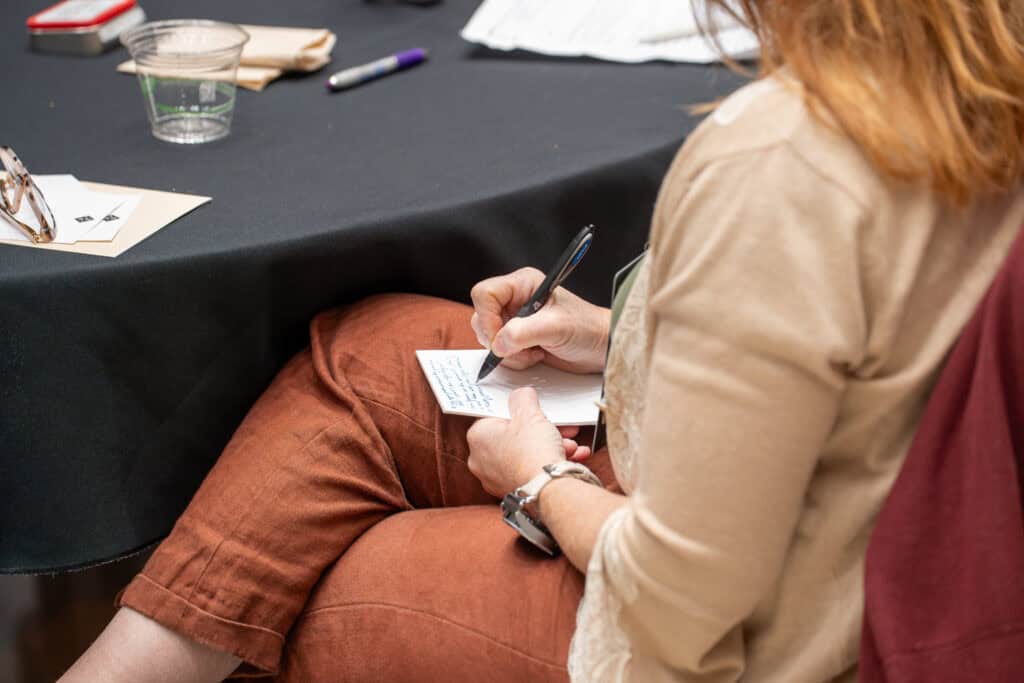
Soon after I completed certification, I signed up for more: I joined the first cohort for Master Certification through Voltage Control in the spring of 2025 because I wanted to go deeper with my skills and particularly with my ability to build empathy in groups characterized by conflict or even hostility.
At the same time, I explored my frustration with the negative impact bad meetings have on the ability of nonprofits to achieve their missions. For my final project, I designed and piloted a three-session workshop series for nonprofit professionals and volunteers, to provide a foundation in the principles of good meetings:
- Connection Before Content
- Have a Purpose
- Do the Work IN the Meeting
I ran the pilot with 7 participants, all of whom appreciated learning and practicing the practical skills that could help their meetings not suck! In the words of one participant, “I so appreciate Robin’s willingness to share her insight and expertise on meeting facilitation! She takes facilitation and participation to a new level. This class really addresses the frustration and boredom that can plague those of us who spend a lot of time in group meetings and brings home the idea that there is another and better way!”
While making my way through the Master Certification program, I was also applying to full-time consulting roles with firms that specialize in nonprofit and foundation work. I wanted to take what I’d developed over nearly 30 years to a bigger audience and work on larger teams, and joining a firm made the most sense for accomplishing both goals.
Soon after completing Master Certification, I joined Tangelo Tree Consulting as a Senior Consultant. My facilitation skills and the investment I’d made in developing them were an influential part of my application. And, with a talented team of other consultants, I get to work with regional and national clients on such topics as reproductive health rights, energy efficiency, affordable housing, and environmental conservation. The work is deeply challenging and feels vital at this moment, and I feel lucky every day that I get to do it.
To “facilitate” means to “ease the way.” Regardless of the direction your professional work is going, I believe you can ease the way by enhancing your skills as a facilitator. So much of what’s wrong with our world comes down to the ways humans interact with each other. We have so much creativity, so much potential for solving intractable problems, and yet so few spaces that are created and held so that people can truly listen to and work with one another.
This is the work I am honored to do as a certified facilitator. Whether it’s improving Tangelo Tree’s occasional online staff retreat, designing and facilitating a program for a hundred stakeholders, or anything in between, I feel most alive and connected when I’m helping others make connections. That’s how we have the potential to solve intractable problems. And that’s my purpose.