Shannon Hart on Co-Creation, Emergence, and Holding the Container at the 2026 Facilitation Lab Summit
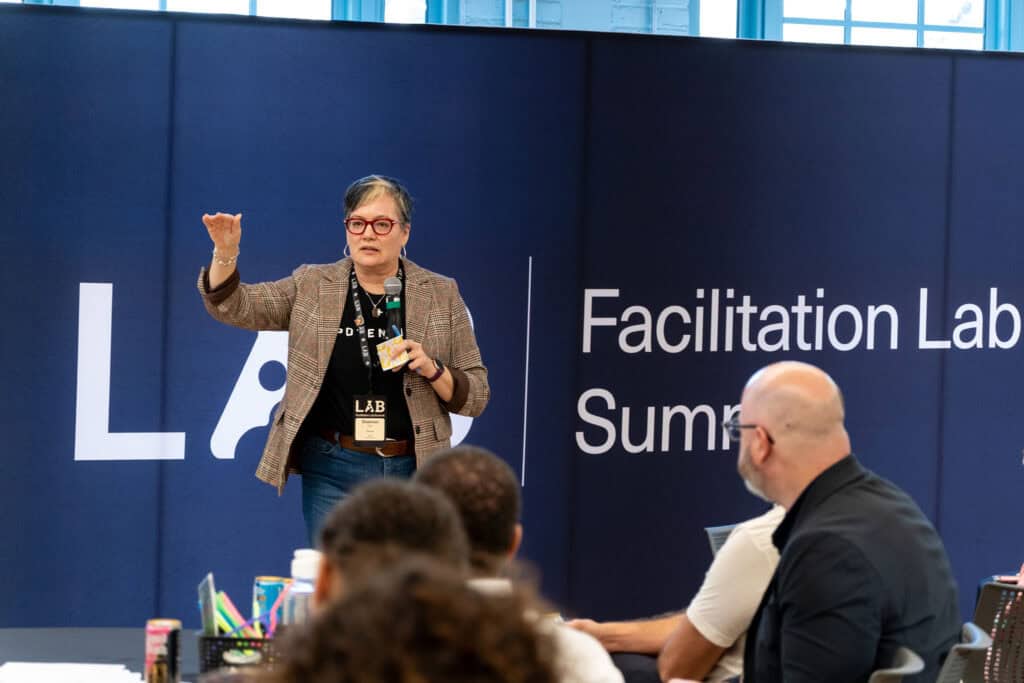
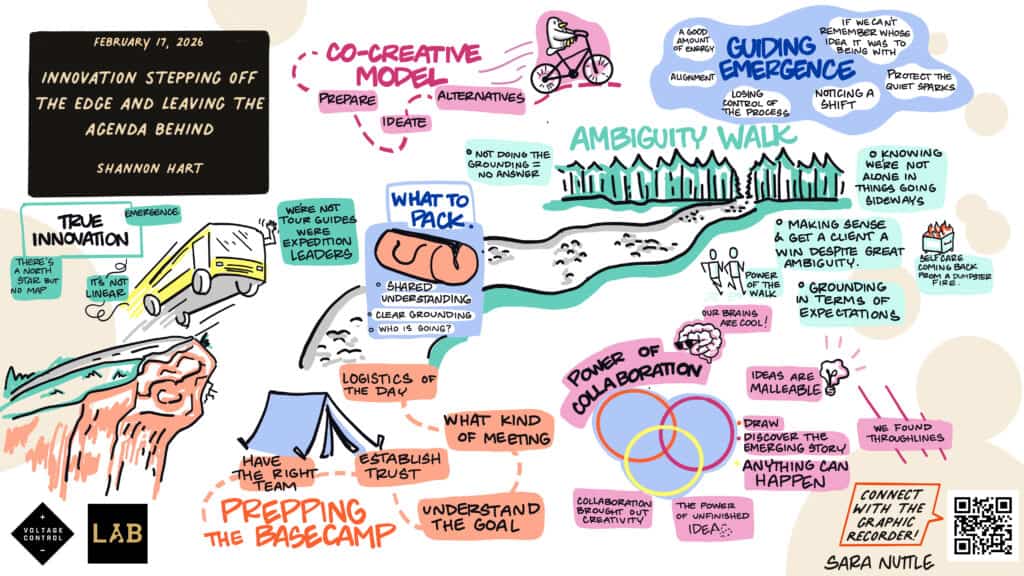
At the 2026 Facilitation Lab Summit, Shannon Hart brought five years of facilitating innovation sessions at Shell International—working with geoscientists, petrophysicists, and data engineers on complex energy sector challenges—and used that hard-won experience to offer a session that was as much expedition as workshop. Her talk, “Innovation: Stepping off the Edge and Leaving the Agenda Behind,” made the case that real innovation doesn’t happen because a facilitator planned the perfect session. It happens when a facilitator creates the right conditions and then trusts what emerges.
From Tour Guide to Expedition Leader
Shannon opened with a reframe that set the tone for everything that followed. Facilitating innovation, she argued, should feel less like a tour guide on a bus—structured, predictable, with carefully timed stops—and more like an Indiana Jones expedition. There’s a north star, there are skills and tools, but there’s no pre-drawn map. The goal is to search for hidden unknown treasures that you can’t fully define until you find them.
That framing carries real implications for how facilitators prepare. Shannon described the work before an innovation session as building a base camp—everything from asking the right questions to deeply understand the actual problem, to getting the right people in the room, to thinking carefully about who might derail versus who is ready to explore. She shared the cautionary tale of discovering, moments before a session began, that a C-suite executive had already signed a vendor contract for the solution the group was supposed to co-create. The room was intended to validate a decision, not make one. That kind of misalignment, she noted, is why base camp work is non-negotiable: you cannot hold space for genuine innovation if the outcomes have been pre-decided.
Physical environment matters too. Shannon pointed to small but meaningful gestures—colored markers, upgraded Post-it notes, pipe cleaners on tables to give fidgety hands something to work with—as signals that creativity is invited. These things are inexpensive, but they shift the atmosphere before a word has been said.
Three Circles and Unmapped Terrain
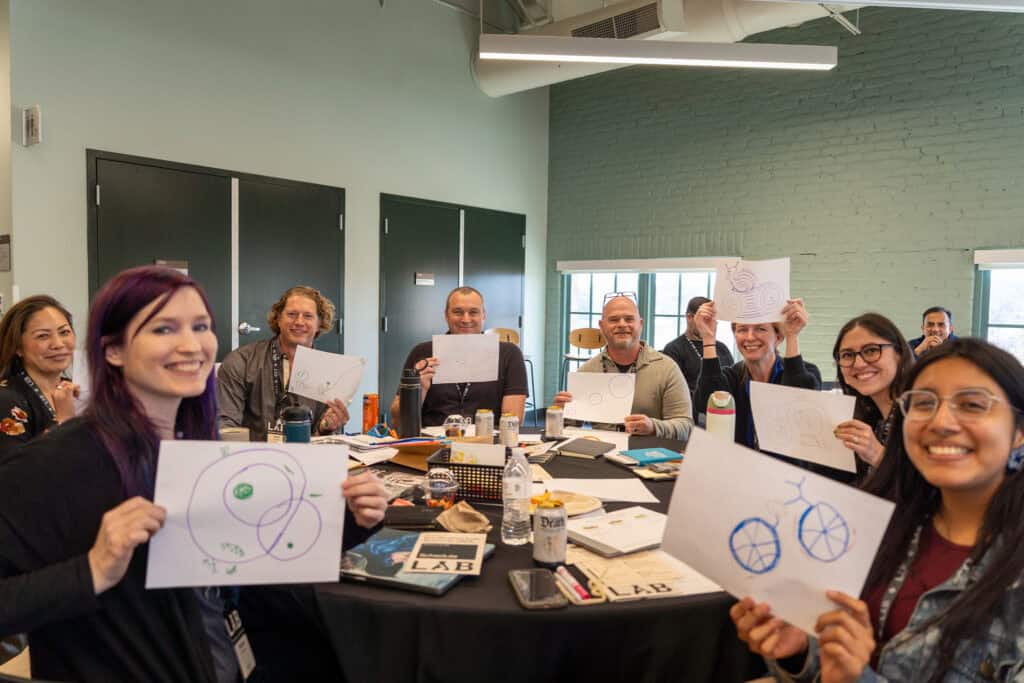
To give participants a visceral experience of what co-creation actually feels like, Shannon ran a deceptively simple exercise: each person drew three random circles on a piece of paper, then passed it to the neighbor on their right, who transformed those circles into something new. Tables then found the connections between what had emerged.
The debriefs were rich. Participants named what the exercise quietly demonstrated: that ideas are malleable, that diversity of interpretation is a feature not a bug, that the brain is wired to find patterns and meaning even from fragments, and that unfinished ideas can be more generative than fully formed ones—because they leave room for someone else to bring them somewhere new. One participant captured it simply: “Anything can happen here.” That, Shannon noted, is exactly the energy needed before a group attempts anything genuinely creative.
From there, Shannon sent participants out into unmapped terrain—literally. The walk and talk exercise paired participants with someone they hadn’t met, sent them wherever their legs would take them for 15 minutes, and asked them to share a moment when they were leading a session and the outcome got disrupted. The insights that came back were grounded and honest: the value of side-by-side conversation over face-to-face, the way movement loosens thinking, the reminder that when a group loses track of the facilitator because they’re so deep in conversation, that’s not a failure of control—it’s a sign of genuine ownership.
Protecting the Space Where Magic Happens
Shannon closed the session with the concept that tied everything together: emergence. In innovation, she explained, emergence is when something new arises that was not present or possible before. And the biggest threat to it is the rush to convergence—the desperate drive to wrap up, reach consensus, and declare the problem solved before the real insight has had time to surface.
One participant, Robin, offered what Shannon called the clearest signal that emergence is genuinely happening: “When you’re no longer sure whose idea it was in the first place.” Other signs the room surfaced included people losing their attachment to a fixed destination, questions becoming more interesting than answers, and a room full of laughter and play. Warning signs pointing the other way: forced consensus, burnout, low morale, and the loudest voices crowding out everyone else.
That last point was one Shannon returned to with particular care. In her work with global technical teams, she had seen brilliant people—foreign nationals, non-native English speakers, those who think more slowly and deeply—consistently overlooked in Western-coded brainstorm cultures that reward whoever speaks fastest. Her reminder to the room: protecting the quiet sparks is a design challenge, not just a good intention. It means building in Post-it rounds, structured round-robins, and Miro spaces that don’t require someone to fight for airtime in order to contribute.
She closed with the simplest version of the whole session’s philosophy: “Rather than control, we create the conditions that enable that to happen.” Hold the container, trust the process, and allow for emergence. That’s the work—and she left the room with no doubt that they were ready for it.
Watch the full video below:
Transcript of Chris’s Session:
Shannon Hart (00:04):
Thank you for having me. It’s so exciting to be in this space. This is my first facilitation summit, but it will not be my last. I’m stepping up here and I just want to acknowledge two things. One is the layers of nuance and wisdom and brilliance that is already in the room from the previous speakers and how maybe you guys are just geniuses that you planned it this way, but how the topics intertwine and layer on each other and are building. And it’s just going to feed into the themes that I want to explore with you guys today. So that’s just brilliant synergy. And then second, to step into a space where, I mean, I was just standing back there and I don’t know, 10, 15 people, some of whom I don’t even know are acknowledging and supporting the success. They want this to go well and they want me to do well.
(01:00):
And that’s just a really cool space and energy and an important reminder for me when I’m in your seat like, “Oh yeah, I don’t need to sit there with no affect and be bored by somebody’s taking a risk and standing in front of me.” So that’s powerful stuff. So I’m excited. I just feel that energy. So thanks for that. Good. Good. Let’s see. When I think about innovation, I’m talking about, yes, the applying of new ideas to create measurable impact, right? That’s basically what innovation is. But holding the concept, we’ve been talking about it in several different ways already. True innovation is a concept that is, it’s non-linear. It doesn’t happen in a simple, straight line. It’s iterative. It takes lots of tries and experiments. It is relational. Innovation doesn’t happen in isolation.
(02:02):
And that relational, the collaboration piece allows emergence. So those are the features of innovation I want us to hold onto as a backdrop to the conversation today. Emergence in the sense that something new arises that was not present or possible before. So we hold those conditions. So if that’s the way we want to think about innovation, facilitating innovation sessions has to be less like this, less tour guide on the bus where it’s really specific and it’s structured and it’s predictable and I know where we’re going, but I give the participants some freedom. “You can get off the bus here. You got 20 minutes. Then we’ll be back on the bus to move on to the next thing.” Right? So less that and more Indiana Jones style expedition. “We’re heading off to who knows where.”
(03:03):
There is an objective, there’s a north star, but we don’t have a pre-drawn map. We have probably some guidelines, but it’s time to be curious. It’s time to explore together bringing the right skills. We’re not going to wander off in the desert unprepared. So we bring together the right things, but we are searching for hidden unknown treasures. So to give you a little bit of context of where I’m coming from, because I walk into this space knowing that my context is very specific. So I have been supporting for the last five years, a team in Shell International, the data digital and innovation team that supports the upstream business. So for the past five years, my job has largely been facilitating collaboration, co-creation kind of spaces, problem solving.
(04:03):
So coming together, mostly scientists in the petrophysics and the geoscience disciplines, coming together to solve big problems in the energy sector with digital and data solutions. So yeah, it’s pretty niche. That’s pretty specific. So I’m curious about for you guys, when we talk through this stuff, how much of it resonates for the spaces that you’re working in. So that’s one of the reasons I’m excited to explore this with you. How many of you already, you are supporting a team or organization that you would put in that innovation bucket. You’re an innovation team, you’re a design space, you’re a startup. Yeah, so more than a third of us probably already in that space. Now, no matter what space you’re in, how many of you are already facilitating innovation sessions where you’re doing brainstorming, ideation, problem solving? A lot more hands that time, almost everybody.
(05:09):
Yeah. I would think with the never before experienced challenges that are emerging with the fast-paced technologies, that’s only going to become bigger and bigger parts of our jobs, right? In some way or another, we’re going to be having to bring people together to solve new and old problems in new ways, so practicing that. I’ve got three main components to the formula if there could be such a thing as a magic formula for creating safe space for innovation. And if we play with our metaphor a little bit, we’ve got part one, we’ve got to create that safe and inclusive base camp. What’s going to be our launching point? What’s the container going to be like? How are we going to prepare that space? How are we going to be ready for that? And we’ll have a creative tabletop exercise in that space.
(06:12):
And then the second component, biggest component is having the courage to venture into the unmapped territories. And it’s nice to have the space. I feel safe here. We’re going to experiment a little bit there and we’re going to do a paired walk and talk in that unknown terrain space. And then last but definitely not least, the concept of emergence, of integration, of synthesis. How do we create space and focus and time to discover the hidden treasure that we don’t even know what it is yet? So how can we possibly know how to get it? In our first topic, I said we’ll have a creative tabletop. We’ll do a walk and talk. And then in that third area, I’ve got a little bit of a case study. We may or may not have time for that. I’m going to practice what I preach and I’m holding the activities a little bit loosely so that we can follow the energy of the room.
(07:12):
But either way, you’ve got the case study and a little blueprint on your table that when the time comes, you’ll be able to walk out with those. All right. So step one here, preparing the base camp. As I said, we would never go on an expedition unprepared. We’re not going to know something. We’re not going to do some planning in advance, some gathering of the right resources and tools. So what does that look like, at least in my corporate setting? I consider the base camp piece to be the step from the moment you’ve gotten the request, “Hey, we need to have a session around poor pressure drilling. We’ve got this big challenge and we’re going to in two weeks have the session.”
(07:53):
So from that moment up until about the first third of the workshop or session or virtual space, all of that is the window of time we have to prepare and that’s what we need to spend some time doing. Because if the ultimate outcome is, “Hey, we want to have this energized team of explorers out there ready to come up with creative and insightful, perhaps risky concepts, what are the things I need to do in advance to make that possible?” So in my space, that has a lot to do with… I whip out my Consulting 101 manual and I ask a lot of questions, because a lot of times these requests, as you guys have experienced, a lot of these requests come in and they’re not completely clear.
(08:44):
We’re not sure why that needs to happen. So we need some better understanding of the underlying, what’s behind that? Or maybe it’s a known challenge, what’s been in the way of solving that challenge before now? What’s the root of that problem? Or what are some of the symptoms of that? So it’s really important before we lead the expedition that we understand what the… Do we really have a deep understanding of the goal? And then getting the right people in the room, that also happens well in advance. At least in my world, you can’t get anybody to a meeting if you don’t give them weeks of notice.
(09:23):
So if you’ve got a specialized skill, “Oh, we forgot to invite the IT guy.” Well, dang, we’re proposing a digital solution, but we didn’t think to get their perspective on it and now the meeting’s tomorrow, right? So doing a lot of pre-thinking and poking and prodding who’d be the right… “Oh, we definitely don’t want Carl in the room. He’s a big naysayer. He’s got a bad attitude.” “Okay, yeah, but if Carl is holding some important piece of information, that’s going to make it important, right?” So we have those conversations. All of that feeds into preparing the base camp. Then the space itself, are we doing a virtual? My teams are global, so most of my work is virtual with the a few times a year face-to-face summits when we’re really lucky. So if I want this playful, creative, curious atmosphere at the end, or for the ideation part, what do I need to do ahead of time?
(10:24):
So big and small things that you can do. We know it’s really hard to be creative if you’re in a boardroom with the big fat leather chairs, or if you’re the one person online and everybody else is in the space. It’s hard to have participation, so we want to consider inclusion, all that kind of stuff is going to make for a safer base camp. So tiny example for the room, pipe cleaners on the tables. If you are someone who needs permission, you have permission to play with them, do whatever you want with them. That’s what they’re for. A lot of us think better and listen better while we have something in our hands. So consider that your neurodivergent gift to have something. It’s an inexpensive, unexpected, so it’s a small thing that you can do in the room. Colored markers, the upscale post-it notes, all those little things that you can do. They’re small touches, but they really help prepare that space.
(11:27):
And then, of course, the session itself, are you opening up in such a way that you’re setting the right expectations with both your participants and whoever’s owning the meeting? And there’s often a big gap there, at least in my experience. “We want you to think big. We’re talking moonshot, disruption. Let’s really blow it up and we need to start by March.” “Oh, okay.” “We’ve got a $6,000 budget.” “Oh, okay.” So helping know what those expectations are when you open a meeting. There’s nothing worse than discovering those constraints while you’re trying to help people be… “Think moonshot creativity, but within a budget or a timeframe.” Another good one, I’ll just plant this, I’ll tell you one story, is for example, they’re saying they want an ideation workshop. “We want to come together. We’re going to bring all the key players together and we’re going to really search through this problem. We want to deeply understand it.”
(12:36):
And then we find out before, right before the session starts, that somebody at the C-suites has already made a contract with the vendor to provide an off-the-shelf solution for the problem that we’re going to explore together. And it was all intended to be a place for him to showcase the features of the thing that he’s already picked, and he wanted everybody to go, “Oh, that’s such a good idea.” Is that what’s going to happen? No. So we have to set those perfectly legitimate requests, but that’s an alignment meeting. That is not a creative innovation ideation session. And that’s one of the reasons why people moan and groan when you go, “Oh, brainstorming,” because we want certainty that whatever we put our energy and thought and creativity in is actually going to go somewhere. It’s going to matter, it’s going to mean something, and if it’s been predecided.
(13:27):
So again, all of that comes in in your base camp. We’re holding the concept of innovation as collaborative, that it is something that requires more than one person’s input. Our world is too complex now for any one person to solve, hold all of the skills, knowledge, information that we need. And for you, maybe your participants are really well-versed in collaborative problem solving. Mine are not. Mine work in deep technical fields where they tend to be the specialist, they tend to work in a silo. I answer the question, I hand it to the next guy, they work on the next layer of work, et cetera, et cetera. So I don’t have a sense of what it feels like or means to work together. So sometimes our opener has to provide a visceral experience. What does it really mean to collaborate or co-create together? So we’re going to have an experience of that right now. This is one that I use fairly often as a warmup.
(14:32):
So grab, I think everybody should have enough. Grab a white sheet of paper. There’s blank paper on all the tables. Grab a blank sheet of paper and something to write with. Choose the color of the day. And we are going to create something new together. And the spark is simply three random circles on a page. So your job right now, very simple, three random circles on the page. You can see mine are small, medium, and large, and they’re intersecting. Yours might be all the same size, but far apart. They might be inside each other. It doesn’t matter. Three random circles. It’s a 30-second or less effort, not a big effort. People are still picking their colors. Okay, come on. Now take your circle, your page with your circles, and pass it to the person on your right. Right hand.
(15:53):
Now, your job, receiver, is to incorporate the three circle drawing you received into something new. So when you look at it, you have just inherited a spark, a new idea, a green shoot of an idea from a coworker, and now you get to evolve it into something else. What does it look like to you? What does it bring to mind? Artistic ability does not come into play. Let your kindergarten drawing shine. So if your three circles was a 30-second exercise, your drawing is maybe a minute or two. Nothing fancy. Just enough for your concept to be clear is fine. Okay. Are you ready to have a little fun with this? So what you’re going to do is you are going to share around the table, show your picture real quick, just everybody get a view.
(17:00):
And while you’re looking at everybody else’s, I want you to start, you can start with internal reflection. What connections do you see? What is the story that is emerging as you look at your pictures together? Now, it might be something that’s very concrete. Oh, I see we all like the color blue, but I would encourage you to stretch a little bit, get creative, leverage those storytelling skills. And we’ll spend about eight minutes here. So decide what your connections are. All right. Let’s begin to draw your connections to a close. Not a close. That’s a tough word. A little pause here. You’ll have a chance. Your drawings aren’t going anywhere, so they’ll be laying out on your table. But I am curious, we could spend a lot of time debriefing that, right? If I were in the session with my Shell scientists, we would be talking about stuff like, “How was that experience for you? Has your mindset shifted from where you were before?” But I’m curious for us as facilitators, what does that exercise reveal about the evolution of ideas?
Speaker 2 (18:47):
Anything can happen here.
Shannon Hart (18:50):
Yeah. That’s an important energy to bring into a room when you’re about to do creative stuff together, right? There’s that air of possibility. Yeah.
Speaker 3 (19:03):
Yeah. I thought what was interesting to me about this was how important it was that you gave us permission to be creative and when. It was like, “You’re going to draw three circles, whatever is fine.” And it’s like, okay, there’s only so much creativity you’ve gotten there. But then it’s like, okay, now here is the time when you need to be creative, and everybody rose to the occasion. And I thought that was really great food for though. For me, as I work in the social sector, and a lot of people don’t have the confidence and the resources or the experiences. And so I just really liked that aspect of it.
Shannon Hart (19:39):
Yeah. And you guys went a little crazy. I heard their story. They’re all going to the country fair and they’re riding a three-wheel bicycle to the-
Speaker 3 (19:46):
We brought snacks.
Shannon Hart (19:47):
And you brought snacks.
Speaker 3 (19:48):
Croissant.
Shannon Hart (19:49):
Awesome. Delightful. Yeah.
Speaker 4 (19:54):
This activity demonstrated how ideas can be malleable and everything can be added on or even modified.
Shannon Hart (20:04):
Yeah. And it’s one of the cores of innovation that we often leave behind. It’s like you go, “Ooh, oh, you said that first. So I’m going to give you permission and I’ll leave it behind.” No, build on it, add to it, enhance it. Let’s talk around it. Right? So that’s a great observation. Yeah. Jordan, mics from all directions.
Speaker 5 (20:27):
I thought it illustrated really well how different experiences, identities and backgrounds can interpret such a universal, simple shape and idea. We all had pretty similar arrangements of a very simple shape, but we all interpret it in such different ways and how diversity of ideas and backgrounds can lead to such an interesting outcome.
Shannon Hart (20:49):
Yeah. And again, one of the cores, if you want to co-create, there’s value in everybody’s viewpoint and it’s, wow, it’s radically different. So it’s a great way to begin that conversation of how are we going to honor what is brought into the room by others, so it’s a good space.
Jordan (21:06):
We have one over here.
Speaker 7 (21:10):
Hello. I liked how we all put these together and passed them along, but we didn’t know where we were going. The outcome or the end goal was not known, but we all brought something very unique to the table and were able to find through lines through it. I thought we were going to keep passing them around, but I like the idea of making a story through the four.
Shannon Hart (21:39):
Yeah. Cool. Go ahead.
Speaker 8 (21:41):
For me, the cool thing was just to see how amazing human brains are and how it’s always naturally trying to find a pattern or a connection or something from nothing.
Shannon Hart (21:54):
Yep.
Speaker 8 (21:55):
So our brains are cool.
Shannon Hart (21:57):
Our brains are cool. Okay. Last thought.
Speaker 9 (22:01):
Well, I was just going to share that I’ve done similar types of activities with groups and it almost as a way to do norms of like deferring judgment and following the rules of the permission in that you didn’t ask us to be an artist. You didn’t qualify that it had to be a certain quality of art, and yet as we shared, I still noticed myself and others defending or… You saw something different than I saw or I didn’t draw that very well, et cetera. And so I think just naming that it’s okay to be imperfect and that I understood what Jackson drew perfectly even though he’s like, “Well, I didn’t do a good job.” And I was like, “But I understood it.” And so the power of just visual thinking as a means for communicating ideas, the bar is a lot lower than we all think it is.
Shannon Hart (22:45):
Yeah. If I had said, “What negative messages do you tell yourself about your creativity that’s keeping you blocked?” We want to put that aside before we start creating together, you’re going to be like, “Well, it’s a different mode,” but having the visceral experience of it’s like, “Oh, it’s right there present.”
Speaker 10 (23:01):
Just a small thing to add, the power of unfinished ideas, because if I had a drawing here of three circles that was clearly something, it’s harder for me to imagine something different because I know what I’m looking at. Instead, when we just have unfinished ideas, we can be a lot more creative sometimes or we allow ourselves to be. And if you think about it, sometimes we’re in a session and because our idea is not all the way clear, we don’t say it out loud and there’s a power in unfinished ideas.
Shannon Hart (23:33):
Yeah. We’re going to explore that a little bit more when we talk deeper in ambiguity, right? It’s unfinished. It’s uncertain. We don’t know. So how do we hold that? So we’re going to explore that next, in fact. All right. Ooh, thank you. That was a good conversation. It is so fun to be in a room of like-minded people. But I can tell you, even when you do that with a bunch of really… What’s the polite word? For the scientists that I work with who are perhaps not as attuned or as open-minded or as relaxed as you guys are, they still always find connections. Humans are wired that way. So again, I call these what to pack for our expedition, but these are your key takeaways, is that reminder that everybody has it in them. Our brains are amazing.
(24:27):
We have these abilities to be creative and innovative. It’s just, it’s layered under a whole bunch of programming that we might have to… So when I think about, do I want to invite Carl who says no to every idea? Do I have the time to do exercises like that to unwind his mindset and help bring him along? And if I don’t, then I probably don’t need Carl in the room. I’m looking for people that are sparky and ready to go when we launch. So trust that everyone is creative and curious, but it still is really important to bring the right people into the room and having the right resources, the right… In my case, the right data, right? It’s a very data-driven organization. If I don’t have the right data, then there’s no point in having the ideations, so having that stuff.
(25:14):
I talked about it, understanding the real goal, and I saw a lot of nodding. You guys understand that clients say one thing, but they mean something else. So before you get into this kind of space, you really have to understand that. And then all the ways that we already know as experienced facilitators to make it safe, to make risk-taking feel better. So psychological safety, warmups and low stakes. And before we leave the topic, low stakes activities like this one where we’re not putting them up on the wall and evaluating everybody’s drawings. But I did want to say one quick thing about grounding. If you’re going to have an ideation session, especially a technical one or something around a complex concept, and you are going to invite Judy from legal and Aman from finance, can they contribute to the conversation? Do they know enough about the complexities of the issue to be able to participate?
(26:15):
So how much or how little, I don’t know, is that a universal term, grounding? We use it in Shell all the time. I need that baseline of information. We need to create a shared understanding before we ideate. The risk in my space is there’ll be three days of grounding and then 30 minutes of ideation. So nobody wants to live through a two-hour presentation on poor pressure before they can start doing the creative things. So really being curated in your grounding, but not skipping that step, that’s really important. So talking with folks about what is it going to take for us all to participate evenly. So all that’s our base camp stuff. Then we’re ready to venture into unmapped terrain and you saw what happened like that was… We didn’t start with clarity. We didn’t start with an end goal. We didn’t even know what was happening.
(27:10):
Although as facilitators were trying to guess, maybe we are going to pass these around. We’re trying to puzzle it out, but we don’t know what’s going to happen, but what did emerge, right? As we worked and shared those fragments and started making sense collaboratively, that’s when meaning and a story started to emerge. So building on that, this moment, it very much is part of the innovation space, but of course it mirrors what happens in facilitation all the time. How much instructions do I give? How detailed? How prepared? How structured should it be? Versus how much freedom, how much interpretation do I need to allow? So that’s, ambiguity and uncertainty is a requirement for innovation. Does that make sense? You’re not going to innovate on stuff when you already know the answer, so how do we handle that?
(28:07):
And I know you guys have loads of experience in it, so we are going to do an ambiguity walk. So I’m going to invite you to think of a time when you were leading a group or a session where you did not know the outcome, or you thought you did, but guess what? Got disrupted, something changed, the group needed to go in a different direction. We’ve talked about this in several different capacities today. What was that experience like? What helped you recover? And what would you do differently? So again, an opportunity to explore how we as facilitators handle that ambiguity. And because you’re advanced, we’re going to notch… I’m especially curious about how handling ambiguity balances with the tension of desired outcomes. So again, I’m being paid to…
(29:05):
At the end of this workshop, we need a roadmap or we need a project plan. But I’m trying to hold space for ambiguity and I’m getting this disruption. So in your experience, I want you to think about an example and then chat with a partner. And I couldn’t think of a better visceral way to experience unmapped terrain than to go walk in unmapped terrain. So 3:45, we’re going to spend 15 minutes in a walk and talk. Find somebody who is not sitting at your table that you have not yet met in the whole day today, somebody you do not know, and share for seven minutes, we’ll switch, they’ll share for seven minutes, but you are free to go wherever your little legs will take you, as long as what? You’re back in 15 minutes.
(29:55):
The risk when you do a walk and talk, especially in an unknown area is that I will never see you again. So I need to see you back here shortly after four o’clock. Okay? So back in here, a little after four, we’re going to play some music. If you want to just make a loop, this building is a nice rectangle. If you want to do more than that, great, but you’re on your honor to be back in the room. It looks, I can see from your faces that that was energizing and nice to get up out of the space for a sec. Anybody go outside? Is it hot out there? Little warm? Good. All right. So maybe three or four different tables. Let’s hear a couple of insights that came up from your walk and talk. What came up for you? Mark’s got it.
Speaker 11 (31:13):
Hi. Both of us had shared experiences where it was actually ambiguous from the beginning and we were given a task to work with some folks that there was… It seemed like just an exercise in ambiguity. And so how could we make sense of that and build something that felt like a win for… Mine was for an organization and hers was for her boss, but it was a win for them that it felt that we were going down a path that was actually helpful and how we used our skills to make that happen, right? That it was like in the end we could work with folks to get somewhere, but knowing that there was such a high level of ambiguity even going into it, that might… Being clear about that, I think from the beginning.
Shannon Hart (32:04):
Yeah. I hear that, the tension between the unknown and the, “We’ve got to have something for our boss at the end of the day.” Yeah, that’s excellent.
Speaker 11 (32:12):
For whatever their reason is.
Shannon Hart (32:13):
It sounds like you navigated that really well, so that’s…
Speaker 8 (32:20):
Thanks. So in my example, it was a team where I didn’t do the grounding part and I didn’t understand the problem space, but I went in with every naive expectation that we could solve the problem that this team needed to solve and quickly ran into a brick wall of no. So that’s when I just called a timeout and I said, “I’m going to meet with you each individually after this so I can level set and I can understand.” Because there was a lot of history about this particular issue that I didn’t have. And so do the grounding, like you said. If you don’t, then surprises happen and you’re probably not going to get the outcome you want.
Shannon Hart (33:05):
Yep. And the grounding doesn’t have to be in the session. Maybe that happens, as you say, in advance. We have little interviews, we have some meetings. Maybe in the scientific community, it’s often a pre-read, “Here’s the 10 things you need to know about this theoretical thing before we start this conversation.” So there’s a lot of ways to be creative about it, but you got to get that part done. Otherwise, surprises happen just as you described. So thanks for sharing. It makes me feel less alone. That’s good. Go for it.
Speaker 12 (33:34):
Thank you. So we were talking about grounding from the perspective of shared principles. So having like, “These are the principles that we work by,” or “This is the intent of this conversation, this meeting.” And then if things get off the rails, coming back to that, or if people don’t respond in the way you intended to, if you set it up upfront. And what I liked about that is it tied back to conversation our table had earlier where people were talking about when you do work with a certain group and the new people join in later, you have to reset those ground rules and you have to reset like, “Here’s the principles of how we’re going to plan to work together.” So just a connection between the sessions today. So appreciate that.
Shannon Hart (34:21):
Yeah. And that’s really powerful because it reminds me of, at least in my environment, it’s really common, “Oh, we’re going to bring an expert in to share about X, Y, Z on Tuesday from two to three, but it’s a three-day workshop.” We’ve all been working together and we’ve created that space and that container. And then here comes somebody in who doesn’t have that context and might say things or derail things without understanding. So it’s a really valid point.
Speaker 12 (34:45):
So I think when you talked about grounding before, it was more in the context of like, what’s the data? What’s the knowledge we need to have?
Shannon Hart (34:46):
The content, yeah.
Speaker 12 (34:46):
The content.
Shannon Hart (34:51):
We use the term in terms of content.
Speaker 12 (34:53):
And then I think what came out of the conversation we had was more really the, how do we work together? What do we expect of the people that are in this room?
Shannon Hart (35:02):
Yeah, I love it. Yeah, whatever you call it, that’s a really important part of it, right? We’ve got to have that, those expectations helps hold the container for sure.
Speaker 13 (35:10):
It’s always so helpful hearing when, because shit always goes sideways. So it’s so great when you hear someone else’s story, you’re like, “That thing may not have happened to me yet, but it probably will.” You know? And it’s so awesome to hear how someone else recovered and landed on their feet or what they said or what they did. So that’s already super valuable, but I was thinking about how… Oh, my train of thought. There it went.
Shannon Hart (35:38):
Left the station. We’ll come back when you need it.
Speaker 13 (35:43):
But yeah, things always go sideways and it’s helpful to hear how other people have navigated things when you know that it’ll probably happen to you.
Shannon Hart (35:51):
It will happen to you. Yeah, that’s good. It’s a good segue. I want to just jump back a minute and think about it again from the meta perspective. For us as facilitators, what is powerful about a walk and talk experience? Or was it not powerful for you? Was it disruptive out of your… I’d love to hear pros or cons about it from your perspective. Yeah. Now you’ve got it.
Speaker 13 (36:15):
I remembered my train of thought.
Shannon Hart (36:15):
Good. Bring it.
Speaker 13 (36:18):
Which is that when you are figuring out what… Oh my God.
Shannon Hart (36:28):
That is so validating. I’m just like, “Yay, you are my people.”
Speaker 13 (36:34):
Oh my goodness.
Shannon Hart (36:35):
Delightful. That is so resonant.
Speaker 13 (36:39):
You know we were talking about… Oh, okay. So I was leading something where it was like a two-hour session that was EMEA-friendly, two-hour session that was APAC-friendly, same group of humans. And we were talking about how you’re not the… It’s not about you. You’re here to provide a service for these human beings in many ways, but the energy with which you’re bringing to that is so important and doing your checklist of staying grounded and all the things. And I, in between the first session, total dumpster fire, and I totally called it out. I was like, “Wow, look at this dumpster fire. It’s happening in real time.” And afterwards, I was like, “I have so much stuff to get done in between these two sessions.” And then I was like, “You know what? No, your job right now is to actually go to the gym, have lunch, take a nap and get it together.” And then the second session was like bomb. We totally knocked it out of the park.
Shannon Hart (37:30):
Awesome.
Speaker 13 (37:31):
Energy was amazing. But that starts with me making sure that I’m showing up in a way that I can serve this group of humans and that part’s super important.
Shannon Hart (37:41):
Yep, that is super important.
Speaker 13 (37:42):
Thank you for-
Shannon Hart (37:42):
Especially post dumpster fire. We need that regroup because you’re busy going, “Oh my gosh, I should have said this and I wish I’d done that.” That doesn’t serve anyone. No, that’s a really good observation.
Speaker 13 (37:53):
Thanks for dealing with my train of thought. Appreciate you.
Shannon Hart (37:55):
I’m thrilled that you brought it back into the room, so thanks for that. Yeah, Kathy.
Kathy (38:01):
So I was talking to Jordan and we had a interesting situations that required us to hold space in the moment when things were on fire. But what stood out to me is not just how maybe the space was grounded, but how did we ground ourselves in that moment so that we could move through it and get beyond it.
Shannon Hart (38:21):
Yeah. Yeah. Yeah. Any maybe quick observations on the meta level more… Oh, you’ve got an observation about the activity itself?
Speaker 15 (38:33):
Yeah. I was just going to connect to your train of thought that we got to around the energy you’re bringing to a space and how much a walk can reset the energy for everyone. Like coffee, yes, great, love it. Sugar, also good, but moving changes I think how you think. You’re not looking eye to eye with someone.
Shannon Hart (39:00):
Side by side. Exactly.
Speaker 15 (39:01):
You’re side to side. You’re seeing the same things. You’re also moving physically in space. There’s just so many things that change about, I feel like my thought process feels similar to when you’re in a long car ride with someone you love and you’re like, “Oh, let’s have a big juicy conversation. You can’t leave.”
Shannon Hart (39:21):
Yeah.
Speaker 15 (39:23):
But a smaller scale within the context of this space is incredibly useful.
Shannon Hart (39:29):
It’s super inclusive too, because when you pair up, you cannot sit back and be passive. So everybody has a voice, small scale, then table scale, then big scale, right? And so that’s inclusivity is just a huge part because so much of the stories we tell ourselves about I’m not creative, whatever, whatever, if we are not being included and drawn in, we just stick with that narrative and then we don’t participate. So for me, a walk and talk is a really easy way. We’re talking about a pause, using the pause. It’s a different way to reset the thinking to create different expectations. It is not something that we do in the corporate world very much. So sending people outside, it’s worth the investment of time. And guess what I was doing while you guys were walking? I can do whatever I need to do, breathe and look at my notes and think about what’s next and maybe pivot because we weren’t quiet where… So it benefits me too.
(40:29):
Anytime I can put the entire activity on you, then I have a minute to regroup, which is for me as a more introverted person and a person who has… That helps my nervous system stay settled. So I need that. And you guys are no worse for wear. It’s an add. It’s a benefit for you. All right. I want to share… This is going to be really quick because some of this is familiar to you, but I wanted to refresh on a couple of models because I think these are narratives that we hold in the back of our heads and I wanted to… I was thinking about what makes innovation/ideation sessions different. We’ve got a lot of us grew up, I won’t age myself, but grew up in this model of, I have a problem, I’m going to brainstorm a bunch of ideas about it, I’m going to pick the right answer, and then I’m going to be done.
(41:23):
And it’s a sequence. It often happens alone. The image that comes to my mind is Thomas Edison sitting in his laboratory. He did what? 10,000 tries at the light bulb and voila, light. And somewhere in our brains and somewhere with our participants, we have conflated that. We have the outdated idea of how invention, how innovation actually happens. In a more updated view, the areas that we’ve already talked through that we need to really emphasize and change is the prepare stage. There’s a lot of prep that has to go in. I need to really deeply understand, to your point, the problem. I need to know what the various viewpoints are. I need to gather the right data. I need to have the right resources. I got to get that guy from IT in the room. So that, we need to emphasize that part a lot more. No ideation can happen until all of that stuff happens.
(42:26):
Then I’ve got to create that safe space so that ideation feels fun and creative and curious as we’ve been doing. But then I have to allow time for that emergence, that integration, that part of synthesis. I stole one of those cards. I thought these were so beautiful, but it’s a different that the synthesizer is the person who can summarize key themes from the discussion and suggest a unified approach. So this is the person that’s the pattern finder, that’s the meaning maker, and we all have that to some degree. So we’ve got to make space. How do I build on ideas? How do I have time to integrate your insights into the story I came in the room with? And then how do I build on it? I’m going to add the wheels to the bicycle and I’m going to make it be a penguin. And then how do we create something different together?
(43:24):
And at least in the space I work in, that push to convergence, there’s such a desperate drive to converge that this is a real challenge to keep that space, that integration space, that emergent space open. And I know that. Does those models look familiar to you? Because they map to what? This is how we facilitate processes. It’s the messy middle, it’s the grown zone, but in innovation, it has a really specific flavor. This is a part where we are finding the patterns, we’re making the meaning, we’re building on those ideas because innovation, real change doesn’t happen without that space, which brings us to wrap things up talking about the emergence phase. How do we discover those hidden treasures? How do we go in new and different ways, co-creating together? So let’s explore that in a little bit more of a practical sense.
(44:26):
I’ve got on your tables, there’s two pieces. One is your emergence trail map. It’s like a little canvas. So pull that out. The other piece is a case study. We’re going to set the case study aside because I want you to have it as a go away. You can read this and think about it. What would I do differently? But for the purposes of our conversation, I want us to focus on reading the terrain. If I’m committed to having emergence happen, how do I know that it’s happening? So spend a moment reflecting. What are you watching for? Renita talked about it really well when she’s talking in general about what are you noticing? What are the things you are noticing if your diamond is… Yeah.
Speaker 16 (45:23):
I just don’t know if there are any more of them.
Shannon Hart (45:25):
Oh, are we missing some?Because some tables are… Yeah. Thank you. Yeah. Raise your hand if you don’t have one or the other. Everybody good? Thanks for asking. So what are the signs and signals that I’m looking for that emergence is either happening or is not happening, has been shut down prematurely? We’re converging too quickly. We’re going to do this in the one, two, four, all liberating structures format. So spend a moment, I’ll give you a couple of minutes. The block on your sheet that I’m calling your attention to is on the backside and it’s labeled Warning Signs and Interventions: Reading the Terrain. But they might not all be warning signs. They might be pros too, like, what are the things you’re watching for that give you clues that emergence is really happening?
(46:19):
A couple of minutes, individual reflection capture some thoughts, and then turn to your neighbor. And this is a good chance for co-creation together. That means cheat off their answers and write them on your paper if they’ve got good ideas and vice versa. So what are those signs and signals you’re looking for that emergence is happening or not happening? Take a couple quick minutes, have a conversation with your neighbor. I am curious about one concise learning that you have when we’ve reflected a little bit about emergence and what are we watching for. So we’ll take four or five insights here as we wrap things up. Yeah, Robin. It’s coming.
Robin (47:31):
One of the things that signals emergence is when you’re no longer sure whose idea it was in the first place.
Shannon Hart (47:37):
Oh, I love that. I love that. And nobody is claiming ownership.
Speaker 18 (47:43):
That was my idea.
Shannon Hart (47:48):
Beautiful. Thanks, Robin.
Speaker 19 (47:59):
Something that was emerging for us in our conversation. It was an aspect of shifting context and shifting perspective, that people aren’t fixed to their view, and that there’s a deeper interest in the questions and the answers, and there’s liberation because of that. People have lost the desire to get to a destination, and they’re a little bit more comfortable with like, “Oh, that’s curious. Why is that that way?”
Shannon Hart (48:31):
Love it. Thank you. Any other thoughts?
Speaker 20 (48:45):
We talked about a sign of emergence not happening is when consensus feels forced. We’re trying to reach consensus so fast that we forget everything along the way.
Shannon Hart (48:59):
Yeah. Yeah. That rush to convergence, man, for some people that is very much human nature and for some organizations that’s the culture. So how to keep that space open so we don’t rush.
Speaker 21 (49:18):
Yeah.
Shannon Hart (49:22):
Go ahead.
Speaker 21 (49:22):
Oh yeah. Okay. Also, another moment when emergence doesn’t happen is when the whole team is in a state of low morale, burnout. That’s a big part of it, like just feels so depleted.
Shannon Hart (49:35):
Yeah. I don’t have any juice in the tank to get creative with you right now. Right here.
Speaker 22 (49:42):
Dan and I had a similarity in ours in that we might ask the question like, “Is there joy? Is there laughter? Does this feel playful?”
Shannon Hart (49:50):
Yeah. As a facilitator, I can often sense it when I totally lose control of the room, like the walk and talk and everybody’s going, going, going. It didn’t matter if I was like, “Hello, everybody.” Right? That’s a really good sign that it’s not just that their attention is elsewhere, but they’re owning the process, right? They’re so engaged in the process and owning the process that it doesn’t matter. And that’s a great sign for structure. So key takeaways, if I could have my slides back, and we’ve talked about several of these things. But one, we really focus on holding that diamond open longer, slowing the rush to certainty, paying attention, are we rushing because we are just depleted, we’re over it, we can’t shift those perspectives?
(50:40):
You as the facilitator, your job is to protect the quiet sparks, especially in the industry that I’m in, there’s a lot of foreign nationals, there are a lot of non-English speakers, and they are brilliant people with amazing ideas who often in our hyper Western-focused, the loudest voice in the room wins culture, they’re often overlooked. So it’s not just, “Hey, did I make sure so-and-so had a chance to talk?” But am I embedding in the immersion space, emergent space, weighs other methods for people who have a harder time speaking out? So are we using Post-it Notes? Are we in Miro? It’s a round-robin. Everybody’s going to talk. So how am I managing those expectations to help protect the quiet sparks?
(51:30):
And then of course, as challenging as that space is, that’s where the magic happens is keeping that integration space open longer. So today hasn’t really been a laundry list of tips and techniques, but it’s really about that space between people where co-creation, collaboration, true innovation actually happens and how we can create, rather than control, we create the conditions that enable that to happen. So it only happens if we’re willing to hold that space. So the hold the container, trust the process, and allow for that, guide that emergence. All right, that’s the work. And I think you guys are ready for it. So there we go. I’ll leave it there. Thank you.