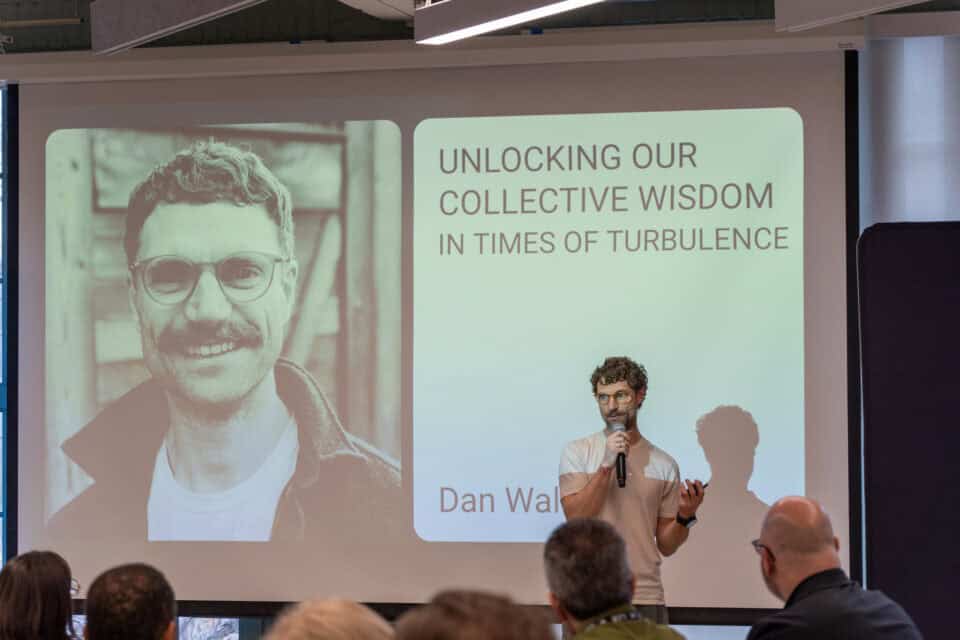
Chris Lunney’s Exploration of Embodied Sense-Making, Authentic Paths, and the Wisdom Beyond the Analytical Mind at the 2026 Facilitation Lab Summit
At the 2026 Facilitation Lab Summit, Chris Lunney opened his session with a blank slide and a single question: “What did you just experience right there?” It was a deliberate provocation—a small, engineered taste of the unknown—and the perfect entry point into a workshop that challenged facilitators to rethink how we navigate uncertainty. Titled “Navigating the Unknown with Whole Intelligence,” Chris’s 90-minute session invited participants to move beyond the analytical mind and access a deeper, more integrated form of knowing: one that draws on the body, the heart, the imagination, and the subconscious alongside conscious thought.
The Trap of the Thinky Brain
Chris opened by naming a tension most people recognize but rarely examine. When we’re trying to move from where we are—Point A—to where we want to be—Point B—we reach instinctively for analysis. We research, compare options, ask for advice, and try to plan the perfect path. The problem is that planning the perfect path tends to leave us stuck, perpetually searching for a missing ingredient that can’t be found through thinking alone. The alternative—finding the optimal path, the shortest route between A and B—is often just exhausting. Sometimes the shortest path goes straight through the mountain.
The core issue, Chris argued, is that we’re trying to navigate the unknown using only the analytical mind: a map without a compass. Our brains are excellent at working with known variables—choosing a refrigerator is his go-to example, a decision with clear dimensions and measurable constraints. But navigating genuine uncertainty requires a different set of instruments. Not just analytical and relational thinking, but somatic and emotional awareness, subconscious and imaginal insight, and personal and collective understanding. He’s been calling this combination “whole intelligence”—what happens when we bring all of these sources of knowing to bear at once, rather than expecting one of them to do the work of all four.

The Refrigerator and the Heart
To make this tangible, Chris led the room through a guided meditation. Participants were invited to bring an unknown situation to mind, close their eyes, and—through a sequence of breathwork and imagery—find themselves at a refrigerator late at night, filled with the weight of their situation. The prompt at the door was deceptively simple: open it to find the exact feeling your heart desires. What word or phrase does that feeling bring with it?
What emerged in the room was striking. One participant found that the answer that surfaced matched almost word-for-word something she had written earlier in the day during a different session entirely. Two others discovered, without any prior conversation, that they were navigating the same unknown—where to move their families. The subconscious and imaginal, it turned out, had plenty to say when given a structured invitation.
The key insight Chris returned to throughout: “The quality of our sense making equals the quality of our sensing.” When we only consult our analytical mind, we’re working with a fraction of the available information. The body knows things. The heart knows things. The imagination, given room to move, often goes directly to what actually matters—bypassing the noise that the thinking brain generates when it’s trying to figure out something it cannot figure out.
From Insight to Experiment
The session didn’t stop at sensing—it built a bridge from inner knowing to action. Drawing on neuroscientist Anne-Laure Le Cunff’s book Tiny Experiments, Chris introduced the concept of a trackable experiment: not a provable hypothesis with a binary pass/fail, but a small, timed commitment that generates useful data. Participants moved from the meditation into identifying one action aligned with what had surfaced—something that engaged the head, the heart, and the hand together—and then gave that action a structure: a timeframe, a way to check in, and a simple retrospective at the end. Plus, minus, next. What’s working? What isn’t? Given this information, what do I do differently?

Three methods, Chris offered, can access whole intelligence depending on who you’re working with and what the room needs: the embodied heart meditation they experienced together; somatic movement practices drawn from Social Presencing Theater, developed at MIT’s Presencing Institute; and structured physical play with objects for those who need to build something in order to think. All three begin in the same place—the body and the heart—and then hand off to the analytical mind once there’s genuine material to work with, rather than asking it to generate insight from scratch in a vacuum.
Chris closed with a poem from his friend Kyle Finchem, a movement practitioner: “There’s always something to see if you’re listening. There’s always something to hear if you’re looking. There’s always someone to feel if you’re here.” For a session about navigating the unknown, it was a fitting final note—a reminder that the path forward isn’t found by thinking harder. It’s found by listening more completely.
Watch the full video below:
Transcript of Chris’s Session:
Speaker 1 (00:06):
Oh, that’s interesting. There’s supposed to be something on this slide. I’m just kidding. What did you just experience right there? Was that
Speaker 2 (00:18):
Like …
Speaker 1 (00:23):
We’re going to talk about that experience today. Usually as humans, we start off at some point. We’ll call that point A. And we do this interesting thing where we want to get to point B. That seems logical enough. And we do this thing where we want a really clear, reliable, easy, risk-free path to get there. And that’s not usually the way it is because it involves change. This is the thing about being at point A. You’re in point A, that’s just what you are. You’re A shaped and you’re trying to get to B shape and that’s just a different thing. And so when you’re trying to get there, it doesn’t look like change. It looks like the unknown.
(01:17):
Because if we stand at point A and we try to figure out how to get to point B, we can’t do that because we’re not point B. We’re trying to be this experience that we haven’t experienced yet. And that’s really scary and frustrating and all types of things. And so today we’re going to talk about how you challenge, well, the challenge of picking the path. Because when you stand at point A, there’s all these other ways you could go. And each one of them kind of looks unknown. And so how do you trust yourself to say, “You know what? Actually, this is the path that I’m going to walk. I might not know so much about it. ” Wow, it’s scary over here personally. I’m like, wow, that’s such a wide stage.
(02:03):
But we’ll explore this today because this is an experiment on how to navigate the unknown authentically. And authentically is going to be an important part about this. We can just go run off into the distance, but there’s a way that’s going to be supportive to do so, sustainable to do so. The beauty is you already have what you need. This isn’t anything new. You just probably are overlooking it. So we’re just going to take a pause here. We learned that earlier. Just to investigate what is your unknown like? You all digesting some food. This is kind of nice. The person after lunch is like, “You got to bring the energy.” It’s like, no, just digest. It’s okay. We’re actually going to sit and just reflect on this for a moment.
(03:00):
You might even want to close your eyes. This is helpful. Bring to mind something that’s unknown currently for you. Seriously, close your eyes. Because this way you’re safer in your own space. Yeah, bring something to mind that’s unknown for you. Something you’re navigating without a clear map. Let yourself really be with this for a moment. Feel where this lives in your body. And patiently identify maybe what sensations arise in you. What emotions? Maybe memories. Maybe images. And when you think about navigating this unknown, what personal tools or resources do you reach for? What’s authentic to grab? Or what do you go to first? Thank you for that. Welcome back to the room. And just in five minutes, just quick and brief, turn to a partner and just debrief. It’s two questions. What sensations are emotions surfaced? And what resources or tools do you commonly reach for in this situation?
(05:22):
If somebody wants to share, what was coming up for you? What emotions, feelings, and maybe what tools were you reaching for?
Speaker 3 (05:30):
Yeah. So sensations, I have lots of things that are unknown right now. So I was like, “What path do I pick?” But what I did notice was that this sort of swirling on instability, once I let myself feel it was like kind of in here was this sort of feeling. In terms of emotions, I mean, that’s just this disorientation, I would say. But because I feel like I’m in this all the time now, that the tools that I’ve been using or the tool that I have going most right now is Twila Tharp. I read the creative habit. She talks about scratching and that you just start scratching at things. And so I don’t need to know where I’m going. I just need to start being very attuned to signs.
Speaker 1 (06:17):
Beautiful.
Speaker 3 (06:17):
And symbols. Yeah.
Speaker 1 (06:18):
Cool.
Speaker 3 (06:19):
Yeah.
Speaker 1 (06:21):
Anybody else? Their experience of the unknown and the tools? Yeah, go
Speaker 4 (06:27):
For it. Is it cheating if I’m from the same table as the previous?
Speaker 1 (06:30):
No. In fact, now
Speaker 4 (06:30):
The
Speaker 1 (06:30):
Whole table needs to answer, but yeah. Awesome.
Speaker 4 (06:35):
For me, there’s the physical sensations, but what I wanted to mention was particularly the resources and something I just experienced that I closed my eyes. And when I got to that prompt, after a few seconds of reflection, I opened my eyes and I instinctively looked at you. And the tools that I look for in those moments are people, humans, their creativity and their wisdom. And it was a subconscious thing. I right away looked up and looked at you in that moment of contemplating what do I need right now. So Chris, I need you.
Speaker 1 (07:04):
Thank you, dearly. I’m going to deflect that as a facilitator and say I don’t have any answers, which is counterintuitive to what I’m about to do. If I could have my slats back real quick. So this is interesting. Kind of between those two answers, there were similarities of like internal investigation, external investigation, and then like personal sense making and collective sense making. And it’s funny, it’s like when you break down the unknown, it looks like risk or failure or, “Oh God, what if I make mistakes or the worst? There’s more unknown.” Oh no, we go through the unknown and there’s just more of this. And then on the other side, it looks like reward and possibility and opportunities and the change we actually seek to make. It looks like that journey between A and B. And the only difference between this is our filtering. One emotional lens is anxiety, which is super easy to fall into.
(08:12):
And the other one’s excitement. I don’t know. I don’t know what’s going to happen. It could be cool. It could be fun. Maybe I become somebody new. It’s kind of like standing in the woods. Eric was just talking to me about this right before this. He didn’t know about it either. And we have this question of like, where am I? I can’t see anything. I have no orientation. For argument’s sake, you were dropped in the woods. You didn’t just walk there. Okay?
(08:42):
And where do I want to go? Is also a deeper question if you can’t see where you are going. Everything’s dense and built up around you. And you’re asking this question, “Well, how do I even get there if I knew all these things?” There’s bramble and bushes and thorns and like, “Is that a river?” Oh God. And so we do this wonderful thing called figuring it out and it really works kind of. We do a lot of research and we compare all the options and we have so many tools to do this now. It’s incredible. We ask other people, “Hey, what have you done in this situation?” Where you’re looking to the facilitator, “What should I do? ” And we do this thing called, “What does the data tell us? No, seriously, what does the data tell us?” Which is interesting. It kind of nuts out one of two ways.
(09:39):
You’ll notice I’m doing a lot of binary thinking here, which is like when our brain goes into freakout mode, we do binary thinking. We don’t see the nuance in between. So at one side, I love this one. This is my favorite. I plan the perfect path.
(09:55):
If I just get all the variables together, I’ll know exactly what I need to do. I’ll have this feeling of like, “Oh, this feels right. I’ve figured it all out. I’ll just do that. ” Or we do this other thing. Well, I’ll get there. If you plan the perfect path, you end up feeling stuck. And why is that? Because you’re always looking for some type of ingredient that feels like it’s rested in you, but you’re moving from an unrested place and trying to fill in the gap about something, frankly, you just won’t know about until you get there. And then there’s the other version, which is I’ll just take the optimal path. What’s the shortest way between A to B?
(10:37):
Thank you. That was the camera guy. Sweet. The shortest path can be tiring. Extremely tiring. Sometimes the shortest path between A and B is through the mountain. Are you going to dig through the mountain? Or maybe it’s at the top of the mountain. All right, fine. You’re going to climb straight up the mountain? How tall is the mountain? You’re going to have to do that for a while. It’s just not sustainable. So something’s missing. Something just doesn’t make sense. So let’s look at sense making for a second. Inside of us, we have this thing called our brain, does the analytical and the relational thinking. It’s pretty good. It’s super good when we have known criteria. It’s like picking a refrigerator. There’s a hole in your wall. It has a specific dimension. There’s an outlet. It has a specific voltage. You have a specific amount of people you need to feed in your house.
(11:39):
You go somewhere and you’re like, “Ah, these three options, these are pretty good. That one’s kind of cheap. I’ll go for that guy.” And there we go. I got a new refrigerator. But then we also have somatic and emotional awareness. This is the thing of what our body’s telling us. And it’s really wonderful when we can combine these two like, “Hey, where should we go to eat for dinner tonight?” This is a fascinating situation. We’re using both our intellect and our body. Where can we go? What can we afford? What do we want to do? What’s close to you? Also, what do I want to eat? What’s nourishing for me? And we’re integrating these senses. And then we also have this interesting thing called the subconscious and imaginal insight. Now, I admit all of this is an abstraction and I’m consolidating a lot of sense making into a single slide, so just bear with me.
(12:24):
This is like happening always even when you’re not conscious. This happens in our dreams. This happens when you’re in the shower and you’re like, “Oh, that would be so cool.” And it’s an amazing thing for asking questions like, “What could my future look like? This is where dreaming and possibility comes from.” And the last one is personal and collective understanding. You’re way ahead of the curve. Thank you. And it’s what do I know about myself and what does the collective know about us together? And when put this together, we can ask questions like, “What could I or we become?” But the thing is, when we’re in the unknown and we only rely on analytical and relational thinking, it’s like using a map without a compass.
(13:07):
Does that make sense? Just bear with me. When you pull out your phone and you look at the map, it’s just oriented to the world. We have taken this for granted greatly. If you were dropped into the woods and someone handed you a map and said, “This is where you are. ” It’s not oriented to anything. You don’t have a compass, especially if you can’t see anything. Yore like, “I can’t see where the mountains are. I don’t know where the river’s at. I have no form of orientation.” And so we have to do this thing where early explorers were looking at constellations. What are a lot of points of reference that I can make sense of together collectively and bring these intuitions and this thinking all into one place where I can start to say, “Ah, this is maybe where I’m going to go. ” And I’ve been coining this thing called whole intelligence.
(13:59):
It’s a shorthand. It’s not perfect. It’s just what I’m working with right now. If you have critiques, come let me know. But it’s this idea of what happens when we put all these pieces together and you’re probably wondering, well, how the heck do we access all of this intentionally? Because that’s a lot of different stuff. So let’s experience it. So in a moment here, we’ll have a nice long bit of time. It’s like you’re still digesting, you’ll just get to meditate. You’re welcome.
(14:34):
In a moment, I’ll bring you through a short guided visual meditation, one where we’ll be accessing the more subtle and embodied parts of ourselves, and we’ll use these along with our intellect to craft a path, something that feels intuitive for us to walk. And before we go in, I want you to bring to mind an unknown situation. It might have been the one that we were just referring to previously. Just pick one if you have a lot. I want you to sit upright in your chair. It might be nice to actually push away from the table too, and you got some little bit of space.
(15:19):
And get oriented. If you’re familiar with meditation and you love an upright posture, rock and roll, if you want to just sit back and relax, that’s also okay. The suggestion is to close your eyes. I think this is easier with your eyes closed. If that freaks you out, don’t worry about it. Keep your eyes open, but kind of have a blurry, vague focus. And classically, with meditation, start focusing on your breath. Just your natural breathing. And just watch the breath. Observe it because we know by just watching the breath, breathing our natural breath, the things we feel out of order or imbalanced, just tend to return to balance.
(16:21):
They tend to restore their natural order just by breathing and watching the breath. And as you breathe out, you see the number three and as you breathe out, you see the number two. And as you breathe out, you see the number one, tall, clear, and bright. And you imagine you’re at home and it’s late at night. It’s one of those nights when your mind has been fixed on this exact unknown situation and breathe out. You find yourself called to the kitchen maybe because you’re still hungry, or maybe you’re just in need of something to distract your mind, and breathe out.
(17:41):
And you arrive at the refrigerator door, and just before opening it, you’re filled with the feeling of your situation, the dynamics of it, the people in it with you, your excitements, and your concerns, and breathe out. What is this situation asking of you? You can sense this in your body and how it makes you feel, and breathe out. And in that moment, you realize something, it’s not your stomach that’s hungry tonight. It’s your heart. Your heart is longing for something in this situation, and breathe out. And with your hands still on the refrigerator door, you now open it to find inside the exact feeling your heart desires, and breathe out.
(19:06):
And just like a dream, you pick up this feeling and you eat it in one bite, your heart and your body satisfied with what’s in you now, and breathe out. And you close the refrigerator door and turn to face the kitchen, and having satisfied your heart’s hunger, a word or a phrase from the feeling in you that you’ve found rises up. And maybe just to yourself in your head, you speak these words as a reminder of how to navigate this situation, to give your heart what it needs, and breathe out. And as easily as you’ve imagined this scene, it now begins to dissolve.
(20:22):
And as you breathe out, you see the number one. And as you breathe out, you see the number two. And as you breathe out, you see the number three, and you slowly, graciously come back to the room. Thank you for enjoying that experiment or experiencing that experiment. So in the next moment, we’ll figure out what to do with emerge for you. You’ll have about five minutes. This is a juicy amount of time for self-reflection, and just write for a second in a notebook, in a device, whatever you got. What images or sensations came up for you in this? I also want to make apparent that if nothing came up for you, that’s okay. That’s totally cool. This is a weird practice that we’re just starting. And in that area of nothingness, there’s also potential.
(21:35):
What feelings emerged? Maybe what word or phrase emerged for you? Did anything surprise you? Feel free to start the timer. Thank you. So next, we’re going to reflect for another about five minutes. How might your heart’s longing be expressed through your actions? These are small things. These don’t need to be grand gestures. Small things that align your head, your heart, and your hand, meaning what makes sense to you? What does your heart want? And what do you know your ability to be able to do? And this phrase could look like, “I could try this, or I could do this.
(22:38):
” So I’m actually borrowing this next method from this book. Go get this book. It’s awesome. It’s called Tiny Experiments by Anne Laurie Lekomf. She’s a neuroscientist and she’s figured out a lot of really good things for how to get unstuck in your life. And she has this technique called building a trackable experiment. Trackable is very different than a provable experiment. Approvable experiments, did it work or did it not? And if you go into the unknown, you might not know, but you will have more information. And so the idea of this is two things. You’re declaring an action, one of those things that you just chose. So just choose one of them. How might this actually look and how might you convert this into something that you can do over time and pick something like a week or a month or something manageable and reasonable that you would actually look at and recount.
(23:35):
And the idea of this is to sense, is there a pattern? Did I even do this thing? And that could be information. No, I didn’t do it. That’s okay. I didn’t want to do it.
(23:46):
And there’s no judgment. We’re just collecting data here. And at the end of this experiment, you do this thing called plus, minus, and not delta. Sorry, voltage control. Plus, minus a next. What’s working? Maybe what’s not working. Given this information, what do I do next in this scenario? And you can recursively regenerate new trackable experiments. So again, in this time, develop an experiment. What’s one of those actions that you came up with and apply some time to it? And maybe how might you check in with yourself? Oh, you know what? I’m going to check in in the morning. I actually do that thing that I said or I’m going to do it before I go to sleep. Or maybe it’s in a moment of work or some habit, some behavior.
(24:42):
So now’s the chatty part. Find a partner. And I think Renita, you maybe shared this earlier, which is this aspect of people are going to be sharing some deep unknown aspects with you. Also, just follow your own boundaries, your own guidelines of what feels intuitive to share. And if somebody’s sharing something really intuitive and authentic with you, hold that. What a beautiful thing to witness. And as a partner, your intention isn’t to like, “Oh wow, that’s amazing. You know what you could do is this. ” You can ask more questions. “Oh, that’s interesting. What do you think of about that? How do you think of applying that? “And I trust we’re in a good room of brilliant facilitators, so we won’t have an issue in that sense. More just guidelines. So we’re going to take 15 minutes, a good chunk of time because we just unearthed a lot of interesting information here.
(25:38):
So at around the seven, eight mark, and I’ll ring a bell because it seems everyone’s Pavlovian in here. That’ll be the cue to switch if you haven’t already. And then I’ll ring the bell again as if somebody won or raced the Olympics and then we’ll come back here.
(26:13):
Just some simple questions. I mean, we went through maybe something that was fairly new for you. Maybe you’re familiar with this type of experience. And I’m just curious, what was that like? The meditation, maybe images, maybe working through these different methods, maybe what felt clear, maybe what didn’t feel clear. It’s totally okay, but both of those are possible. Did anything surprise you?
Speaker 5 (26:37):
I was surprised by two things. I was surprised during the meditation exercise that the sort of answer came to me so clearly. I wasn’t
Speaker 6 (26:46):
Anticipating
Speaker 5 (26:47):
That. And then I moved over to this table for a partner because we’re at odd tables and my partner and I had both explored the same unknown, which was, where should our families move to? Nice. So that was a very weird bit of synergy there in our conversation.
Speaker 1 (27:10):
Yeah. Okay. Perfect. That’s a wonderful serendipity. Anybody else? Yeah.
Speaker 6 (27:23):
I’m going to make a connection between my experience in the meditation and one of the previous reflections we did in one of the other facilitations, but the question of what’s your heart’s desire. My answer spontaneously came out and I was like, wait, I think I wrote that earlier today. And I had the same answer for the pursuit of joy and wellness. I had to look at my notes and I was like, literally the same words came out. So that was surprising and interesting to me.
Speaker 1 (27:54):
Convergence. Yeah. Yeah. I mean, that’s also just how sense making works. It’s like we didn’t just drop into the problem for the first time right now. As this has been building over time and what we’re collecting. Maybe from the perspective of the listener, of somebody else explaining their path, what was that like to experience or maybe what surprised you or what felt intuitive for you and how to respond?
Speaker 7 (28:30):
So I first-
Speaker 1 (28:31):
This table’s going strong.
Speaker 7 (28:33):
All
Speaker 1 (28:33):
These other
Speaker 7 (28:34):
Tables. You have to step your game up. Yes. We are the yes and team.
Speaker 1 (28:39):
Remarkable.
Speaker 7 (28:40):
Yes, Antarctic.
Speaker 1 (28:41):
Mark, you’re not allowed to give this table a mic anymore.
Speaker 7 (28:44):
Thank you, Mark. So I think I shared first for a moment and then my lovely partner shared and we both actually came up with a similar visual of how we were looking at ourselves and where we are in time and space and in experience. And then someone that we shared our lives with has a different experience and they’re in a different space and time and pace. And it was very interesting because we both were like, well, we’re out here and our person is over here and we have it come at it from different angles, but the visual of it was the same. So that was really, wasn’t that surprising? I thought that was very cool. So thank you. Cool. I’m going to pass it to someone at my table. Oh my
Speaker 1 (29:38):
Goodness. Oh, thank God.
Speaker 7 (29:45):
We have one over here.
Speaker 1 (29:47):
Yeah. Over here. You have one. Yeah, please.
Speaker 2 (29:51):
We’ll
Speaker 1 (29:52):
Come to you next. Thank you.
Speaker 2 (29:53):
So Jane and I, our unknowns were wildly different, but one of the things that we both really agreed on in general I was supporting ourselves by thinking to ourselves about our unknown in a way that we would maybe talk to a good friend if they were going through that. So we talked about the power of self-talk and how it’s interesting how the nicest people to other people can have really negative self-talk. I mean, I think we all kind of do at some level. And that’s really not fair because we would never say that to someone that we love. So why is it okay for us to say it to ourselves? So we both, even though our unknown was so different, we both really linked up and connected on that concept of, am I actually giving myself a fair shake in the tone that I’m speaking to myself about this?
(30:43):
Probably not. What would I tell a friend or what would I tell somebody that I love? So that was a takeaway for us.
Speaker 1 (30:49):
That’s amazing. Yeah. And there’s a lot of nuance in what you’re sharing. And it’s, God, like the narrative and the language around what our path is and why we could or could not do that and what resists that and how that shapes what we think is even unknown in some way. I want to hear yours after this session, if that’s okay. That’s totally fine. Thank you. So I want to break this down for a second because we kind of just ripped through the exercise. It was quiet, but we were just doing it consistently. The first thing we did was start with personal sensing. Probably no surprise there. And we were looking at our body and our heart and our imagination. And you’ll notice that this really requires slowing down. Sorry, bud.
(31:37):
And deep listening, of which I witnessed you were capable of both. So it’s totally cool. And then we were reflecting and capturing. We were converting things that were inherently ephemeral into something that was structured. So we’re actually taking something that our non-language brain does and moving it into language. And this way we can do something with our analytical brain where we can translate this and synthesize this and come up with patterns and understand what’s emerging for us. We literally do, we let the thinking brain do what it does best. We’ve now given it some material to work with instead of just chatter with itself in a circle.
(32:20):
And then lastly, we were designing a learning experiment. It’s just trackable. And critically, I can’t stress this enough, we are aligning our head, heart, and our hands. Just take that away today. If you just thought I was rambling, just remind yourself of head, heart, and hand. And the beauty is you can just repeat this pattern, the learning keeps going. And so here we have a compass, right? This is our heart. We have a map. This is our head and we have a path because we’ve shaped it to our ability and what’s intuitive for us to walk. It’s not, might be a little scary, but we’ve at least shaped it to a way that we’re invited to go do it. And you might be saying, “Wow, this isn’t so different than most workshops.” And you might be right. We’re just starting somewhere else. It’s like most of the time we ask people to brainstorm, which is a really funny, weird thing when we’re exploring the unknown.
(33:10):
We say, “Hey, use your thinky brain to do some stuff that the thinky brain isn’t going to figure out. ” And so instead, we just use the same structures, but we started somewhere else. We started with the body and the heart and imagination because you can see the rest of it’s just like, cool. We’re generating options. We’re synthesizing those options. We’re discovering patterns. We’re building prototypes out of these things. We just started somewhere else in the body and the heart.
(33:34):
Does this make sense? This is resonating. Yeah. Okay, cool. I think that’s all I wanted. That’s great. I don’t know why. I was like, “I’m going to pause and ask everybody,” but they were like, “Yeah, go for it. ” I was like, “All right, sweet.” I love this quote. This is one of my favorite things. The quality of our sense making equals the quality of our sensing. The quality of our sense making equals the quality of our sensing. If we’re expecting high quality sense making out of ourselves, we need to use all of our senses and we spend … I know I do. I spend most of my time thinking in front of a computer with some AI chat.
(34:20):
And so I know all you are thinking right now. So every time I’m facing the unknown, I should meditate on my refrigerator. Dear God, no, please don’t do that. We should have a refrigerator like branding for this event, at least. I’m going to share a few methods with you. So the first one is what we just experienced. This should be intuitive based on just having gone through it, but it’s simple. We’re breathing and we’re grounding and we’re bringing the challenge to mind and body. We’re not thinking about it, we’re embodying it. That’s not a hard thing. We just have to slow down and be like, “Oh, I’m already feeling these things.” And we shift into our sense of what our heart’s longing is. And if that’s hard for you, I love the reframing of like, what are you hungry for? We experience hunger almost every day, and it’s so much easier, especially if you’re not practiced at asking your heart questions.
(35:14):
And you can reframe that. Well, what’s my heart hungring for? It’s a slightly easier reframe. There’s another thing. If you don’t like meditating and sitting still, you can also move your body. And I’m stealing this from social presencing theater, which is used in theory you to develop at the Presencing Institute at MIT. And it’s an entire suite of embodied practices that you can use to do systems change work and all types of stuff. And I’m doing a real quick abstraction of this one. This is where I wish I had a lav mic.
(35:46):
You can just stand there and say, “What is my unknown situation?” And you can feel it in your body. And it’s kind of like, I don’t know, it’s like this. I don’t even know what the heck this is, but this is what my body is doing. Cool. Okay. And then I’m going to pause. I’m going to say, okay, if this is what my unknown situation is, I’m not going to move to a desired situation. I’m not going to be like, “Ha ha, this is what I want. ” Your brain did that. Don’t do that. I feel this thing and I say, “Oh, this is interesting.” And it’s almost like sitting in a chair uncomfortably for a while. Your body just knows when to move. You don’t think, “Hey, maybe I should move because I’m not getting enough blood flow to my legs.” And then you do that.
(36:32):
It’s like your body just tells you. And so you sit here and you’re like, “Oh, what’s interesting? Oh, oh, I’m feeling … There’s something like standing is easier and actually, oh, whoa, something’s happening. Where is this going? Oh, what do I do with this?
(36:53):
” But this is a very different thing than this. And then you’re doing the same pattern. You’re going to look at those differences and say, “Oh, we can make sense of this. This is a different thing. This might not be the solution, but it’s a different way of relating to this situation.” Where’s my little clicker? The next one. For all the Lego serious play humans out there, this is almost identical. If you’re like, “I don’t want to meditate. I don’t want to use my body weird like you, Chris. I just want to sit at my desk. I’m sure you have a bunch of crap all over your desk and if you’re super organized, get some crap on your desk.” Or you can rip up some pieces of paper and you can scatter them around and just structure like play as if you were a kid building the city of your situation.
(37:40):
What does that look like? How is it structured? What’s stable? Wha’s instable? And maybe move some pieces around. Why would you move that piece specifically? And how would you chart a path through this space differently? So three very different ways to approach something that is more subtle and not thinking first. Okay. So let’s try to apply those. I know we went through those fast and they were abstract. You have at least experienced one of them. And I’ll give you some things to work with here. I’m not going to just throw you into the fray. Again, select a moment of the unknown. You can work with the same one. Actually, it makes more sense to work with a previous one or a future one, I’m going to say. And sketch a plan for how you might engage this concept of whole intelligence, leaning into something you’re not thinking first to develop an authentic path.
(38:33):
And I’m going to give you a few things, right? We have the process. This is what we went over before. These are just some steps. It’s kind of like design thinking, but a little different. And then we have some methods. Just use these or make up your own. You’re like, actually, I do this funny thing when I go and walk my dog that all the answers from my unknown come to me. You’re like, great, just use that dog walking method. We’re going to have a few minutes to digest this. And while you’re answering this, maybe concentrate on these specific questions of like, well, why are you picking this situation to apply it? And maybe you’re not applying it just to yourself, you’re applying it to a group. How might you adapt it to be appropriate for this collective?
(39:35):
If I can bring your attention back here, thank you so much. Yeah, if we could stop the timer and hopefully this remote works. I’m going to do this thing where I trust everything was clear. Everything was amazing. It all worked out perfectly only because we’re nearing the end. So as we were before, you can hop to miro.com/join or use the QR code. And we’ll be answering this question. I’m going to go to the next slide and maybe somebody in charge of slides can click the little QR code button again, the top right. Amazing. We’re going to investigate this question. What’s one thing that’s beginning to emerge for you today? And you could think about this at a personal level. Oh, this is something personal that’s emerging or ooh, these are interesting concepts and practices and maybe this is emerging for me philosophically or conceptually about this.
(40:53):
No right or wrong answer. Truth, failure is not final. More listening to my heart is hungry for the tacos. Just appreciating now, slowing down to the unknown. The real answer is inside of us all along. Trust. Use/listen to your body. Already did some of this work intuitively. Perfect. Unification of my design, emotional and spiritual practices. Thank you for saying that. That’s been the thing I’ve been struggling with most of my life. Convergence. Stretching myself creatively and creating frameworks to do so. I am safe. Beautiful for how everyone’s experiencing this. Being present to what already is. The value of sitting in the unknown longer. Letting the unknown exist without needing to solve it. It’s also a beautiful observation. So often we feel the thrust to do something in the unknown. You’re like, “What if you just sit there? What if you just sit in the unknown for a moment?
(42:04):
If the world’s changing, something will come to you. This is great. I’m going to move forward.” Okay. So the next time you’re in this situation trying to move from A to B and you’re looking for a perfect path, but instead you find yourself in the woods of the unknown. Remember, you have a compass. This is different than a map. Start with a compass.
(42:31):
Start with a compass of your heart, your feelings, your emotions, what’s really you’re yearning for, and then get out the map. Then chart a path. And with that information also into it, what’s reasonable for me to do here? What is my ability? What can my hands achieve in my life? Because this way you can find your authentic path, because the only way through the unknown is the path that you can walk authentically. I wanted to end with a poem from a really good friend, this guy, Kyle Finchem. This guy’s literally in the jungle right now. He’s a great movement practitioner and he’s taught me a lot about how to use the body first and not the mind. And the poem is this. There’s always something to see if you’re listening. There’s always something to hear if you’re looking. There’s always someone to feel if you’re here.
(43:34):
Open your heart, Kyle Finchem. So thank you. Enjoy navigating your path, and I’m very grateful that our paths could merge for a little bit today. See you.