Renita Joyce Smith on Authentic Presence, the Unmasked Facilitator, and Building Trust at the 2026 Facilitation Lab Summit
At the 2026 Facilitation Lab Summit, Renita Joyce Smith stepped into the room—and immediately made the room itself the subject. Her session, “The Edge of the Room Is the New Center,” challenged facilitators to stop hiding behind tools, frameworks, and polished agendas, and start asking a more uncomfortable question: how much of you is actually in the room when you facilitate? With warmth, humor, and a gift for meeting people exactly where they are, Renita guided participants through a deep exploration of authentic presence—what it means to be unmasked, why it matters, and how it changes everything.
The Unmasked Facilitator
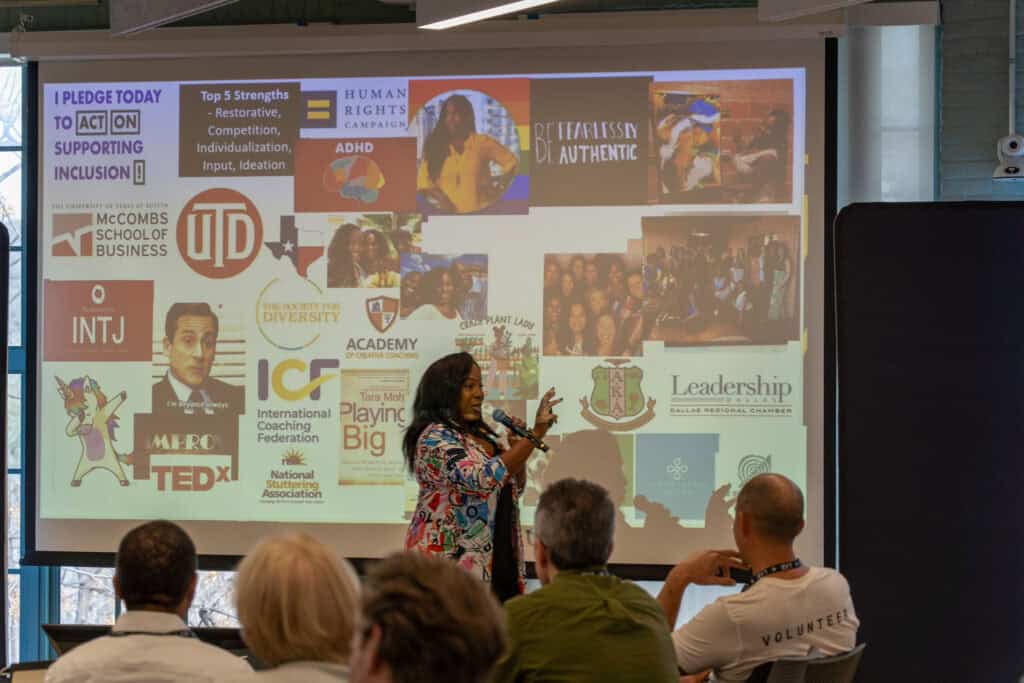
Renita opened with what she calls her “welcome mat”—a belonging slide that trades the standard resume for a more honest introduction. Oldest daughter (which drew knowing laughs from a specific demographic in the room). Natural introvert. ADHD/autistic. Improv enthusiast. Owner of a famously bougie dog. The point wasn’t to overshare; it was to model something she has tested across years of facilitation work: when a facilitator lets people behind the curtain, the room breathes differently.
She grounded this in a story from early in her career. During an executive retreat, a CFO paused mid-session and shared something raw: “I really just don’t feel like I have the trust of this team.” Renita heard it—and then, with her agenda queued up and her rent payment ringing in her other ear, she kept moving. “Thanks for sharing. Next activity is.” The debrief afterward was polite but flat. They hadn’t gotten to the heart of it. She knew exactly which moment she’d missed.
That experience became a turning point. “From that moment on, I’m going to sense and really be present in what’s around me. And remember that there are humans in the room. Beyond the plan, there are humans there.”
She was careful to draw a clear line around what being unmasked actually means. It isn’t oversharing. It isn’t ignoring what the room needs in favor of performing your own authenticity. What it is: being real enough so the room can be real back. Trusting your instincts. Naming what’s actually happening. And knowing your secret sauce—what Renita calls your “bay leaf in the gumbo.”
The Stage and the Paradox
Midway through the session, Renita sat openly with a paradox she’d wrestled with for days while building it: how do you show up as your full self and hold the room’s wisdom at the center? How do you be the person who facilitates and not just the facilitator?
The answer came from an unlikely source—a glass of whiskey and a rewatch of Hamilton. Renita was captivated not just by the show but by the stage: its turning platforms, its hidden intricacies, its ability to expand and contract around whatever the story demanded. She tracked down the set designer’s interview. David Korins described his task simply: “To create a malleable envelope that could expand and contract to support the story and then stay the hell out of the way.”
Facilitators, Renita offered, are that stage. Not the star of the show—but the carefully designed, responsive container that makes the show possible. The invitation was to build your own stage: a full toolkit of pivots, questions, and moves you can deploy the moment you sense the room shifting. That’s what allows you to be fully present as a human and fully functional as a facilitator—at the same time.
Notice. Name. Invite.
The session’s practical framework was deceptively simple: notice what’s happening in the room, name it out loud, and invite the room to go there with you. Noticing, Renita emphasized, isn’t just reading faces—it’s tracking shifts in language, energy, pacing, and the offhand comment that changes the texture of a moment. Naming means having the courage to say the thing everyone in the room is already feeling: “I’m sensing a shift here—is it just me?” Inviting means opening a door, not issuing a demand: “May I ask you a question? If you’re willing…”
She illustrated what this looks like in practice with a live moment from her own work: a CIO who kept speaking in data and process, with conspicuously little warmth. Renita asked her directly, “Do you like people?” The mask dissolved. The CIO admitted she found the emotional demands of managing people exhausting—and that became the real design brief for the workshop.
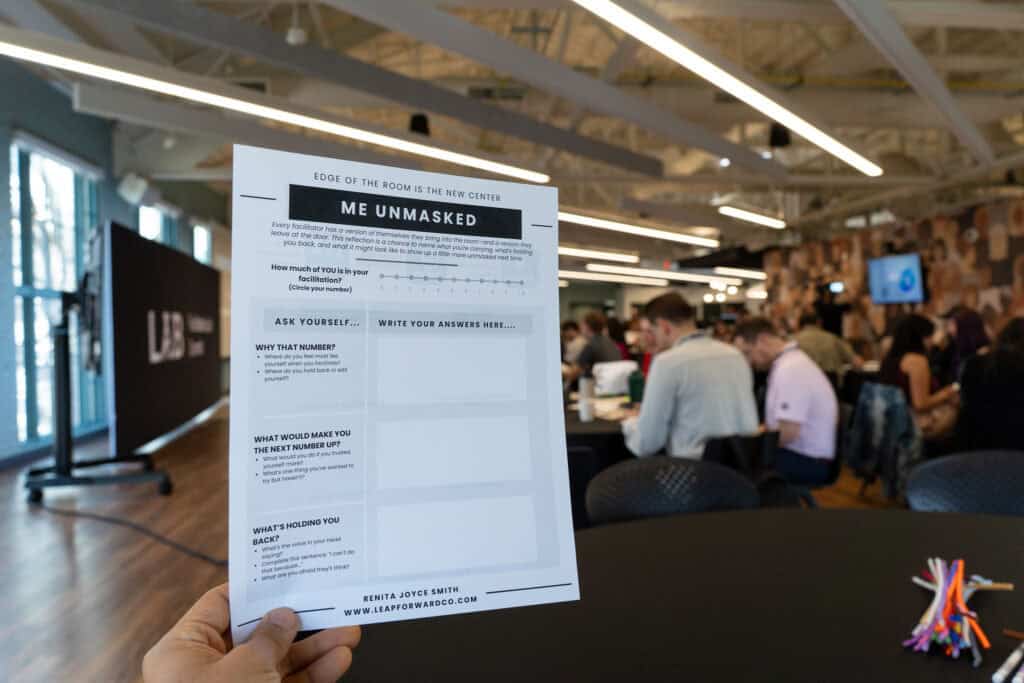
Participants then worked through their own versions of this, revisiting moments where something had been missed, writing a headline for that moment, and then rewriting it—what would you have named, and what would you have invited? The tip exchange that followed surfaced a remarkable collection of practical tools the room generated together: “elephant spotting” with actual stuffed elephants on the table; fist-of-five alignment checks done with eyes closed; ten-second pauses that cost nothing and give everything; and the simple reminder that clarity is kindness.
Throughout, Renita returned to the same thread: the facilitators in the room who were showing up most powerfully weren’t the ones with the most polished technique—they were the ones willing to say the real thing, ask the real question, and trust that the room could handle it.
Renita closed with an invitation as much for herself as for the room: we are never finished becoming. The work of showing up unmasked isn’t a destination—it’s a practice that evolves with every room you enter. For a session that challenged facilitators to stop performing and start connecting, Renita modeled exactly what she was asking for. The room, in turn, gave it right back.
Watch the full video below:
Transcript of Renita’s Session:
Speaker 1:
Let’s give a warm welcome to Renita.
Renita Joyce Smith:
So excited to be here. This is a great space. I was contemplating in the back of the room listening to Dan’s great. Thank you for teeing all of this up amazingly. What I noticed hearing all the conversation, I was like, “Oh, Renita, you get the opportunity to model what you’re talking about today.”
This room is very self-aware. This room is very advanced. I’ve been in a lot of rooms. I’m like, “They’ve got poetry. They singing songs. We doing land agreements. Oh, this is a different type of space.” So, I’m going to invite myself to also pivot in this moment to dance in what we are in this space together. I’m going to copy and paste over Dan’s container and agreements. Is that okay? All in favor, say aye.
Audience:
Aye.
Renita Joyce Smith:
Any opposed? Awesome. The motion carries. Second thing. I love conversation. So, the same energy that you brought to the last session of being able to, I have a thought, here’s how I’m contemplating. I invite that into this session as well. All in favor, say aye.
Audience:
Aye.
Renita Joyce Smith:
Any opposed? Motion carries. Awesome. So, what are we talking about as the edge as a new center? I don’t know if any of you noticed lately, the world’s been interesting lately. We talked about a lot of it in the last session around how are we holding this tension? How are we holding these spaces in different types of ways?
But what I’ve been noticing is that outside of work walls, we’re having these conversations. But when it comes in to the corporate spaces, we clam up. We have to be professional, and the conversation stops. We don’t push ourselves. And so what I’ve been experimenting with over the past few
years is what does it look like to push a room, to be a bit more of myself, to allow others to be more of themselves?
It was a risky gamble because I like to eat and I like nice things. My dog likes his little dog food that has actually little wet dog food. Listen, he’s spoiled and he’s bougie, like his mama. And so it was a gamble and a real risk to show up this way because people are paying me tens of dollars to be in these spaces and in these rooms to facilitate these conversations.
And if I take a gamble by pushing the edge, will I get invited back? Will I have more work? Will I be able to keep doing what I love doing? And I said, “Okay. Let’s give it a whirl.” What I found out is the more that I pushed myself, the more the room opened up. The more conversation got deeper. The more unhinged I was, folks were like, “Oh, my God, we love you, Renita. Come back. Come to my room.” Not that room, come to our… Although any of those invitations, hit me up later on, we’ll talk. Just kidding.
But what I’m setting the context for now is that what we thought before were these edges and being a bit more of a rebel, actually is the re-baseline of what is necessary right now. The world has recalibrated, but we haven’t quite caught up with it just yet. So, the whole purpose of this session right now is to invite you into a recalibration of yourself.
Dan hit on it that to be able to do the work out there, we got to do the work in here. So, in my deep self, I’m going to be inviting you to do the work in here. So, every time that I present, first thing I throw up is a slide. It is called a welcome mat or a belonging slide. There’s usually a wonderful resume or a bio read about me. She was in management consulting, blah, blah, blah, blah, blah, blah, blah.
But the real thing is this is who I am. I’m a oldest daughter, which informs a lot of how I… See, I always listen for the laughs in the room because it’s usually the eldest daughters. It informed my sense of responsibility and how I show up. Quiet as it’s kept, I’m naturally an introvert. This takes a little efforting for me to be into personality, to be in an extroverted space.
I’m going to crash when I get home. I tend to be a bit more on the ADHD, autistic side as my therapist is like, “Take this test.” And I was like, “Oh, this explains a lot of things.” But when I lift that up, folks in the room are like, “Actually, I’m neurodivergent as well. Thank you for saying that.” I was feeling odd and quirky, but now to see you doing this, I can show up more in the room too.
In addition, I have a diverse group of friends racially and ethnically. I hang out with pretty much everybody. Now, what this does is two things. I’m let you behind the curtain. I don’t tell my folks this. I’m going to tell y’all this, okay? When I show up into a space, especially when I was doing a lot of DEI work, folks are like, “Here’s the black woman coming and talk about DEI.”
So, to be able to flash this up and say, “There is a whole human with a lot of experiences.” I do improv. I like unicorns, queers, hells. There’s a lot going on right here. It brings my humanity into the space where regardless of whatever ideas they had of me, now I’m telling the real story here of who I am. I’ll tell you, like I tell my folks that are usually in my sessions, if you were to make this, what would be on your slide?
In this moment, I invite that version of you into the room. Not the one with the title, not the one that says facilitator, but who and what is in your collection of background and experiences that make you you? Even the most obscure thing. I do improv and I love it. Folks are like, “Nerd Alert.” I jam out on it, but it’s my secret sauce in spaces, because I can pivot and dance with a room and tell a very corny dad joke every once in a while.
Now, how did I get to this moment? So, a few years ago, I was invited into a room. I had just got my fancy certification and I had executives come to me and say, “We need you to facilitate an executive retreat. We aren’t gelling as a team. We got this whole strategic plan, God help us, that we aren’t rallying around. So, we need to circle back and get alignment and cohesion for the path forward for the organizational goals.”
And I’m like, “Yay, this is going to be great.” So, any great facilitator, I had my slides, I had my exercises, I had my agenda, my session lab was on cue, had my mural queued up. It was great. So, we’re partway through the session, working out all the things, and the CFO says, “I really just don’t feel like I have the trust of this team, and that’s what’s getting in the way.” In that moment, I heard Eric in my ear, “Hold this space.” And in my other ear, I heard my rent payment, “Keep going.”
They didn’t put you here as a therapist. They didn’t ask you to do all this, and I froze. I looked at my session lab, it’s like two seconds before the next activity, and I looked at her and said, “Thanks for sharing. That’s important. Next activity is.” I asked, you debrief on your follow-ups, I was like, “How was the session? Did we get what we need?”
And they said, “Yeah, it was a great session. It was fine.” I was like, “It’s a little bit of a lackluster fine. What’s going on?” They said, “I really don’t think we got to the heart of what’s actually going on.” I knew the exact moment they were talking about because I missed it. I went back and said, “Well, why did you miss that, Renita? Why’d you punk out?” I talk to myself kindly sometimes.
I said, “I was scared of the moment. What if it got out of control and people started crying and rinsing robes and gnashing of teeth? How would I hold that space? I didn’t trust myself in the moment.” So, from that moment on, I said, “Okay. Now on, I’m going to sense and really be present in what’s around me. And remember that there are humans in the room. Beyond the plan, there are humans that are there.” And that brings me to the whole thesis of our time today, which is, what does it really mean to be unmasked?
It’s a cute word. Be yourself, be real, be authentic. What the hell does that mean? Especially when this has our money involved, our credibility, all these things. And then we say the V word, be vulnerable, which is a hot topic now. But what does it truly mean to show up as the person who facilitates and not as the facilitator?
I struggled with this topic a bit and really wanted to explore what the difference between what unmasked is and what unmasked isn’t. So, I’ll start first with what it isn’t. It isn’t oversharing or making it about you, but it’s a fine line because I know I just showed y’all a slide that was all about me. But it served a purpose of setting the container and the framing for the room.
Unmasked also isn’t ignoring the room’s needs in order for you to be authentic. If you haven’t noticed, I have a personality. I love the knot there. Thank you. Now, this personality has a dial setting. If I’m showing up into a stiff room, I’m not coming out to Shut Up and Dance
With Me. Maybe. But I can dial that in based off of the setting on where I am for what the room needs in the moment.
Also, unmasked doesn’t mean performing personality for its own sake. You may easily come in here and say, “Renita, you got a lot going on. I’m more reserved. I’m more quiet, more pensive and thoughtful.” There’s room for that in here. Show up that way bec
ause people who are like, “This is too much,” want you instead in the room and your fullness of yourself that’s there.
Last but not least, it’s not abandoning your role as a container holder and getting caught up in the drama of the moment. I can’t believe you just said that. Well, what do you think about that? Well, let’s stir the pot some more for stirring the pot’s sake versus stirring the pot in a very responsible way. So, if we talk about what it isn’t, let’s now talk about what it is.
What unmasked actually is, is being real enough so the room can be real back. Someone was mentioning at the end of the last session, I was like, “Y’all can come up here and teach my own session here.” Being able to name what’s happening in a moment. I did that earlier. I got to pivot some things because y’all are smart and thoughtful.
I can be real enough to say that in front of y’all and know that that’s what’s happening right now. It also means trusting your instincts, and we’ll talk about that a lot, that intuition. There’s going to be some other speakers today talking about, and Chris is talking about whole intelligence.
What are these signals in your body that’s giving you information about what’s happening in the room? That’s letting down these barriers and these guards and saying, “Let me really be present and embodied in this whole space.” And then you layer on top of that, “What is your secret sauce? What’s your style?”
I tell people, “What’s your bay leaf in the gumbo? How are you seasoning it up beyond the salt and pepper?” Please use more than salt and pepper. Thank you. There’s garlic powder. Tony Chachere’s has got a whole league in the spice aisle. What else are you adding to the food, to the moment to bring your own style?
So, when I’m introducing you to these concepts, I’m curious now pivoting it to the room. What are some of your thoughts when you think about being masked versus unmasked? What’s coming up for you as we’re exploring this concept? Yes.
Audience:
Just as of December, I’m starting my own business. I’m a freelance graphic designer. Thank you. It’s terrifying. I’m really balancing what you’re talking about right now, but specifically the word professionalism. I have to bring a level of professionalism. I have 10 years of expertise. I know that I can do the work, but how do I show up in a way that just frankly shows my human, my whole self?
The way that it’s showing up for me right now is that I’m not really interested in showing up in semi-business wear, just reminding people that I am human, and trying to find those intersections within conversation where we can remind one another that we are in this human struggle together.
Renita Joyce Smith:
Okay. Let me ask, what have you tried so far?
Audience:
Besides how I show up clothing-wise, I’m not good at small talk, but I’m practicing it more so that those as inroads to find the meat of conversations and things that we have in common. If somebody really passionately cares about something, that’s something I gravitate to and letting that drive the conversation.
Renita Joyce Smith:
Yes. Thank you for sharing. Thank you for sharing that. I’m a coach at heart and a sage, so may I invite you into a coaching moment?
Audience:
Sure.
Renita Joyce Smith:
Awesome. More of an advisor moment, actually. Something that really helps, and you touched on two things; clothing and small talk. Clothing is a small act of rebellion, and usually just enough to crack it open to begin to say, “Well, that was safe. What else can I do?” We need those moments of safety and experimentation to give us more information than, “Oh, this actually is safe. This jacket is a whole choice.”
The first time I wore it, I was like, “We going to see what happens.” The feedback I got was like, “Girl, it’s a cute jacket. That’s cute. I like this.” Data then told me I don’t have to show up in a black blazer, in black slacks, in a white t-shirt. I can do this and it’d be okay. So, you’re experimenting to get more data, which is amazing.
A quick thing on the small talk. I don’t do it either. But I have a pocket of questions that I ask that’s not about weather and sports because I mess up sports so bad. I’m like, “So, did they get the goal in the hole of the…” No. But I have three questions. What’s bringing you joy right now? What’s alive in you lately? What are you curious about?
Still small talk, but it has substance that’s there so you can experiment with that. Thank you for sharing. What else is coming up when we were talking about masks and unmasked? Yes. I got you friend. I don’t think you could. Breathe, honey. You’re good.
Audience:
I’m a new mother, I have a one-year-old, so something I’ve been doing… Thanks. Something I’ve been doing, especially with my online meetings, is being honest when I have a little kid running around and crying, and I’ll bring them on camera before I even start and be like, “Hey, this is Shiloh. Shiloh, say hi.” I just take the mask off. I’m like, if I seem distracted, I am.
The other thing I’ve been doing, especially with my online meetings, my neurodiversity makes it really hard to have meetings with my camera on and I’ll call that out. I’ll say, “I’m turning my camera off because I’m neurodiverse and this helps me get through my agenda more focused way.” And people really respond well to that and they’ve pulled me aside after and been like, “Thank you for saying that. I love that.”
Renita Joyce Smith:
Absolutely. I’ll meet you right there. Thank you for sharing. And the cool thing here again, listen to the data in response. People responded back and said, “Thank you for sharing that.” People are craving. Please be real because they’re being real, real on the TV and the tickety toks. They’re being real.
And now I got to show up on a Zoom screen and act like everything is okay? That I also don’t have kids screaming in the background and a partner popping in here asking me random questions when they know I’m on a call? Life is happening. And when we can acknowledge that life is happening, we stop gaslighting ourselves.
So, as facilitators, how can you reduce that as well to not gaslight your folks of everything is fine, everything is okay when you can feel in the room it is not. What else is coming up if it’s talking about mask versus unmasked on this side of the room? Yes. I got you. Go ahead. Let me obey up here. Let me …
Audience:
I think there’s a tension between being, if you’re a people leader, you probably have a lot of ambition and motivation and ideas and things like that, that gave you fuel to get where you are and lead people. But at the same time, if you’re a facilitator, then it’s the opposite.
Now you’re just a container, you’re trying to help other people take the spotlight and think and collaborate. So, then there is a tension where depending on your personality type, you’re masking your internal desire to participate directly or insert yourself or whatever.
And so you’re having to occupy two spaces simultaneously, where you are cognizant of the goal and you’re cognizant of your own ideas, but you’re also trying so hard to be present with people and sensitive to them. It’s hard to be in your head with your thoughts and in their space with their thoughts simultaneously.
Renita Joyce Smith:
Very much so. So, my coaching question for you, you don’t have to answer in this moment, unless you would like to, what would it look like for you to hold both at the same time and not see a separation, but collapse it into one identity? The facilitator that holds the room with experience, ideas, vision, and all the things, what would it look like to hold both?
Audience:
That’s hard to answer because I think when it’s happening, for me anyway, I don’t know about other people’s experiences of this. But I think sometimes we are in a flow state where we are holding both, but in such state, we’re not aware maybe. We would need someone else to tell us like, “Wow, you held both,” or whatever.
But then in a state of suddenly becoming aware of these two different levers that you’re supposed to be pulling at the same time, then there can be a lot of insecurity about whether you’re doing it successfully. Oh, no, I went too far in my direction. Maybe I made someone feel alienated. There’s so much insecurity in the gap whenever you’re aware of these two people you’re supposed to be at the same time.
Renita Joyce Smith:
Oh, great. Thank you. Thank you. Thank you for bringing that in. We’re going to actually work through this. How many of you identify with what she just said of holding two identities at the same time? Yes. Thank you for being honest. We’re not alone, sis. Me and you.
The thing that happens, and there is a term within coaching and psychology, it is being able to examine what is the limiting belief that’s in my head right now? I say collectively, let me take the belief out of my backpack and say, “The story I’m telling myself is that I have to be two different people and switch back and forth between the facilitator and the professional/people leader.”
We get to ask ourselves, “Is that true? Do I actually have to choose? Have there been moments where I’ve been in this flow state and not had to choose? What did that look like?” That’s how we can begin to dismantle the narratives that keep us masked of, I can’t do that because. Well, is it actually true? And most of the time it’s not.
But I also am very much aware that there is a paradox. I sat with this for days working on this slide. I’m like, “Renita, you’re saying two different things.” One, to show up in your fullness of yourself and also to be able to hold the room and let the room be in its own wisdom. How do you navigate and choose what you’re doing at any given moment?
I was like, “Well, wait a minute. I don’t want to do too much that way, because then I hear Eric in my ear.” You stay with me often. “And then I don’t want to go too much the other way because then you miss the moment. So, what do you do?”
So, I had a glass of whiskey one night and I had on… Yes. This little musical you may or may not have heard of, it didn’t really make a splash. It’s called Hamilton. I sat there and I was looking at the stage in the moment where Angelica was like, “Rewind, rewind, rewind.” I was like, “This stage is doing the Lord’s work.”
I kept watching, so the stage turned. If you haven’t seen Hamilton, let me paint you a picture. It looks like this, just two floors, wooden planks, but there’s so many hidden intricacies within this stage. It turns, the dancers are using the furniture on the stage on the world turns upside down. They’re turning tables and chairs and Lafayette is jumping off of the tables. And the stage is in service of the show. And as great AUDHD goes, I go in to say, “Who was the set designer? And there has to be an interview.”
I want to know what made him create the stage in this way? There’s always an answer in the bush. So, David said, “My task was to create a malleable envelope that could expand and contract to support the story and then stay the hell out of the way.” He built a container that could push and pull and be flexible, so that the actors on that stage could then be able to use it into its fullest capacity.
So, you may say, “Renita, great story. How does this apply to me?” As facilitators, what is your stage that you have built? What is your bag of tricks in your containers you can pull out at any given moment to say, “Hey, the room needs this. I sense something.” Here is a pivot. Here is a question. You walk in and folks may not think, “Oh, you have a whole agenda,” but they might not be knowing how you are pivoting in the middle because you have a whole stage of things that’s available to you.
What we’re about to do in a second here, I want to invite you to explore something, so we can really begin to talk about how we can push our own selves. I love the concepts of experiments. When I’m coaching clients, a lot of times I’m inviting them/telling them to say, “Hey, let’s go try this new behavior.” And a lot of times resistance pops up because it’s like, “Well, wait, if I try that, then I’m changing my whole personality,” and our nervous systems and our brains are like, danger, danger, danger. We don’t know. We don’t trust this.
So, what an experiment allows us to do is to try it on for size. Do I like this? Let me get some information. Let me see how the world responds to it. In the book, Holding Change by Adrienne Maree Brown, Inca Mohamed has this quote, “Learning and experimenting with new approaches is key to keeping the excitement and passion alive as you walk into a room.” When was the last time you experimented with something as a facilitator? I see it all the time. When have you tried a new activity?
At the same time, keeping it alive for yourself answers the question of the paradox. “To trust that the people in the room have the answers and be mindful that my job is to not get in the way, but to facilitate the surfacing of those answers.” So, my experimentation is to have as many ways as possible to allow those answers to surface in a room.
So, I’m going to turn this now to you. I have talked enough, my dear friends. In front of you, there is a handout on your tables. It should look like this. Pass it around. If you don’t have one, my friends will come and find you and give you one. We’re going to start on the side that says, “Me unmasked.”
Speaker 4:
If you don’t have one, raise your hand.
Renita Joyce Smith:
You told me to ask that. You did. I’m sorry. If you don’t have one, raise your hand. So, here’s what I’m going to invite you to do. I mentioned I’m a teacher at heart, and someone mentioned also wanting to go back analog. There’s a lot of power in having people write things down tangibly.
So, doing a mix of both technology and also allowing people to write is a tool in your toolbox. So, start on the side that says, “Me unmasked.” At the top, you will see how much of you is in your facilitation. You’re going to rate it on a scale of 1 to 10.
One, they don’t know my name. I’m showing up as a figure on a stage. 10, I’m all the way live. This is me, Greatest Showman style. You’re going to rate yourself. And then I invite you to reflect on three questions. Why that number? What would make you the next number up? So, if you rated yourself a five, what would a six look like? And then the last piece of what is holding you back from beginning that next number?
So, we’re going to play some nice music for about four minutes here, and we’re going to go into a pair share afterwards, but just stay in this moment and I’ll lead you to what happens next.
All right, my friends. As we bring it on back, I am here for all of this conversation. It is delightful and yummy. I want to hear what came up for y’all. So, I would love to invite three shares, one from this side of the room, a middle, and I’m going to mose my way on down that way, so get your minds right.
I’ll allow you to choose your own adventure. Share either what came up for you during this contemplation and conversation, any net new awarenesses or aha moments. So, I’m going to start down or my friends are going to start down there. I’m going to stay put like y’all told me too. Yes.
Audience:
This may be more of a question for you.
Renita Joyce Smith:
Absolutely.
Audience:
I gave myself an eight, but as in the discussion, we talked about it being a refined civilized eight versus silly, goofy 10. And so I pull myself into a professional grownup version of myself instead of the curt, silly, goofy tend that I could be in a room, but the room probably doesn’t need that.
Renita Joyce Smith:
That is a really good… So, I toy with this often, so thank you for saying this. I often talk about authenticity and vulnerability being a ladder, and figuring out where you are on the ladder at any given time. A lot of times we think of that authenticity as going from zero to 100. Nobody wants that. It’s exhausting.
It is, if you’re at the eight, what does the texture of the nine look like? And even having a net new ladder and a scale for professional settings. My brunch 10, nobody wants to see that. It’s a hoot and a half. I will get fired. I will get fired. But my professional 10 has a little bit more unleashed in it. Depending on the crowd, I might throw out a million dollar word here and there that’s in the other side of the dictionary to wake people up a bit.
I said hell earlier. That is scooching towards the professional 9, 10. Another part too is if you do have a bit more of an unhinged personality, I set that tone with whoever is writing the check at the beginning. Do you know who I am? They call me a velvet hammer. My personality is a secret sauce. I’m going to push the room with it.
I might say a couple of things here and there, do y’all have the tolerance for that? Pause for response. So, no one is surprised by you showing up as the 9 or 10, but figuring out what that looks like for you. Thank you for that share. Moving towards this part of the room. Yes. Behind you.
Audience:
Yeah. I’m really glad you brought up the whole topic of the person writing the check. So, if the person writing the check really indeed in their heart want their team to get better, or they’re just checking the boxes say it’s the annual retreat, let’s bring somebody in and entertain.
I think in those early calls where you’re actually vetting the person hiring you, then say, “If you really want to get here, your competition got here. We can get you here. It’s going to be uncomfortable potentially for you and your managers. Are you okay with that?” And then we can calibrate this session to actually get you there.
So, I think a lot of times that conversation that what is the sponsor really willing to allow you to do? In that case, then you can actually zoom in on what you want to do and then scale up and get to your 10.
Renita Joyce Smith:
Absolutely. I will even invite you to push that further and talk about what uncomfortable looks like.
Audience:
Yes.
Renita Joyce Smith:
You’re uncomfortable and my uncomfortable, wildly different. Sometimes what they’re imagining is uncomfortable really isn’t the thing that’s uncomfortable. So, being able to paint it out in almost explicit detail of, I’m going to ask these types of questions and I’m going to want you to also answer in the room. Are you okay with that?
This is what’s going to happen. I have almost a mini coaching session with them. The fact that people keep hiring me is wild. I talked to one CIO and again, this is all on that spectrum of being unmasked. And some of the answers she was giving me, and I’m like, “I’m going to be real honest with you. Can I be honest and ask you just a real question? Do you like people?”
She looked at me, she’s like, “Renita, what?” I said, “I am just, look, it’s in my head. Do you like? Because I’m hearing a lot of process and data. Do you actually like managing people?” I saw her mask begin to dissolve and she was like, “Actually, no. I hate this part of my job. It’s so many feelings that are involved and personalities. It’s too much.”
Then we got to the heart of the session of actually we’re going to work on that. How can this team be able to flex and talk to each other in ways that bring in emotion, but also hold the data in the process? But because daring to ask the real questions and stay in the container, you can actually design the workshop that’s really needed, not the one that they signed up for on the paper. But it’s risky in doing it.
Thank you for bringing that in. What else came up for this exercise?
Rob:
So, we were talking and it actually just came up. I was talking to Stephanie and we were sharing back and forth and I had written myself down as an eight and it was this insight at the very end of our conversation that I thought about. I think what would be very interesting with this exercise is if there was a second line.
The second line is, what do these three people who you work with very closely, what number would they give you? Because my number was an eight, but I think a lot of those people would be like, “Well, Rob’s like a three or a four.” And so I think it’s our perception and how people perceive us. And is that an opportunity for us to think more broadly about what we could do differently?
Renita Joyce Smith:
May I ask you a follow-up question?
Rob:
Sure.
Renita Joyce Smith:
If the folks around you did rate you a three, what do you think that they’re seeing that make you a three?
Rob:
I think they would say that Rob, I look at it as myself managing… Someone had said it earlier on, making sure that we introduce as much of ourselves as needed for the intended outcome of the session. It’s not egregious. And so I look at it as I’m managing, I’m introducing myself, but I have the service of what we’re trying to do here together in mind. I think they would just say I’m just too closed up. They see me in other contexts and they’re like, “That’s not you all the time.”
Renita Joyce Smith:
Interesting. Thank you for sharing that. So, what Rob noted here is there are two parts of this process. We talked about phase one, staying in the container and being the human in the room. There’s this other phase two of actually doing the session where we can’t turn ourselves off there. So, what does it now begin to look like?
These aren’t revolutionary practices that I’ve named here, but it’s three of them. Each facilitator across these two days is going to probably double click in my consulting language into each of these as the techniques and tools for how to do it. But again, I’m bringing into the identity of who you are. So, three things that I invite you to. When you’re in phase two, now you’re actually in the session.
What are you noticing? What are you naming, and what are you inviting? So, within the room, what are you noticing as the energy of the room? I’m noticing various levels of folks varying contemplation. Some folks the caffeine has worn off. Some people are like, “What’s she going to do next?” And so I’m paying attention to the pulses that are here and responding as such.
And then it comes to being able to name it, to actually say the thing out loud, I’m noticing this and then inviting a pivot. So, let’s dig into these a little bit more. So, when we notice something, we tend to just look at maybe one or two pieces of data, faces, or if there is awkward silence because no one is answering your questions. But what else is available to your senses for you? If we turn on our bodies, what else begins to be in the space that we notice?
Whether it’s something that someone said, was there a shift in language? Did somebody make an offhand comment where they’re just being disruptive, or are they not? How do we notice really what’s happening in these textures of the moment while still holding our agenda, but at the same time, being able to say, “Something is afoot here.” Good, bad, or indifferent. This is just not a negative circumstances.
Sometimes the room is so locked in and zoned in and buzzing, you allow them more time, but what are you picking up by being present in the moment? And in addition to that, the next step is you back in your humanness, what can you say out loud to put a label on it, to put words to what you have noticed? What does that look like for you?
Sometimes it could be I’m sensing a shift in the room. Is it just me? I noticed when you just said that, I want to pause right now and really give that some space. I’m noticing we might need to take a little break and do an energizer because the energy is dipping. But being okay with noticing and naming it out loud and some facilitators are like, “I can’t actually say the thing that I’m seeing.”
Well, guess what? Everybody out here is seeing it and feeling it too. So, you can be the person that says, “I’m feeling a little bit of a pivot here. Can y’all rock with me?” So, having something in your tool belt that will allow you to be able to name it in your own personal style.
And last but not least, it is to invite. It’s one thing to notice and name, but the wheels fall off the bus in inviting. I don’t know how to ask the person. What if they feel like I’m picking on them? You’ve noticed how I’ve done it here. May I ask you a question? If you’re willing, can you tell me more? I would like to pause here. Are you okay with that? What does it like for you to invite someone to expand on a moment in a space?
So, what we’re going to do next is on the back of said handout that you just had, in true facilitator style, there’s more contemplation here. So, I want you to think about a facilitation experience you’ve had that may not have gone the way that you wanted it to go, or you could have went deeper into the moment.
If you’re like, “Renita, I haven’t had a facilitation moment. I just got here. I still have fresh ink on my facilitator badge.” Think about a meeting you had, or a conversation with a friend, a loved one, a coworker. Those are also facilitated moments when you might have missed something.
So, if you were to revisit that, I want you to think of a headline of the moment. I was in the C-suite meeting. Someone said there was lack of trust. I missed it. With that, what did you notice and what didn’t you name? This is teaching us how to be very explicit and hone our senses.
And now we get to rewrite history. That second row says, how would you name it now and how would you invite? So, we get to create tools in our toolbox. And then those last two boxes we’re going to save for a moment. So, here’s what’s going to happen. I’m going to give y’all about four minutes here to write this out.
And then in the spirit of there being collective wisdom in the room, we’re going to have a round two of a table share, and I’m going to give you instructions there. So, get your minds right, you’re going to be talking some more. But for first, about four minutes while we have the experience playing and really lean in to this, because you will be sharing. Let it be messy. There are no wrong answers. And go.
Okay. Now we’re going to do a bit more of a complex facilitated exercise, but I trust this room to be able to handle it. Yes? All in favor? Any opposed? Wonderful. Motion passes. I need one volunteer from each table to raise your hand. One volunteer from each table. As you all look at each other like, “You knew, not me.” Thank you. One volunteer each table.
We got someone, we got some holdouts in the draft. There we go. Here’s what’s about to happen. We’re doing two rounds. First round, you as table captain are going to help facilitate this. It’s a low lift. Each person is going to go around. Give your two-second headline of the moment. This is not War and Peace. Well, back in 1960.
Picture it. Sicily. No. I was in a room. I facilitated a team. Someone said X headline. You’re going to say what you noticed, and then what you’d name now and what you’d invite. So, how would you invite and how would you name it? 90 seconds per person, probably less than that. Table head, if folks are giving War and Peace, do this.
If you’re their neighbor, you can invite to gentle. May I touch you?
Audience:
Yeah.
Renita Joyce Smith:
Hey. Okay. We’re going to do a little bit of speed round around the table. This is not a crosstalk moment. Just going to listen to each person’s share. When your whole table has gone around, I need the table captain to raise your hand, so I know that y’all are done, okay? Any questions? And go.
Okay, my friends. In the spirit of true facilitator style, I’m going to also pivot because I’m very nosy. I want to hear some of the tips in the room. So, this is going to be a little bit of a two-parter. This is now going to be the tip exchange. So, this first round, you heard each other’s stories, what they would do. You probably heard some things that was like, “That’s a good idea. I’m going to steal that.”
This is the only situation you have permission to steal. So, there’s a whole box in that lower left-hand corner on tips I’m stealing. What did you hear that stood out on pivots, on naming, on inviting? I want to hear as a room, some tips that you talked about and how you would name, notice, invite that came up at your table that you might have even shocked yourself of like, “I’ve never had that in me.” What came up for you?
Let’s just share this wisdom. I’m going to start down here this time. Yes. I heard great stories, I know y’all got tips.
Audience:
I’m going to share one. It’s elephant spotting.
Renita Joyce Smith:
Tell me more.
Audience:
So, a lot of people talk about the elephant in the room. No one really wants to talk about it. There’s an opportunity ahead of time though with your sponsor, with the group that you’re going to be spending time with. And it’s like, let’s surface some of those things that no one really wants to talk about. And maybe there’s opportunity to surface those.
Renita Joyce Smith:
I’m immediately stealing that. It’s going to be a whole elephant. I see a whole poster. The elephant. Yes. Great tip. Thank you.
Audience:
To lead on that, I actually make little flags out of a chopstick and a thing that would be, in that case, would be like elephant. So, it could just be on the table and we talk about it and set it up, so that someone can actually just pick up the flag and go like that. Like you name the things and you bring it forward and then you give people tools to nim them in the moment.
Renita Joyce Smith:
Fantastic tip. What I love about these both, it’s both tangible and tactile, where you account for all personality types; the shy ones, the outspoken ones. The little popsicle stick, it’s fantastic. What else?
Audience:
Can I just build on that idea?
Renita Joyce Smith:
Absolutely. Build away.
Audience:
I’ve heard this idea, but then literally with stuffed animal elephants at the table. And so you can grab the elephant. Instead of the flag, you could have actual physical elephants.
Renita Joyce Smith:
I’m going on Amazon or whoever we support nowadays. Yes. Getting actual. Hi.
Audience:
I think, forgive me, I didn’t catch your name.
Noel:
Noel.
Audience:
Noel mentioned, can we pause? I’m horrible at it. I’m a maximalist in my agendas. We’re slamming. We’re getting shit done. When you said, “Can we just pause for a moment?” I haven’t asked a team to just stop and breathe in years. That’s just my jam. So, that was really refreshing.
Renita Joyce Smith:
And are you willing to incorporate that?
Audience:
Oh, heck yeah. Absolutely. 100%.
Renita Joyce Smith:
Thank you. So, what’s cool about that too is the level of self-awareness as facilitators we have to have of, I know I do this a lot. I might need to incorporate a new tool in my tool. I can imagine your sessions are gangbusters, man.
The pause is a gift for all humanity. Let’s just take a beat and an inhale and an exhale. See, that’s how you do it. You’re doing it great. It was only 10 seconds. You’re still on agenda. Yes. What else do we have? Oh, we’re volunteering, voluntelling someone. Here. I love the collective wisdom. You.
Audience:
We talked about this idea of that when somebody is quiet, you can interpret that as that they disagree. We have a new leader, a new CEO in our company, and the way that whenever we’re making a decision or discussing something, he says, “Show your hands.”
If you show five fingers, it means I emphatically agree. Four means I agree, but can we tune or fine tune this a little bit? Three means I’m skeptical. I need some convincing. And basically two and one is I’m not with you. And then you can have a discussion about the, why not? And then a decision can be made, but you can disagree and commit and everybody had the chance to weigh in to buy in.
Renita Joyce Smith:
How have your sessions changed by doing that?
Audience:
One thing is it’s become playful because first for all, are we throwing on three, or two, or four? It’s like rock, paper, scissors. But sometimes you realize that you have alignment and you can move on. You don’t have to dwell on it. And so sometimes it helps you move faster.
It’s also been surprising that sometimes there’s misalignment on things that seem trivial and it would be easy to blow by it. But if you have two people that aren’t there, it’s good to identify it and take the extra moment to understand it and try to work through it.
Renita Joyce Smith:
Fascinating. Thank you for sharing. Also in the pocket. What else came up? These are getting juicier as you progress. New friend here.
Audience:
Hi. I have to share with the idea of the stuffed elephant. I have used stuffed worms, stuffed rats, and it’s about going in a wormhole or a rat hole. You can literally throw them across the room. I had four of them with a group of 25 people recently and they loved it, and it caused this big giggle in the middle of the whole conversation. It’s really awesome.
Renita Joyce Smith:
But that wasn’t professional. But amazing. What I’ve loved all these shares progressively is that no one stormed out of the room and said you’re fired, right? Anyone say you were fired? Popsicle stick, anyone say you were fired? Elephant, anyone say you were fired? No. Aha, there’s a theme. Let’s keep going this way. Yes.
Audience:
So, just listening to everyone in our group, I was pulling out themes of what’s similar in everyone’s unique little secret sauce. And really, the two main themes came up and one was just clarity is kindness. So, clear and direct. Naming it. Using those I statements of like, “I noticed this, I did this,” or, “I want clarity on this.”
And then the second part is how do you follow up with a probing question or more of an honest and curious question. So, really utilizing your inquiry mindset to approach and pivot in the conversation.
Renita Joyce Smith:
Absolutely. And being able to have a basket full of questions in your pocket is the greatest thing. You find out how many people don’t ask questions when you start asking them, like, “Oh, that’s a good question.” I know. I Googled it before I got here.” It was great. So, being in that appreciative inquiry is a fantastic tip. One more.
Audience:
I have one. I just want to respond to the fist of five, not the energy one, but the alignment one. I wonder what would happen if you did it, where people closed their eyes and they put it up? And then maybe you have them open their eyes so they’re not influenced by other people’s decisions and they saw, or just keep it anonymous the whole time. And then you can see as a facilitator, that’s data for you to see where the alignment is.
Renita Joyce Smith:
In my pocket.
Audience:
Yeah. I’m stealing that for sure.
Renita Joyce Smith:
Fantastic. Thank you. So, then thank you for all of the tips here. And as you’re going into lunch and at your tables, reflect back on each other’s stories and say, “This may be a good moment here or that’s a really good idea. This doesn’t have to stop here.”
So, any good facilitator, I always ask, what are our curiosities, our questions? What’s still sticky, if anything, in your mind that you want to bring into the room? I invite a bold soul that’s like, “Renita, I got questions.” Oh, yes.
Audience:
A curiosity that I’ve been thinking about is navigating what the potential client hired you for. Which is, at least in my experience, it’s often they want something practical, they want a final product, they want something tangible. But often I find myself leaning of the intangible things and that balance between what the client is paying you for, and meeting that goal or that expectation. And really holding that container of surfacing what is actually happening or what the group actually needs in that moment. So, it’s a question. I don’t have an answer.
Renita Joyce Smith:
Yes. I invite others during break to also come and add to the wisdom. One thing that’s worked for me is the ability to hold both. So, there’s a duality. Your discovery meeting is your gold session. So, you take everything they want to happen and you give the good old improv, yes and this is also what you’re going to get. It becomes your differentiating factor.
Other facilitators are going to come up here and probably give you a workshop out of a box. I’m going to also feel what’s in the room and pivot in the moments and really dig in deep. You’re still going to get a framework, a report out, and a whole coach in the moment. So, it is a gift and a benefit, not just, you want this? I’m going to give you this. How can you be a partner in it?
That becomes that secret sauce there. Fantastic curiosity. I see a hand. Did that help answer? Yes. Oh, he’s writing. Okay. It was a good answer then. Yes. Oh, did you have a hand? Oh, I’m with you. Yes. Yes. Any other questions or curiosities to bring into the room? Yes, please. One over here.
Audience:
If you are still in the process of unmasking, what is the best way to accelerate that? To really determining who you are unmasked.
Renita Joyce Smith:
Can I give you a secret?
Audience:
Please.
Renita Joyce Smith:
We never stop being in the process. I have asked my therapist this consistently. When am I done becoming? Can I became? Have I be’d yet? I have racked my brain on this. There is no destination unless you’re probably in a crematorium or a casket. But that also becomes the fun part of you get to discover net new pieces of yourself. We don’t spend time in our curiosity and wonder of ourselves. We want to rush to the final product.
I want to be the best facilitator now. But we were talking about patience earlier and how we can be impatient, and it’s allowing the process to move through you. I tried some stuff up here today. I’m like, “We’re going to debrief myself on that later on. How did that go?” But that is also the unmasking and it becomes its own adventure and you’re never done.
When you stop doing it, that’s when you get concerned because it gets stale. Fantastic. So, in true fashion, we have a question for you on the miro join here, le QR code. The question for you is going to be, what is your secret sauce? And then what’s one aspect of your unmasked self that you’re bringing in? Is it your contemplation? Do you like to tell a dad joke? Are you going to bring in a pause, Eli?
Eli:
I’m going to try.
Renita Joyce Smith:
Let them breathe. Are you going to ask, tell me more? What’s going to be your secret sauce? As I see some of these come in, and as we talk about sauce, I want to thank you for allowing me to be in my secret sauce today. I hope that the lunch is saucy as we go to it next. I’m around for questions, conversations. Thank you so much for having me, and turning this back to our Master of Ceremonies.