Fraud Blocker

Case Study

From Captured Moments to Living Systems

How Voltage Control Transformed the 2026 Facilitation Lab Summit with Miro AI

Organization:  Voltage Control

Partner:  Miro (Sponsor)

Event:  2026 Facilitation Lab Summit, Austin, TX

Scale:  150 attendees · 8 workshops · 8 facilitators

Minutes

Time to Insights

vs. 1–2 months before

5

Outputs Per Session

summary, actions, prompts, posts, & landing page

2x

Business Impact

deal categories opened post-summit

The Challenge: Brilliant Events. Forgotten Insights.

Every year, the Facilitation Lab Summit brings together 150 practitioners for a day of workshops led by eight alumni facilitators: people who represent the cutting edge of the profession. The conversations are generative. The energy is high. The learning is real.

And then it fades.

Like most professional events, the Summit had historically relied on a patchwork of post-event processes: volunteers taking notes, a videographer capturing sessions, a few live social media posts, and eventually, weeks or months later, a written recap assembled from memory and scattered documents.

The outputs were real, but the timeline was slow. Key takeaways might surface a month or two after the event. Graphic recordings, rich, layered visual captures of each session, were photographed, posted, and archived. Action plans didn’t exist. Conversation prompts for networking had to be generated manually if they were generated at all.

The insights were there. The infrastructure to extend them wasn’t.

What if the artifacts from a single summit could fuel content, practice, and client conversations for months to come, starting the same day they were created?

The Strategic Opportunity: Multiplayer AI in Practice

Voltage Control’s consulting work sits at the intersection of organizational transformation and AI adoption. As more enterprise clients grapple with how AI changes the nature of work, how teams collaborate, how knowledge flows, how decisions get made, Voltage Control needed to do more than advise on these shifts. They needed to demonstrate them.

Miro’s vision aligned directly with how Voltage Control sees the future of AI at work: not as an individual productivity tool, but as a collaborative layer that amplifies teams. Miro’s multiplayer AI capabilities, the ability to bring people together on a shared canvas and use AI collectively, represented a more mature model of AI adoption than the solo-use patterns most organizations default to.

The 2026 Summit became the proving ground. With Miro as the presenting sponsor, Voltage Control designed an experiment: could they use Miro AI not just to capture what happened in each workshop, but to transform those captures into a living, generative system of insight, in real time, during the event itself?

It was also a direct demonstration of the consulting work Voltage Control brings to enterprise clients: what it looks like when AI adoption moves from individual productivity to collective intelligence — and what organizations can build when it does.

The Design: A Custom Integration Built for the Edge

The architecture Voltage Control built was custom, deliberate, and deeply integrated. Every element served the goal of turning ephemeral session content into structured, actionable output before attendees finished their coffee in the break between sessions.

Step 1: Capturing the Workshop Experience

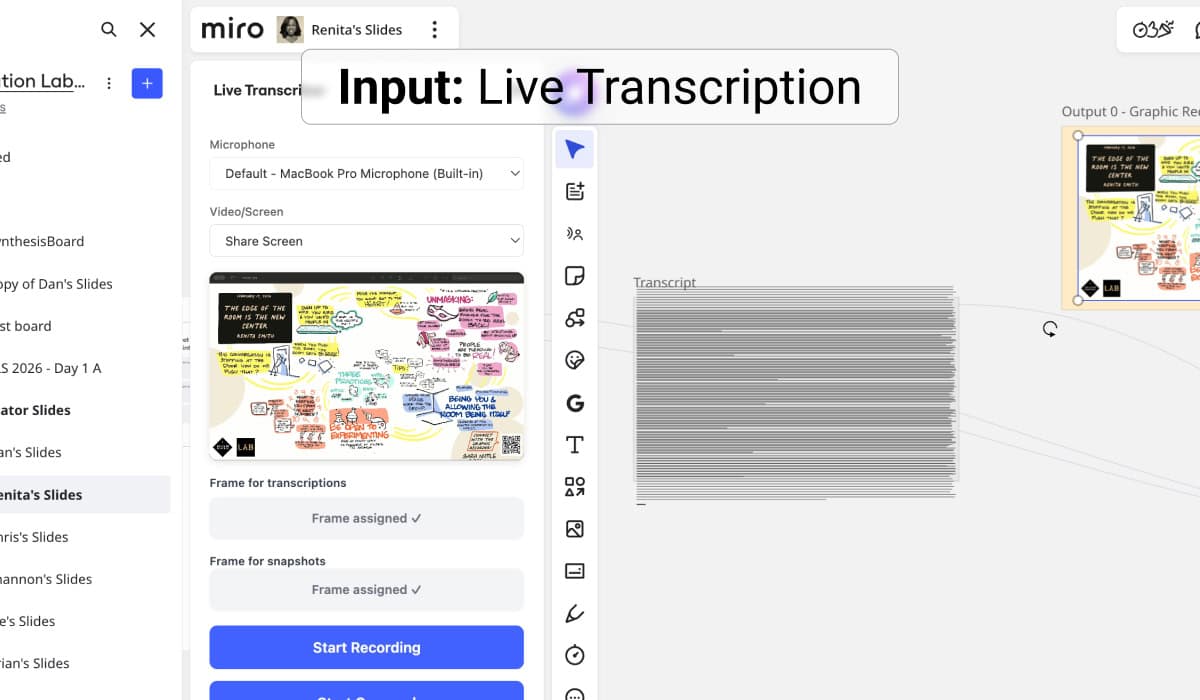
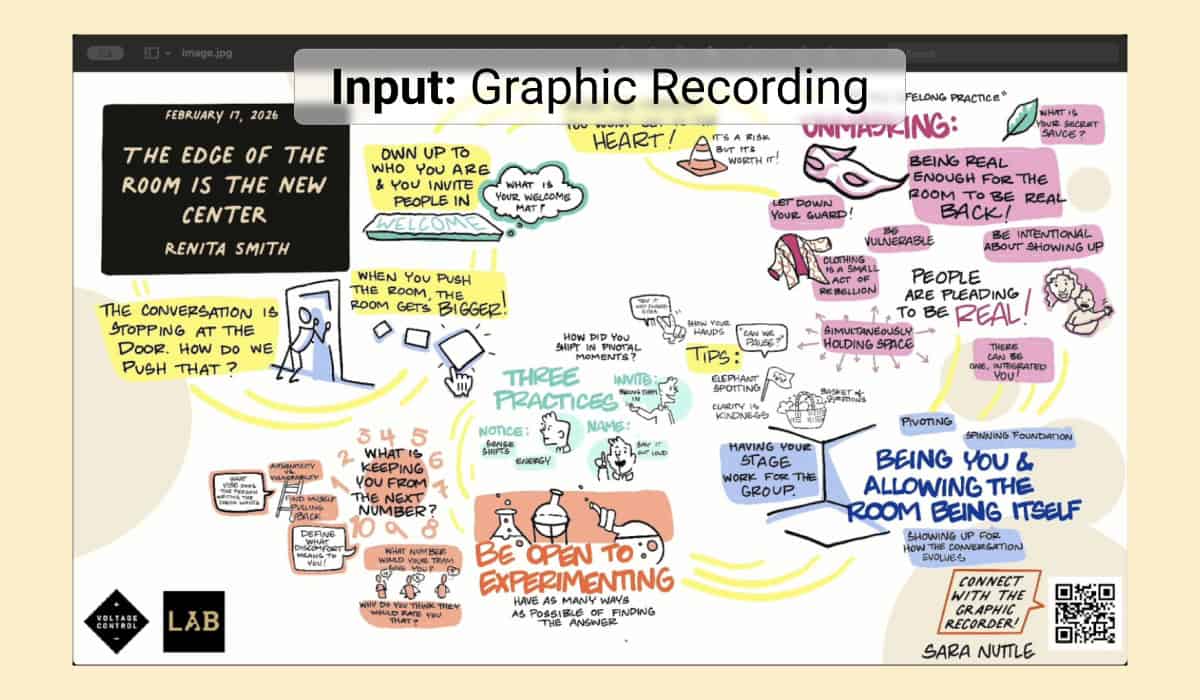
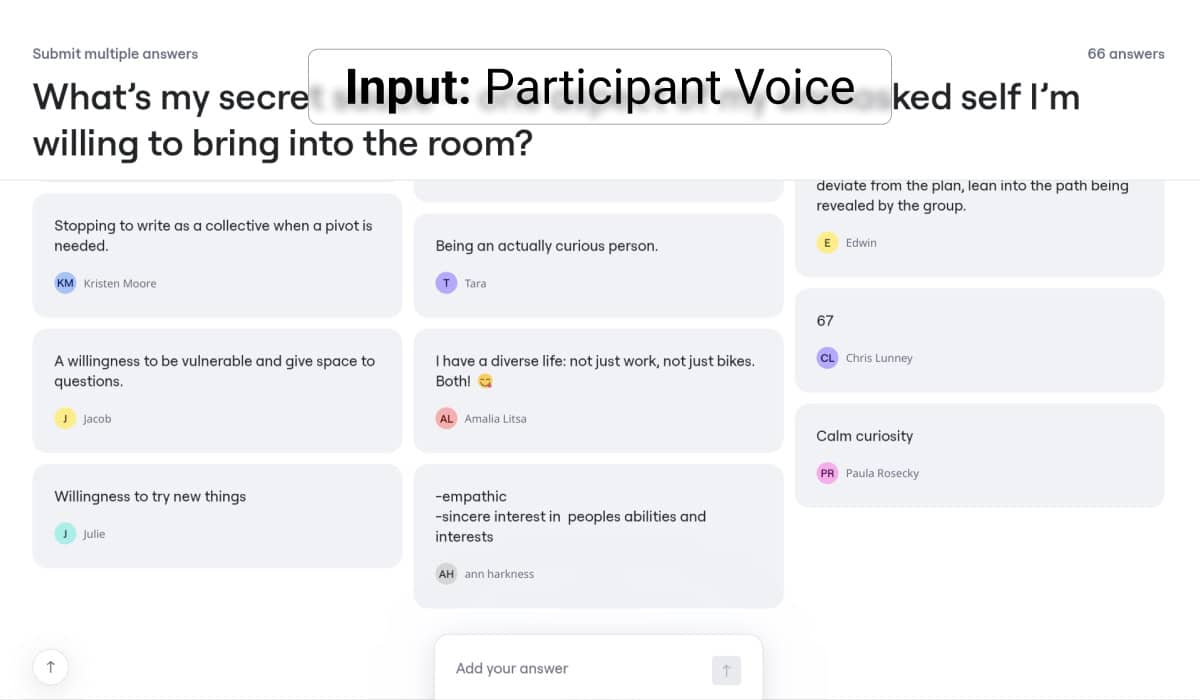
Every workshop generated four concurrent data streams, all flowing into a single Miro board:

By the time each session closed, the Miro board held the full record: slides, transcript, graphic recording, and participant voice. Four streams. One canvas. Ready for synthesis.

Step 2: A Custom Miro App to Connect Everything

The custom Miro app acted as the connective tissue of the entire system, capturing live transcriptions, importing graphic recording snapshots, triggering AI workflows, and running the Carousel that presented outputs between sessions.

After each AI workflow completed, the Carousel automatically navigated the Miro board in a choreographed sequence: zooming to the graphic recording, then scrolling through each output in turn. A QR code gave attendees the option to explore the board at their own pace on their own device. Sponsor recognition was woven into the flow.

The result was an ambient display of session intelligence running in the break space between workshops, ready for anyone who wanted to look, reflect, or spark a conversation.

Step 3: AI-Powered Insight Generation

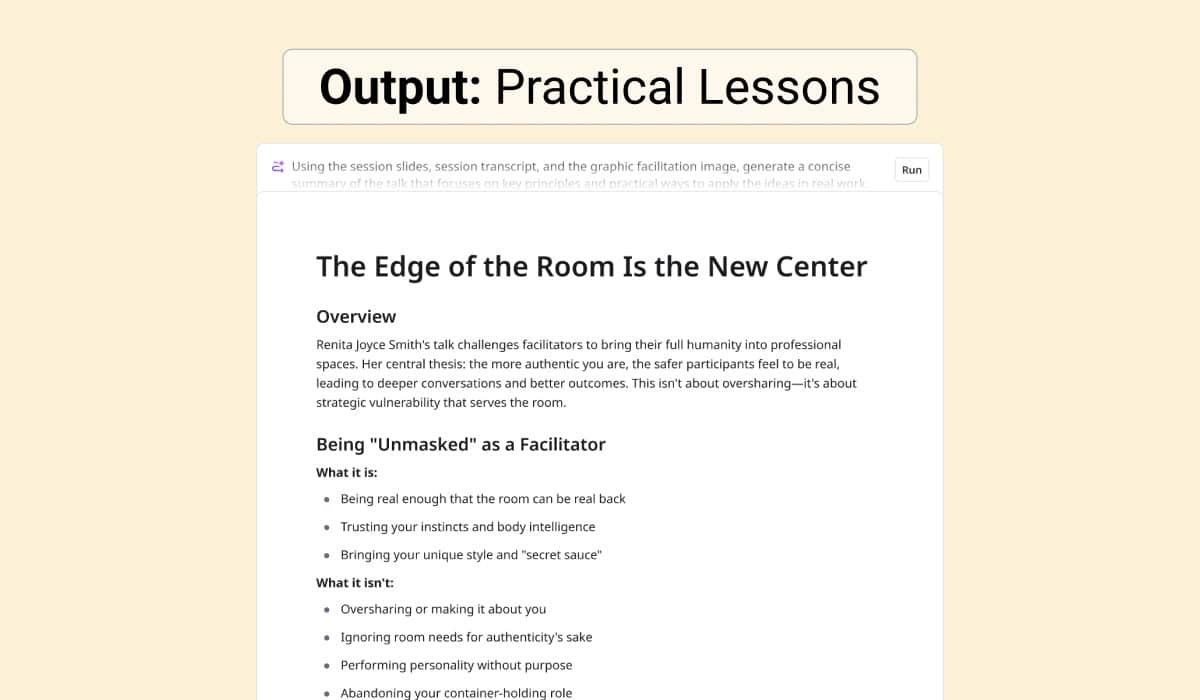
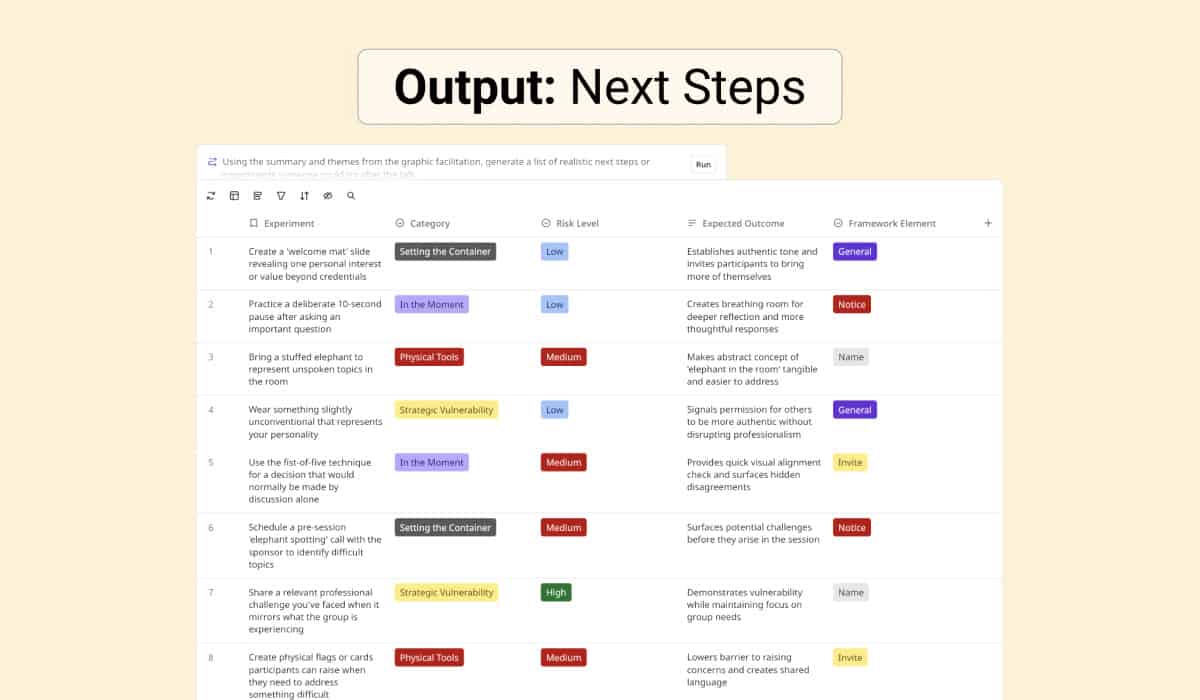
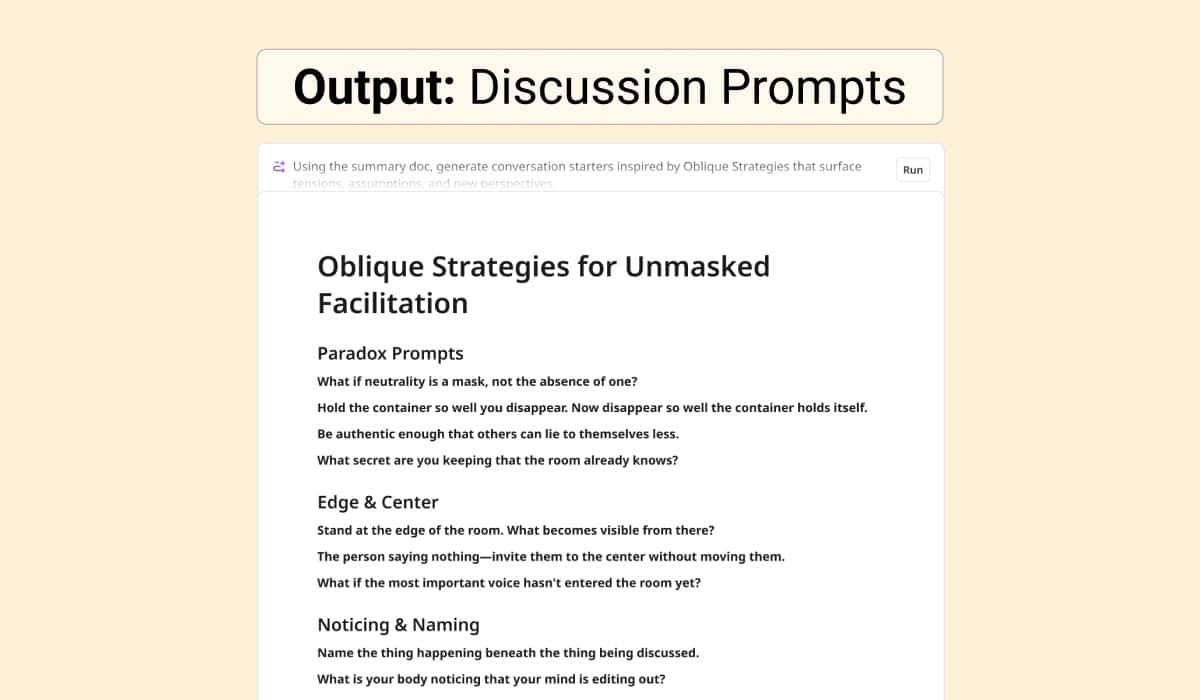
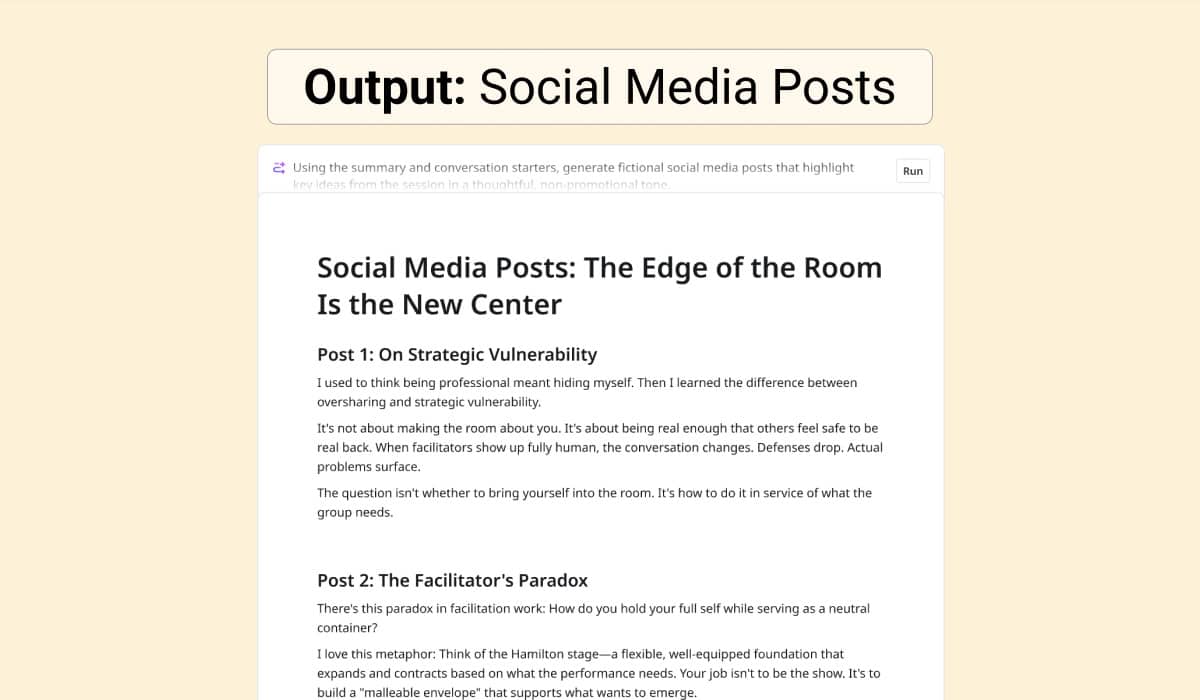
With all four streams assembled, a Miro AI workflow processed each session’s content into five distinct outputs:


Step 4: Insights Available Before the Next Session Began

Within the 30-minute break between sessions, the Carousel was running. Participants could read the workshop summary, scan the practice activation table, pick up a conversation prompt, and see the landing page concept, all before the next facilitator took the floor.

What previously took one to two months now took minutes.

What Happened: The Response Was Immediate

Reflection Happened Inside the Event

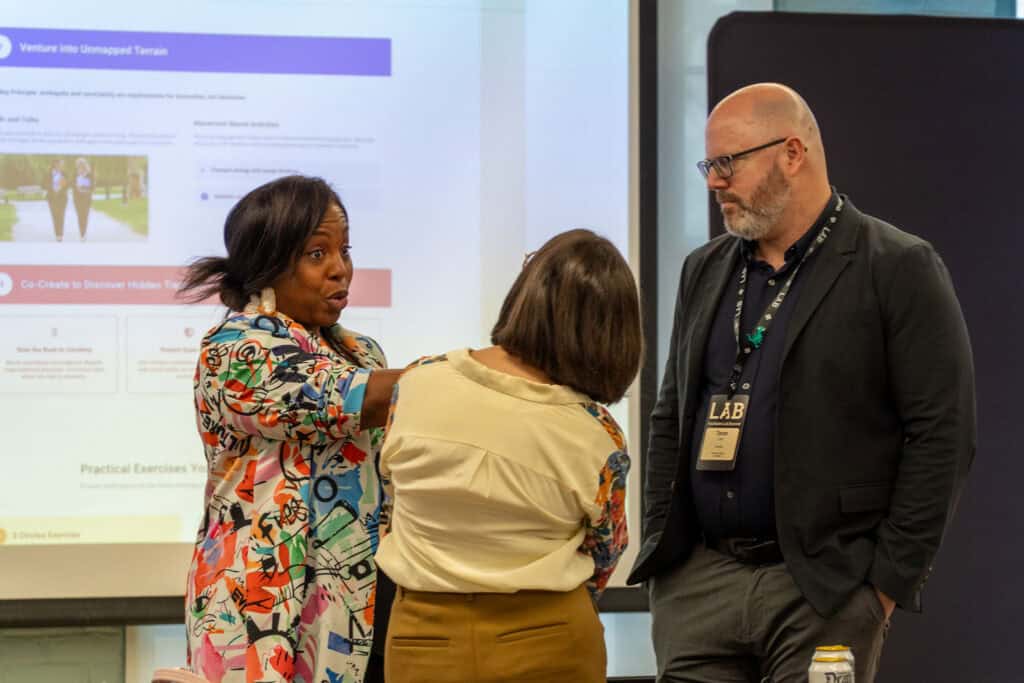
Participants didn’t have to wait for a post-event recap. Within minutes of each session closing, insights were visible, scannable, and in conversation. QR code scans spiked during breaks as attendees pulled up the Miro board to explore what had been synthesized about the session they’d just experienced.

Huddled conversations formed around the screens. Phones came out. People were drawn back into the content rather than drifting away from it.

Networking time became anchored in reflection. People weren’t just mingling; they were processing, comparing, and planning.

Participants Engaged More Deeply Between Sessions

The AI outputs became a catalyst for peer-to-peer dialogue. The Practice Activation Tables gave participants specific language for how to bring new skills back to their organizations. The Conversation Prompts gave those huddles direction. The energy between sessions felt different; less social small talk, more substantive exchange.

Facilitators Gained Unexpected Assets

Perhaps the most unanticipated outcome: facilitators themselves found the outputs immediately valuable. Several are now drawing on the AI-generated landing page prototypes as inspiration for updating their own websites and workshop marketing materials, an asset category that didn’t exist at any previous summit.

Curiosity Became Pipeline

For many attendees, including current and prospective Voltage Control clients, the Summit was their first direct experience of multiplayer AI in a real, high-stakes professional context. The effect was immediate. Attendees began envisioning direct applications in their own work: faster cross-functional synthesis, cleaner handoffs between teams, more efficient collaborative review.

Those conversations have since translated into active consulting engagements across two categories: AI-powered facilitation and workshop design, and enterprise AI adoption and transformation.


What This Means for the Profession

The 2026 Facilitation Lab Summit was designed around the idea of practicing at the edge, the edge of certainty, of control, of identity and leadership. This experiment lived at a different kind of edge: the structural edge of the profession itself.

Historically, facilitation artifacts have had a short lifespan. The conversation ends. The notes get filed. The graphic recording gets posted. The energy dissipates. What Voltage Control demonstrated is that this doesn’t have to be the default.

When visual capture, live transcription, participant voice, and AI synthesis are integrated into a single workflow, a single event can generate:

This is the difference between recording an event and designing a learning ecosystem. One preserves. The other builds.

We are no longer just facilitating conversations. We are designing systems of learning.

The infrastructure for that shift is already here. The 2026 Facilitation Lab Summit is proof.

Bring This to Your Organization

The system built for the 2026 Facilitation Lab Summit isn’t a one-time experiment. It’s a model — and it’s one Voltage Control is actively bringing to enterprise clients.

If your organization is navigating AI adoption, rethinking how teams collaborate, or looking to get more lasting value from workshops, offsites, and learning events, Voltage Control works with you on two levels:

The Summit showed what’s possible when a single event is designed as a learning system. We can help you design that system for your team.

About

Voltage Control is a change agency based in Austin, TX, specializing in organizational transformation, AI adoption, and facilitation. Voltage Control works with enterprises to redefine ways of working as AI reshapes roles, team structures, and the nature of collaboration itself.

Miro is the collaborative visual workspace platform powering the next generation of team collaboration, with AI capabilities designed for multiplayer use at enterprise scale.

Black Flag is a development partner that collaborated with Voltage Control on the custom Miro WebSDK application powering this integration.