Most training companies will tell you their programs are high-quality. We decided to prove it.
In March 2026, Voltage Control was granted the HLC Short-Term Credential Provider Endorsement by the Higher Learning Commission (HLC) — the same accrediting body that evaluates hundreds of colleges and universities across the United States.
I want to tell you what that actually means, why we pursued it, and why I think it matters — not just for Voltage Control, but for anyone making decisions about where to invest in professional development.
Let me start with the problem this solves
The professional training market is enormous and almost entirely unregulated in terms of quality. Anyone can call themselves a training provider. Anyone can issue a certificate. There’s no equivalent of a building inspector, no independent body showing up to check whether what’s being taught is actually rigorous, whether the organization running the program is operationally sound, or whether the credentials being issued mean anything at all.
For individual learners, this creates a real dilemma. You’re being asked to invest time, money, and professional credibility into programs you have to evaluate almost entirely on faith, based on testimonials, brand recognition, and the provider’s own claims about their quality.
For enterprise L&D buyers, it’s even harder. When you’re recommending a training investment to your organization, procurement wants to know: how do we know this is legitimate? What’s the third-party validation? What happens if this turns out to be vaporware?

For a long time, we’ve answered that question the same way most providers do: with client logos, testimonials, and the strength of our reputation. That’s not nothing. Our alumni include leaders from Google, IBM, Nike, Autodesk, SAP, Cisco, and hundreds of other organizations. But reputation is still self-reported. I wanted something better.
Reputation is self-reported. I wanted something better.
What the HLC endorsement actually is
The Higher Learning Commission has been accrediting colleges and universities since 1895. When you think about what makes an institution’s degree legitimate, why a hiring manager trusts a credential from one school and not another, HLC is a significant part of that answer for institutions across the United States.
A few years ago, HLC recognized that the world of learning was changing. Short-term credentials, professional certifications, bootcamps, and workforce training programs were growing fast, and learners had no reliable way to know which ones were worth pursuing. So they created the Credential Lab, an innovation hub specifically focused on evaluating and endorsing short-term credential providers.
The endorsement they offer isn’t a membership fee or a badge you buy. It’s an independent evaluation. HLC’s Credential Lab reviewed Voltage Control against rigorous criteria for quality, reliability, and operational soundness before granting the endorsement.
“We’ve always believed that facilitation and innovation skills deserve to be treated with the same rigor as any academic discipline. This endorsement from HLC is a powerful affirmation of that belief — and a meaningful signal to our learners, partners, and the broader workforce development community that what we offer is genuinely world-class.”
Douglas Ferguson, Founder, Voltage Control
It applies to us as a provider, meaning it’s a statement about the organization and how we operate, not just about one course. And it has to be renewed. We’re not a once-and-done. We maintain an ongoing relationship with HLC and will go through a renewal process before the current endorsement cycle concludes in March 2028.
Why we pursued it
Honestly? Because I think facilitation skills deserve to be treated with the same rigor as any academic discipline, and I wanted to put our money where our mouth is.
We talk a lot about the importance of quality; in how we design our programs, in the standards we hold our instructors to, in the feedback loops we build into every cohort. The HLC endorsement is a way of saying: we’re not just claiming this internally. We’re willing to have it verified externally.
There was also a practical dimension. As we’ve grown and especially as we’ve moved into enterprise training and AI transformation programs, we increasingly work with organizations that have real procurement requirements. Legal teams, L&D directors, and procurement committees want documentation. They want to know that the provider they’re recommending has been evaluated by someone other than themselves.
The HLC endorsement gives them that. It’s a recognized, independent signal that travels well in institutional contexts, such as higher education partnerships, enterprise procurement processes, and government contracts. It’s the answer to ‘how do we know this is legitimate?’ before the question even gets asked.
It’s the answer to ‘how do we know this is legitimate?’ before the question even gets asked.
What this means for our learners
If you’ve completed a Voltage Control certification or you’re considering one, here’s what I want you to know:
- The credential you earn is backed by an independent endorsement from one of the most respected accrediting bodies in U.S. higher education. It’s not a participation trophy.
- When a hiring manager, an institution, or a procurement team asks about your credential, there’s now a verifiable public record. HLC lists endorsed providers on their website. Anyone can check.
- For practitioners working in or with higher education institutions, this matters especially. Our credentials now speak a language those institutions recognize and respect.
I’m also aware that many of our alumni already hold impressive credentials from top institutions. The HLC endorsement isn’t trying to compete with your MBA or your PhD. It’s a signal that the facilitation and innovation skills you’ve built with us have been evaluated by the same world that issued those credentials.
“Our team has worked incredibly hard to build programs worthy of this kind of recognition. I’m proud of what we’ve built and excited about what this opens up for the people and organizations we serve.”
Erik Skogsberg, VP of Learning Experience, Voltage Control
What this means for organizations investing in their teams
Enterprise L&D is full of decisions made under uncertainty. You’re trying to build capability in your organization, and you’re betting on providers you can’t fully evaluate from the inside. The HLC endorsement is designed to reduce exactly that uncertainty.
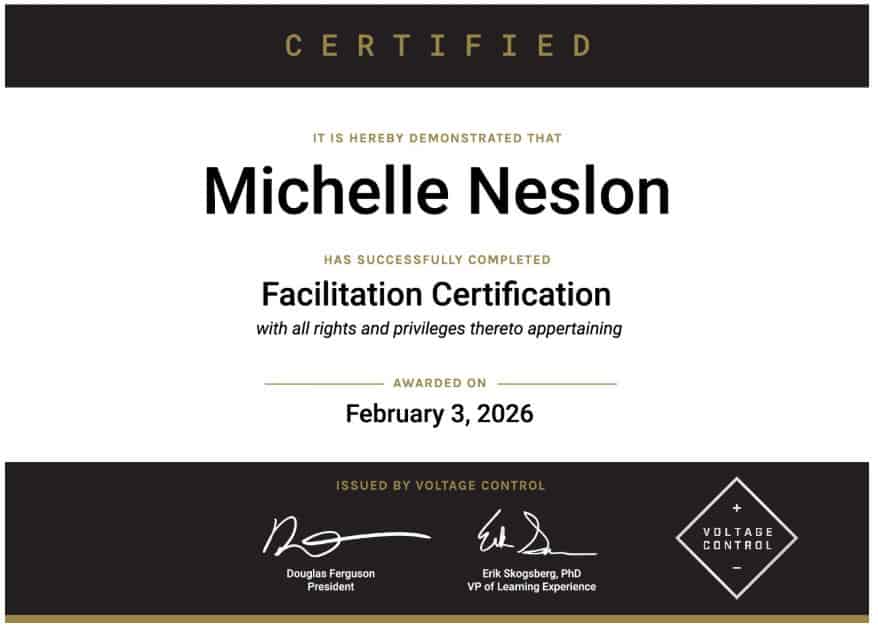
When you bring Voltage Control into your organization, whether for a private facilitation training, an AI transformation engagement, or a cohort through our certification program, you now have independent, third-party validation that you’re working with a provider that meets institutional-grade quality standards.
That’s meaningful for your procurement team. It’s meaningful for the leaders you’re recommending this investment to. And it’s meaningful for the employees who will carry these credentials forward.