How the profession is evolving from control to illumination in an era that demands it
Table of contents
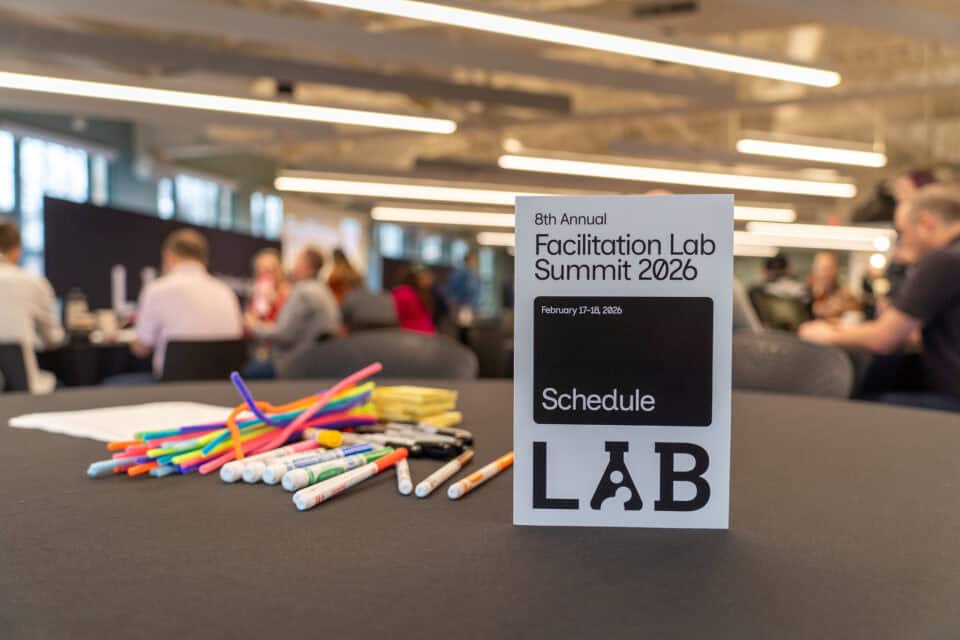
The most powerful spaces in facilitation exist at edges—those uncomfortable thresholds where certainty dissolves and something new becomes possible. At the 2026 Facilitation Lab Summit, eight facilitators explored what happens when we stop performing expertise and start practicing presence at these edges. Their collective wisdom reveals a profession in transformation, one urgently needed in a business world grappling with unprecedented complexity.
The Practice of Edges
These eight perspectives converge on a profound reorientation of facilitation practice—one that mirrors broader shifts in leadership and organizational thinking.
The traditional facilitator arrived as expert, controlled the process, directed attention, and evaluated contributions. Success meant achieving predetermined outcomes efficiently.
The edge-practicing facilitator arrives as presence, creates conditions for emergence, distributes attention, and illuminates participants’ latent wisdom. Success means unlocking collective intelligence and building capacity that persists beyond the session.
This shift requires practicing specific edges:
From certainty to curiosity: Acknowledging “I don’t know” becomes strategic rather than admitting weakness. Dan Walker showed how embracing collective wisdom means releasing the need to have answers yourself.
From expertise to authenticity: Bringing your whole self rather than just your professional persona. Renita Williams demonstrated how being “real enough” creates permission for deeper engagement.
From analysis to integration: Trusting multiple forms of intelligence—somatic, emotional, intuitive—alongside rational thinking. Chris Marquez’s “whole intelligence” framework provides pathways through true unknowns.
From structure to exploration: Designing for discovery rather than predetermined outcomes. Shannon Berg’s “expedition facilitation” allows breakthrough thinking to emerge.
From voice to listening: Finding your unique facilitation voice while staying exquisitely attuned to what the room needs. Joe Dager’s DJ metaphor shows how preparation and presence dance together.
From expert to illuminator: Seeing participants as “already worthy” and tending conditions for their brilliance to shine. Brian Formato’s fire framework shows how facilitators ignite rather than instruct.
From thinking to embodying: Engaging the full physical presence and recognizing how bodies regulate (or dysregulate) together. Robin Goodwin brought facilitation into flesh and nervous systems.
From control to safety: Understanding trauma lives in every room and creating multiple dimensions of safety so people can move from protection to connection. Trudy Duffy provided the neurobiological foundation for why edges feel risky—and how to make them safer to explore.
The Edge of Collective Intelligence
Dan Walker opened the conversation with a deceptively simple premise: “The smartest person in the room is the room.” Yet in practice, this belief requires facilitators to abandon the comfortable center of their own expertise and venture toward an edge where outcomes cannot be controlled.
Dan described this tension beautifully: edges exist “distant from the comfortable space at the heart of us.” They represent the challenging spaces we must move into, even when—especially when—”the world itself feels like it’s at an edge.”
His insight cuts to the core of modern organizational challenges. When business leaders face problems too complex for any single expert to solve, the facilitator’s role shifts fundamentally. The value isn’t in having answers but in unlocking the “collective brilliance that exists and is so heavily needed.”
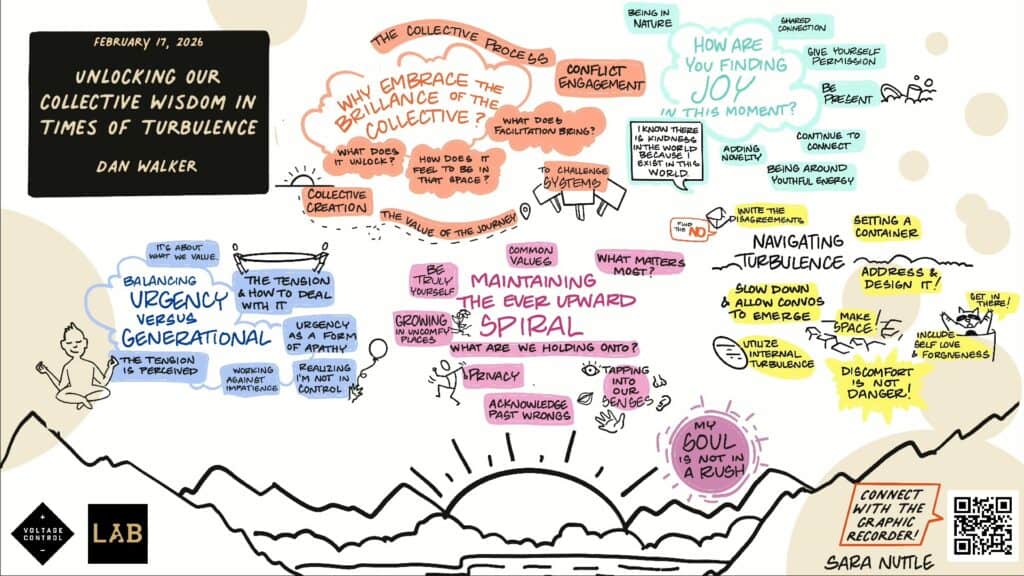
Dan introduced another critical edge: the tension between urgency and patience. Organizations demand speed—”we need this yesterday”—while meaningful change operates on generational timescales. “How do you balance that tension between urgency we need this now… with actually the quality work takes time?” he asked participants.
This isn’t an edge to resolve but to hold. The wisdom lies in recognizing when to honor both forces simultaneously.
The Edge of Authenticity
Renita Smith named what many facilitators feel but rarely articulate: the exhausting gap between who we are and who we think we should be professionally. “Outside of work walls we’re having these conversations,” she observed, “but when it comes into the corporate spaces we clam up.”
Her framework for being “unmasked” offers a provocative alternative: “Being real enough so the room can be real back.”
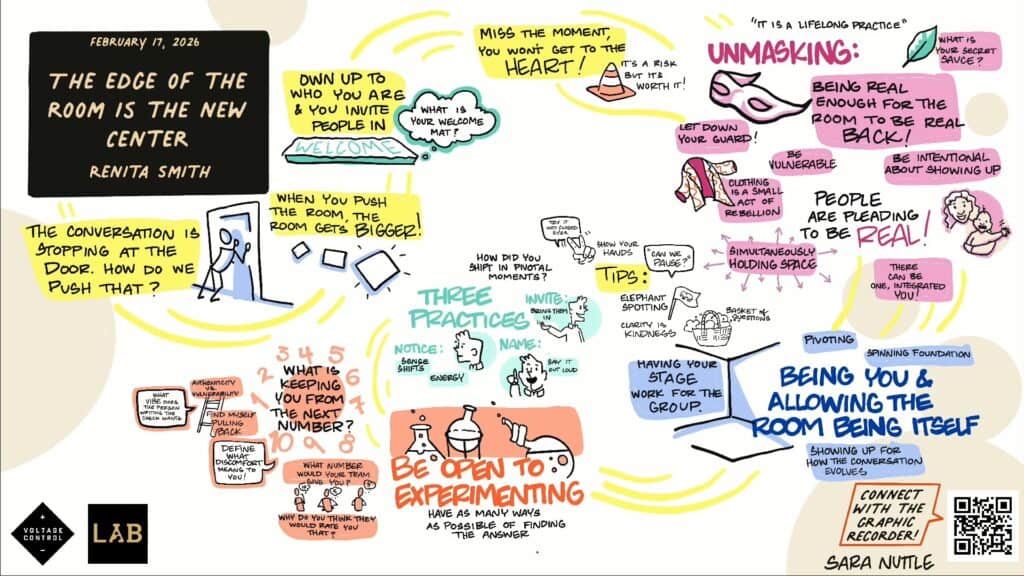
This isn’t about oversharing or abandoning professionalism. Renita distinguished between performing personality “for its own sake” versus bringing genuine presence that creates permission for others to do the same. When she started showing up fully—sharing her welcome slide listing “oldest daughter, naturally an introvert, ADHD/autistic, diverse group of friends, does improv, loves unicorns, queer as hell”—her facilitation transformed.
“The more that I pushed myself, the more the room opened up,” she reflected. “The more unhinged I was… the more conversation got deeper.”
For business leaders struggling with authentic leadership in polarized times, Renita demonstrates how vulnerability isn’t weakness but strategic invitation. When facilitators model wholeness, they create conditions for participants to bring their full cognitive and creative capacity to complex problems.
The Edge of the Unknown
Chris Lunney introduced the concept of “whole intelligence”—integrating analytical thinking with somatic awareness, emotional intuition, and subconscious insight. In practice, this means trusting more than your head when navigating uncertainty.
Through a guided visualization, Marquez led participants to access what their hearts longed for in an unknown situation, then translate that into “trackable experiments”—small actions aligned with head, heart, and hand.
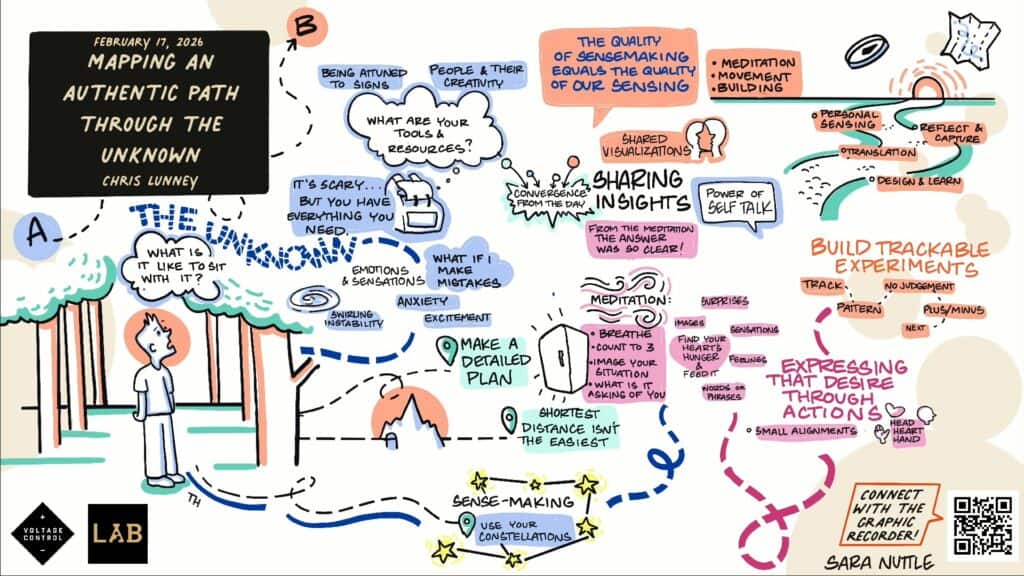
This approach addresses a fundamental business challenge: traditional analysis fails when facing true unknowns. “When we’re in the unknown and we only rely on analytical and relational thinking,” Marquez explained, “it’s like using a map without a compass.”
The facilitator’s role becomes helping groups access multiple forms of intelligence to chart paths through terrain that cannot be mapped in advance. This proves essential when innovation requires not just solving known problems but discovering which problems need solving.
The Edge of Innovation
Shannon Hart translated this into practical innovation facilitation, distinguishing between “tour guide” sessions—structured, predictable, with predetermined stops—and “expedition” facilitation that ventures into unmapped territory searching for “hidden unknown treasures.”
“True innovation is a concept that is non-linear, iterative, and relational,” Shannon emphasized. It requires “less like this [tour guide] and more Indiana Jones style expedition.”
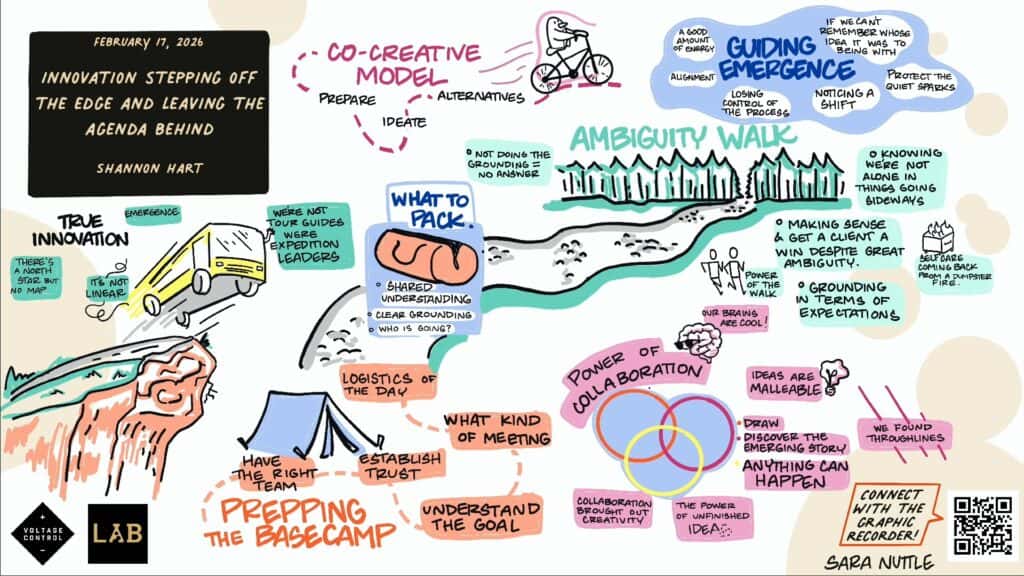
Her framework addresses why so many innovation sessions disappoint. Organizations want breakthrough thinking but design workshops that minimize uncertainty. Shannon advocates for deliberately holding the “diamond open longer”—resisting premature convergence that kills emergent possibilities.
“The rush to certainty” she warned, particularly when teams are depleted, causes groups to settle for safe solutions rather than transformative ones. The facilitator’s job is “protecting the quiet sparks”—the fragile new ideas easily drowned by louder voices or habitual thinking.
For businesses seeking competitive advantage through innovation, Berg’s message is clear: you cannot mandate breakthrough thinking in containers designed for control.
The Edge of Voice
Joe Randel explored how finding your facilitator voice requires balancing preparation with presence. Using the metaphor of a DJ, he demonstrated how “voice is pattern choice”—the unique decisions you make about how to guide group energy moment by moment.
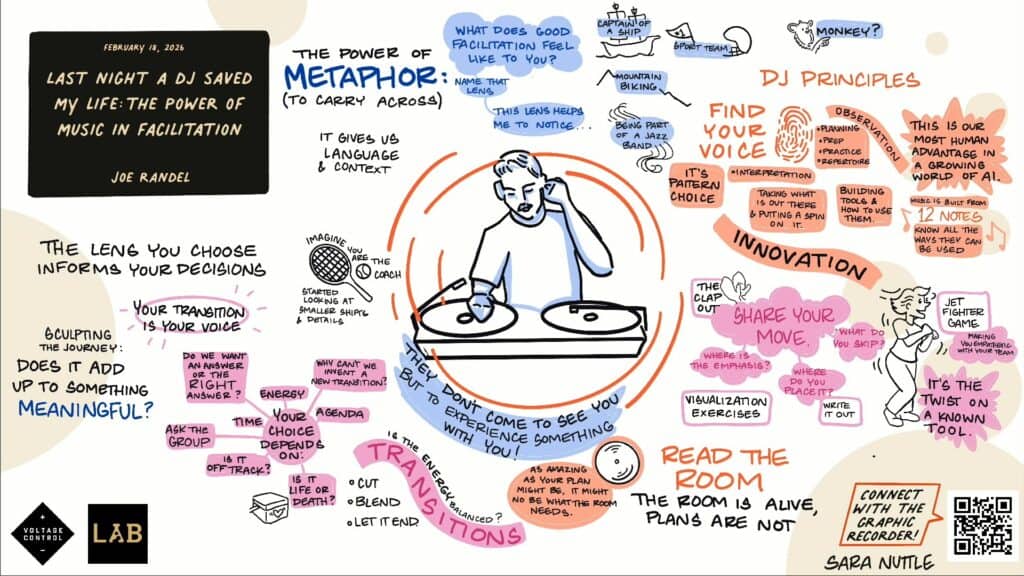
The DJ metaphor illuminated facilitation dynamics beautifully. DJs come with repertoire and plans but succeed through reading the room in real-time, choosing whether to cut, blend, or let a moment end based on what the space needs, not what the setlist demands.
“Your voice is your competitive advantage,” Dager argued, especially as AI tools can generate session agendas and activities. What remains irreplaceable is the human capacity to sense energy shifts and make judgment calls that serve the group’s emerging needs over the facilitator’s prepared plan.
This resonates powerfully in our current technological moment. As automation handles routine tasks, the competitive advantage lies in distinctly human capacities: reading subtle cues, holding complexity, making intuitive leaps, and building trust through authentic presence.
The Edge of Illumination
Brian Buck reframed the facilitator’s fundamental stance through fire as metaphor. Rather than being the flame everyone follows, skilled facilitators tend conditions that allow others to ignite.
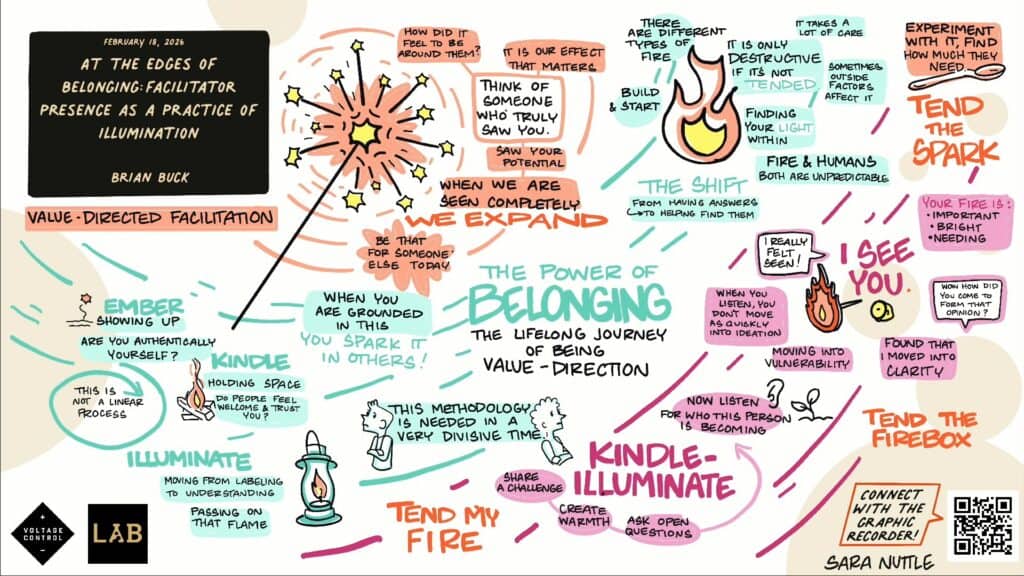
His framework moved through three stages: Ember (internal self-work and regulation), Kindle (creating the container), and Illuminate (igniting others’ potential). The crucial shift happens in moving from Kindle to Illuminate—from “I am the content driver” to “I ignite the fire of other people.”
Brian drew on David Brooks’ work on belonging: “The ultimate gift you can give another person is to see them deeply, to understand them, and to make them feel known.” When facilitators see people as “already worthy” with depth and mystery rather than problems to manage, belonging deepens and collective intelligence emerges.
“Illuminators don’t spotlight answers,” Brian explained. “They spotlight people who have the answers.”
For organizations concerned with engagement, retention, and high performance, this reframe is crucial. Belonging precedes performance. Psychological safety is felt, not declared. When people feel seen and valued, they bring energy and creativity that no amount of expert advice can generate.
The Edge of Embodiment
Robin Neidorf brought facilitation into the body, drawing on 30 years of yoga practice to demonstrate how physical presence shapes group dynamics. Through exercises exploring energy centers and group sizes, she made visible how “embodied sound and vibrations… regulate your nervous system and put you quite literally in harmony with” others.
Her insight challenges the cerebral approach dominating professional spaces: “If we don’t bring ourselves fully as bodies into the spaces we’re working in, participants won’t.”
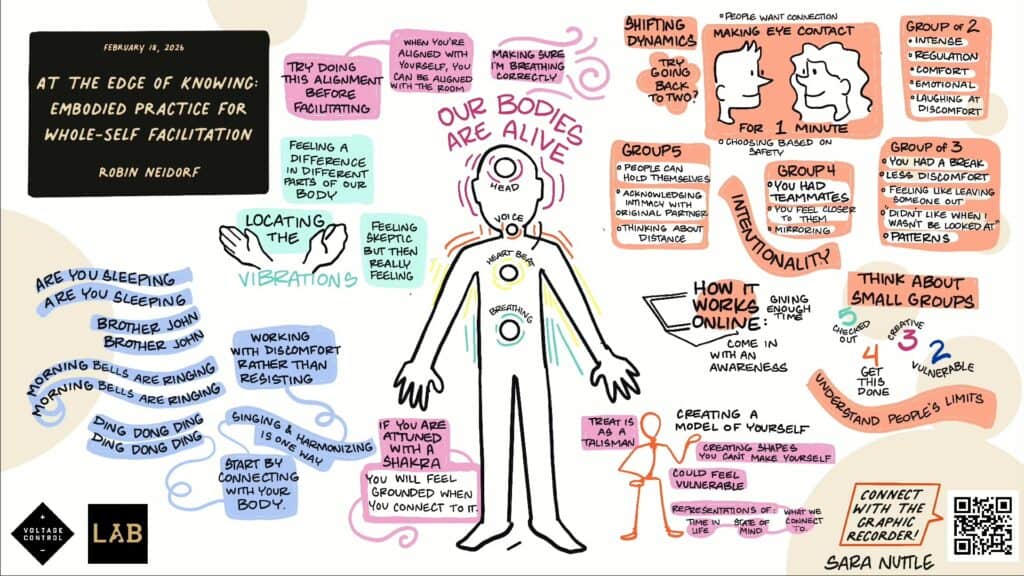
Robin demonstrated how different group configurations create distinct felt experiences. Pairs generate vulnerability and deep connection. Threes enable creative rhythm. Fours feel solid and task-oriented. Fives create space for people to pull back when needed. Understanding these dynamics allows facilitators to design activities that serve emotional as well as cognitive objectives.
In an era of Zoom fatigue and screen-mediated work, Robin’s emphasis on embodied practice offers a corrective. The body holds wisdom that thinking alone cannot access—wisdom increasingly essential as work grows more complex and demanding.
The Edge of Safety
Trudy Townsend closed the summit by naming what underlies all other edges: trauma exists in every room we enter. Drawing on the landmark ACEs (Adverse Childhood Experiences) study, she explained how trauma isn’t the event but “the experience of that event living in your body.”
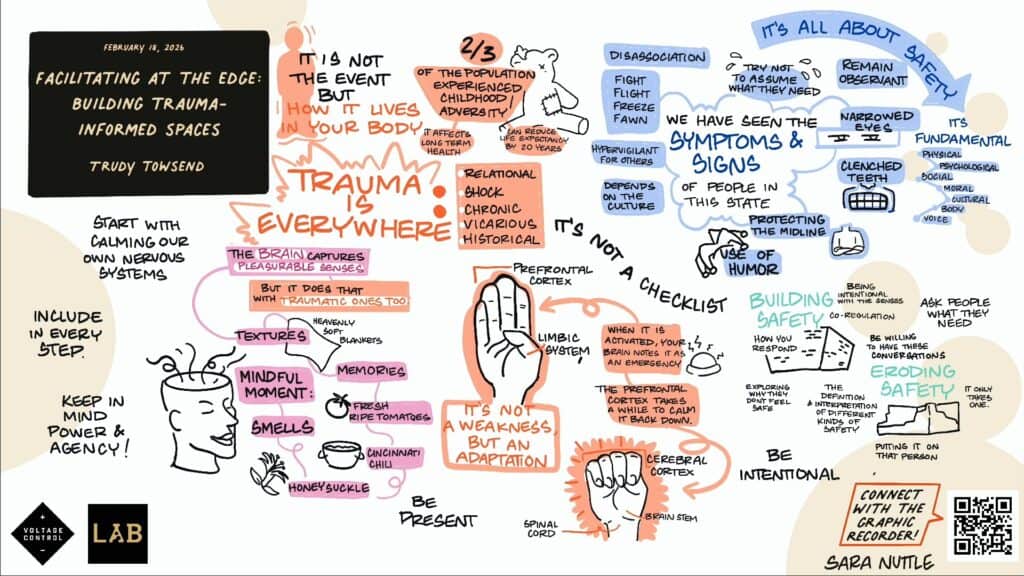
Understanding nervous system responses—the rapid “flipping of lids” when people feel threatened—reframes facilitation challenges. That quiet person isn’t disengaged; they may be in freeze response. The person making jokes isn’t being disruptive; humor may be their protection mechanism.
Trudy identified five dimensions of safety facilitators must consider: physical, psychological, social, moral, and cultural. “Safety is a fundamental antidote to trauma,” she emphasized. “When the nervous system calms down… we naturally shift out of protection mode. Our breath changes, our jaw loosens, muscles start to soften, our attention widens.”
This matters immensely for business. Innovation requires psychological safety—the felt sense that you can take interpersonal risks without negative consequences. But safety isn’t one thing. Different people need different conditions to feel safe enough to contribute fully. Trauma-informed facilitation means continuously noticing signs of activation and adjusting to support regulation.
Why This Matters Now
These insights arrive at a critical juncture. The business world faces challenges—climate crisis, technological disruption, social polarization, unprecedented complexity—that exceed the capacity of traditional hierarchical problem-solving. Organizations need their people’s full creativity, wisdom, and engagement. But accessing that requires fundamentally different approaches to bringing people together.
The COVID-19 pandemic revealed how quickly certainty evaporates. The rise of artificial intelligence challenges assumptions about expertise and knowledge work. Social fragmentation tests our ability to work across difference. These conditions demand facilitators who can work at edges—holding space for groups to discover what they don’t yet know they need to know.
The facilitation practices explored at this summit offer more than techniques. They model a leadership paradigm urgently needed: one based on presence rather than control, on illumination rather than instruction, on collective intelligence rather than heroic expertise.
When Dan Walker says “the smartest person in the room is the room,” he articulates what complexity science has shown: emergent solutions to complex problems cannot be designed by individuals, only discovered by collectives. When Renita Smith invites us to be “unmasked,” she addresses the authenticity crisis in leadership. When Chris Lunney teaches “whole intelligence,” he provides tools for navigating irreducible uncertainty. When Shannon Hart advocates “expedition facilitation,” she enables the innovation organizations desperately seek. When Joe Randel explores “voice through metaphor,” he helps us find authentic expression in professional contexts. When Brian Buck shifts us from expert to illuminator, he addresses engagement and belonging challenges. When Robin Neidorf brings embodiment forward, she reconnects us to wisdom beyond thinking. When Trudy Townsend teaches trauma-informed practice, she provides the safety necessary for all the rest to be possible.
The Invitation
These facilitators invite us to explore our own edges—the places where our facilitation practice feels uncomfortable, uncertain, vulnerable. Not because challenge is virtuous but because edges are where growth happens. For ourselves and the groups we serve.
The world needs facilitators willing to release the comfortable center of their expertise and venture toward edges. To trust the room’s intelligence more than their own answers. To bring authenticity that creates permission for others to do the same. To access multiple forms of wisdom. To design for discovery. To find voice while reading the room. To illuminate rather than instruct. To embody presence. To create safety for the difficult work of collective sense-making.
This isn’t naive idealism. It’s pragmatic response to genuine need. Organizations filled with brilliant people achieving mediocre results don’t need better experts. They need facilitators who can unlock the brilliance already present—by practicing presence at edges where control dissolves and collective intelligence can emerge.
As Brian Buck observed, reflecting on his journey from expert to illuminator: “What I’m excited about is… the one I’ve gone to illuminate and I’m like what just happened… suddenly the fire makes the whole darkness around you lights up that you didn’t see before.”
That’s the work. That’s the edge. That’s the practice these facilitators invite us into—tending the conditions that allow groups to illuminate themselves, discovering together what none of us could create alone.
The edge between what we know and what wants to emerge is where facilitation becomes truly transformational. And in a world at its own edges, that transformation has never been more necessary.