Starting the year strong by crossing thresholds with intention
Table of contents
New years are crisp thresholds. The calendar flips, and whether we like it or not, our attention snaps to what was and what could be. Thresholds can be disorienting—or incredibly clarifying—depending on how we approach them. At Voltage Control, we’re leaning all the way in. Our Summit in February is dedicated to Edges: the personal edges each of us are facing, and the edges our organizations are standing on. January is our invitation to notice those edges, name them, and practice stepping across them with care.
This month’s newsletter blends reflection and action. You’ll find ways to read the signals that you (and your teams) are near an edge, simple structures to design consent-based stretches, and practical tools to turn momentum into durable habits. We’re also featuring one of our favorite liberating structures as the Activity of the Month—What, So What, Now What—to help you reflect on last year and align on meaningful next steps for the year ahead.

Whether you’re a full-time facilitator, a leader who facilitates, or a graduate of our certification programs guiding transformation inside your company, this is for you. Edges sharpen our ability to change. Let’s cross the new year’s threshold with clarity, consent, and momentum.
Seeing edges clearly
Edges show up long before we name them. Sometimes the first signals are somatic: a quickened pulse before a decision, shallow breath as a meeting gets thorny, a jaw that tightens when roles are fuzzy. Other times it’s the stories we tell ourselves—reasons to delay, a pattern of avoidance, or a sudden insistence on perfect plans. As facilitators and leaders, we can train our attention on these cues, and normalize talking about them. “I’m noticing I’m rushed here” or “I’m feeling some uncertainty about scope” names the edge so fear has somewhere to sit and listen instead of driving the bus.
Edges are also social. Every group carries collective signals of stretch: silence after a challenging prompt, debate that circles without criteria, or a burst of energy that fizzles once action is mentioned. Reading those signals lets you calibrate your next move. You can offer choice and pacing—two safety rails for brave work. Rather than pushing, invite: “Would you like to explore this now, or do we need one more beat to gather context?” Consent-based stretches preserve dignity while still moving the room.
Finally, remember that edges exist at multiple levels simultaneously: the community’s edge, the organization’s edge, the team’s edge, and each individual’s edge. When you acknowledge those layers out loud, people feel seen and supported. You also resist the trap of treating a system-level edge like an individual performance issue—or vice versa. The new year is a perfect moment to check in across all levels and name the edges that matter most.
Step across with openers, agreements, and prototypes
If edges are thresholds, openers are the doorway. Thoughtful openers help people step into an intentional state—individually and together. This month, try an opener that surfaces the threshold explicitly. For example: “What edge are you bringing into this meeting—something you’re ready to try, a risk you’re weighing, or an assumption you’re open to revisiting?” Follow with a quick energy and risk appetite check. A simple “Low/Medium/High” on both gives you a read on where to set the tempo.
Working agreements are your threshold guardrails. Invite the group to author or revisit three agreements for Q1: one about how we decide, one about how we learn, and one about how we care for each other. Keep them short, testable, and visible. The moment you write an agreement, you also create the opportunity to tune it. Ask, “What would make this easy to live with daily?” and “How will we know it’s working?” Agreements make bold moves legible and fair.
This is also the season to trade resolutions for prototypes. Instead of a sweeping commitment like “We’ll transform our meeting culture,” run a tiny, time-boxed experiment: “For four weeks, we will end every meeting with a two-minute Now What and record actions in our project board.” Name a single owner, define “good enough,” start small, and harvest loud. Small commitments beat sprawling plans, and earned buy-in beats selling. When the prototype delivers value, scale it with evidence—not hype.
Reversible bets, identity choices, and mission clarity
Not all edges are created equal. Some are reversible—if you step and don’t like what you see, you can step back. Others are identity-shaping—decisions that, once made, define who you are as a team or company. Your decision approach should match the type of edge. Use consent for reversible bets: “Is anyone opposed to trying this for two sprints?” Use consensus for identity choices: “Do we agree this is who we are and how we’ll be known?” Getting that distinction right prevents decision whiplash and builds trust.
If your organization feels like it’s at a fuzzy edge of mission, resist the urge to wordsmith your way out. Pilot short, sharp experiments that test the mission in the real world. “We believe our impact increases when we teach leaders to facilitate. For the next six weeks, we’ll run two micro-cohorts and measure demand, retention, and downstream behavior change.” Harvest the evidence, make sense of it together, and sharpen your language only after the data speaks. Experiments plus evidence clarify mission faster than debates.

Make roles and records explicit. When you approach a company edge, name who’s the driver (responsible for forward motion), who’s the decider (accountable for the choice), and who are the advisors (offering input). Publish the artifact that records the pathway—assumptions, criteria, options considered, and the decision. This makes the move legible later, reduces rumor and re-litigation, and helps new teammates learn how and why the choice was made. Visibility is oxygen for culture.
Diverge, converge, and guard your cadence
Edges invite urgency—and urgency, when unexamined, invites haste. Haste blurs the edge in unhelpful ways. The antidote is cadence. Slow the early moments just enough to see the whole chessboard, then move with speed on aligned actions. Use the simple sequence we teach leaders and facilitators: criteria first, options second, decision last. When groups decide without criteria, they argue preferences; with criteria, they reason together.
Diverge and converge with intent. Start by diverging on perspectives: Collect “What” without judgment—facts, observations, what happened. Then “So What” to make meaning—patterns, implications, consequences. Finally “Now What” to choose actions. This arc prevents premature action and gives you a shared map of reality. When an edge feels particularly charged, widen the aperture with 1-2-4-All before converging. If energy is low, keep it simple: a quick note-and-vote inside the Now What can move you to commitment.
Asynchronous check-ins warm cold feet. Before a big threshold meeting, ask two or three edge questions and gather input async. For example: “What edge do you think our team is approaching this quarter?” and “What would make a stretch here feel like a choice, not a push?” You’ll surface concerns that are hard to voice live, reduce surprises, and enter the room with context. As a bonus, async contributions create a durable record you can harvest later.
Activity of the Month What, So What, Now What
What, So What, Now What is our January go-to because it meets the moment. It’s a lightweight retrospective that helps people see the whole board before moving the next piece. Perfect for closing a project, making sense of last year, or aligning a cross-functional group at the start of Q1. Its power lies in sequence: observe, make meaning, then act. That sequence is a threshold in itself—one you can cross together in 20 minutes or deepen over an hour.
Here’s a fast way to run it in a 30-minute meeting:
– What (7 minutes): Prompt participants to capture observations from last year or the last sprint. “What happened? What did we try? What did we learn? What surprised us?” Use silent writing for 2 minutes, then 1-2-4-All for 5 minutes to widen the lens and cluster the key facts.
– So What (10 minutes): Shift to sense-making. “What patterns do we see? What matters most? What were the consequences—intended and unintended?” Invite pairs to pull out two implications that feel consequential, and then dot-vote as a group to prioritize the top three.
– Now What (10 minutes): Convert insights into commitments. “Given what we learned, what will we do next? What will we stop, start, continue?” Capture decisions as action statements with a single owner, a target date, and a signal of success. Record them in your project tool before you close.
Layer other liberating structures as needed. For hybrid teams, keep time visible and instructions simple. Use 1-2-4-All inside each step, or add note-and-vote to converge on the most meaningful patterns during So What. If you’re reflecting on the entire year, extend the What by five minutes and prompt “highs, lows, surprises.” If your group tends to leap to action, put a timer on So What and require at least three distinct implications before you move to Now What. If you’re a visual learner, watch the Activity Video What So What Now What on our site for a quick walkthrough.
Finally, make your Now Whats durable. Decide in advance where actions will live—your project management board, a shared doc, or a team dashboard. Keep the process light, but make it visible. Protect accountability with a cadence, not a burden. A five-minute review at the start of your weekly sync will keep commitments alive and build momentum without bureaucracy. Small commitments beat sprawling plans—especially in January.
Getting ready for the Summit Edges
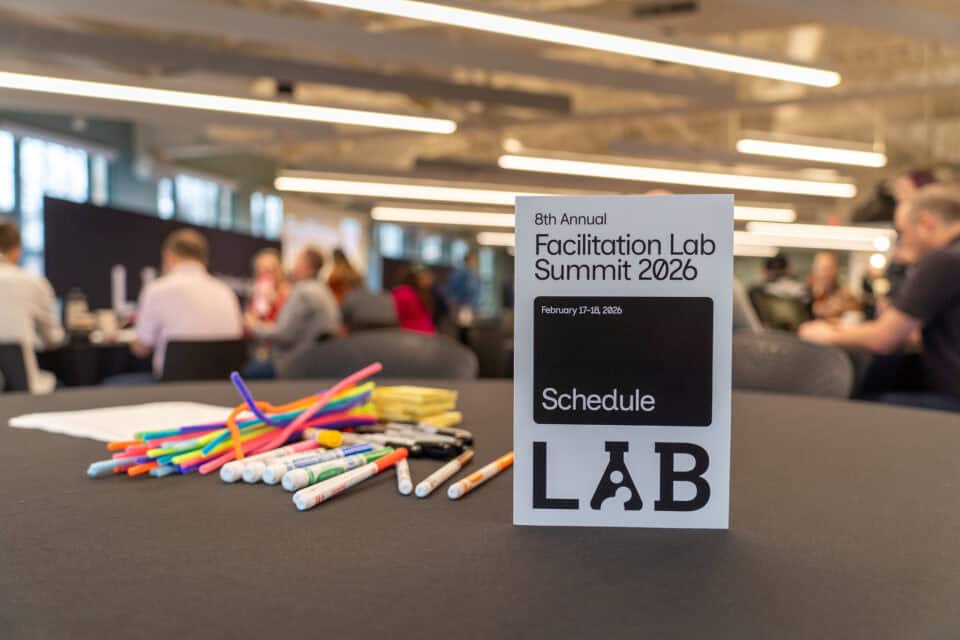
In February, our community will gather for the Summit to explore Edges from many angles: how they show up in facilitation, how to work with them as leaders, and how to design experiences that help groups cross thresholds with consent and clarity. We’ll close with a collective practice to identify the edges each attendee is ready to step into next. Consider this your pre-work: What edge are you already aware of? What edge might be hiding in plain sight?
Invite your team into that pre-work with lightweight prompts. Share a short async check-in with three questions: 1) What edge do you see for yourself this quarter? 2) What edge do you see for our team or company? 3) What would make a stretch here feel like a choice, not a push? Ask for a one-sentence answer to each, plus an optional “signal” they’d want to notice if progress is real. Then harvest themes and bring them into your next team opener. You’ll arrive at the Summit (or your own internal summit) warmed up and aligned.
Remember that different edges call for different invitations. For a team-level edge (e.g., “We need to improve cross-functional handoffs”), use consent for a reversible prototype: “For two sprints, we’ll test a one-page handoff brief with a 24-hour feedback window.” For a company-level identity edge (e.g., “We exist to develop facilitative leaders”), design a consensus process: gather input, draft statements, test them against evidence, and decide together. Both paths benefit from tiny pilots, loud harvests, and visible artifacts. Edges clarify mission when experiments meet evidence.
Renew your rituals and harvest your momentum
January is a powerful time to renew rituals that encode culture. Revisit openers and closers, not as formalities but as threshold technologies. Choose one opener you’ll use for the next month that helps people step into the edge at hand. For example: “Name one assumption you’re willing to examine today” or “Share a signal you’ll watch this week that tells you we’re learning.” Keep it short, repeat it consistently, and tune it for group size without losing intention.

Design closers that harvest what matters. A two-minute checkout can surface confidence, concerns, and commitments. Try: “One insight I’m taking, one concern I’m naming, and one next step I’m owning.” Capture those now whats where they’ll live—your task board or a simple shared doc. Add a light measurement and a return date: “We’ll check back on this in two weeks.” If it isn’t harvested, it withers; if it’s recorded and revisited, it compounds.
Make the invisible visible. Post working agreements where they’re easy to find. Add your opener and closer to the meeting agenda template. Keep a humble log of experiments, owners, dates, and outcomes. The more visible the path, the safer the edge feels. You’ll create a marked trail the team can follow, adjust, and teach to newcomers. And with a steady cadence, you’ll transform January energy into durable practice—not just a burst of enthusiasm that melts like fresh snow in the sun.
As you cross the new year’s threshold, here are three simple moves to start strong this week:
-Run a 20-minute What, So What, Now What with your team to reflect on last year or your first sprint. Record three Now Whats with owners and dates.
– Pick one opener and one closer you’ll use for the next month. Keep them short, make them visible, and tune them lightly based on group size.
– Choose one tiny prototype to replace a big resolution. Time-box it for two to four weeks, name an owner, define “good enough,” and harvest loud when you review.
We’d love to explore your edges with you. Join us at the Summit in February to dive deep into personal and organizational edges, practice consent-based stretches, and leave with prototypes you can run the next day. Bring your team or come solo—you’ll find community either way. If you can’t attend live, reply, and we’ll share highlights and tools you can use. This is the moment to step forward with intention. Let’s cross the threshold together.