A practical guide to running the room when your AI rollout spans departments
Table of contents
- A practical guide to running the room when your AI rollout spans departments
- Why alignment breaks down without a workshop
- Who needs to be in the room, and why fewer is better
- Structuring the agenda around a real decision
- Design thinking activities that surface disagreement instead of hiding it
- Common pitfalls that derail these workshops
- Practical steps for planning your first workshop
- Closing the workshop so commitments stick
- Bringing it together
A practical guide to running the room when your AI rollout spans departments
A cross-functional AI alignment workshop is a structured working session that brings people from engineering, product, operations, and leadership into one room to agree on how AI will actually change their shared work, not just their individual functions. It exists because AI adoption decisions rarely stay inside a single department’s lane, and the gap between functions is one of the most common reasons AI initiatives stall after the pilot phase. Done well, it produces a shared definition of the problem, a short list of agreed next steps, and a named owner for each one.

Why alignment breaks down without a workshop
Most companies don’t skip alignment on purpose. They skip it because everyone assumes someone else already has it handled. Engineering assumes product has picked the use case. Product assumes leadership has set the guardrails. Leadership assumes engineering has scoped the risk. Nobody is wrong exactly, but nobody has said any of this out loud in the same room, and that’s where a workshop earns its place. Three conditions have to be true for a cross-functional AI alignment workshop to actually work:
- The right people are in the room, not just the most available ones.
- There is a real decision on the table, not a status update dressed up as a workshop.
- Someone is facilitating the conversation, not presenting a plan for approval.
Skip any one of these and you get a meeting that produces a slide deck instead of a decision. Voltage Control’s own AI transformation program starts almost every engagement with exactly this kind of session, because clients consistently tell us the technology was never the hard part. The hard part was getting four functions to agree on what problem they were actually solving together.
Who needs to be in the room, and why fewer is better
The instinct is to invite everyone with a stake in the outcome. Resist it. A workshop with fourteen people produces polite consensus, not real alignment. Aim for six to nine participants who each hold a distinct piece of the decision:
- A senior engineering voice who can speak to technical feasibility and existing infrastructure constraints.
- A product owner who understands the customer or internal user the AI initiative is meant to serve.
- An operations or process lead who knows what will actually break downstream if a workflow changes.
- A budget holder who can commit resources in the room, not just relay a recommendation upward.
- One or two frontline practitioners whose day-to-day work is the thing being redesigned.
That last category gets skipped constantly, and it is the single most common reason workshops produce recommendations nobody adopts. If the people doing the work were not in the room, the room’s conclusions are a guess. In Voltage Control’s facilitation certification program, candidates routinely report that the workshops they ran before certification skewed heavily toward managers and directors, with almost no frontline representation, and that this single change, adding two or three practitioners to the invite list, did more to improve outcomes than any agenda redesign.
Structuring the agenda around a real decision
A cross-functional AI alignment workshop should never open with “let’s discuss AI.” That framing is too broad to align anyone on anything. It should open with a specific, answerable question: which workflow are we changing, for whom, and what does success look like in ninety days. Everything else in the agenda serves that question. A half-day block, roughly four hours including a break, is usually enough for a first session. Shorter than that and the group rushes the workflow-mapping step. Longer than that and attention degrades past the point of useful decision-making. A workable structure for a half-day session looks like this:
Step 1: Frame the problem in one sentence. Before any tools or vendors get mentioned, the group writes down, together, the specific friction they are trying to remove. If the group cannot agree on one sentence in the first twenty minutes, that disagreement is the most valuable output of the day. Surface it, don’t paper over it.
Step 2: Map the current workflow. Walk the actual steps a task takes today, who touches it, and where the delay or error lives. This is where the frontline practitioners in the room matter most. Leadership’s mental model of a process and the actual process are almost never the same thing.
Step 3: Identify where AI changes the workflow, not just the tooling. This is the step teams most often shortcut, jumping straight to “which model” or “which vendor” before establishing what changes for the humans doing the work. Slow down here.
Step 4: Surface risk and ownership together. Who owns the outcome if the AI-assisted process makes a mistake. Who monitors it. This question belongs in the room, not in a follow-up email three weeks later.
Step 5: Commit to three to five concrete next steps, each with a named owner and a date. Not “we’ll look into it.” A person’s name and a week.
Design thinking activities that surface disagreement instead of hiding it
Standard status-update meetings reward polite agreement. A well-run workshop needs the opposite: it needs disagreement to surface early, while it’s still cheap to resolve. This is where design thinking workshop activities earn their keep, because they were built for exactly this problem in adjacent contexts. A few design thinking workshop exercises translate directly to AI alignment work:
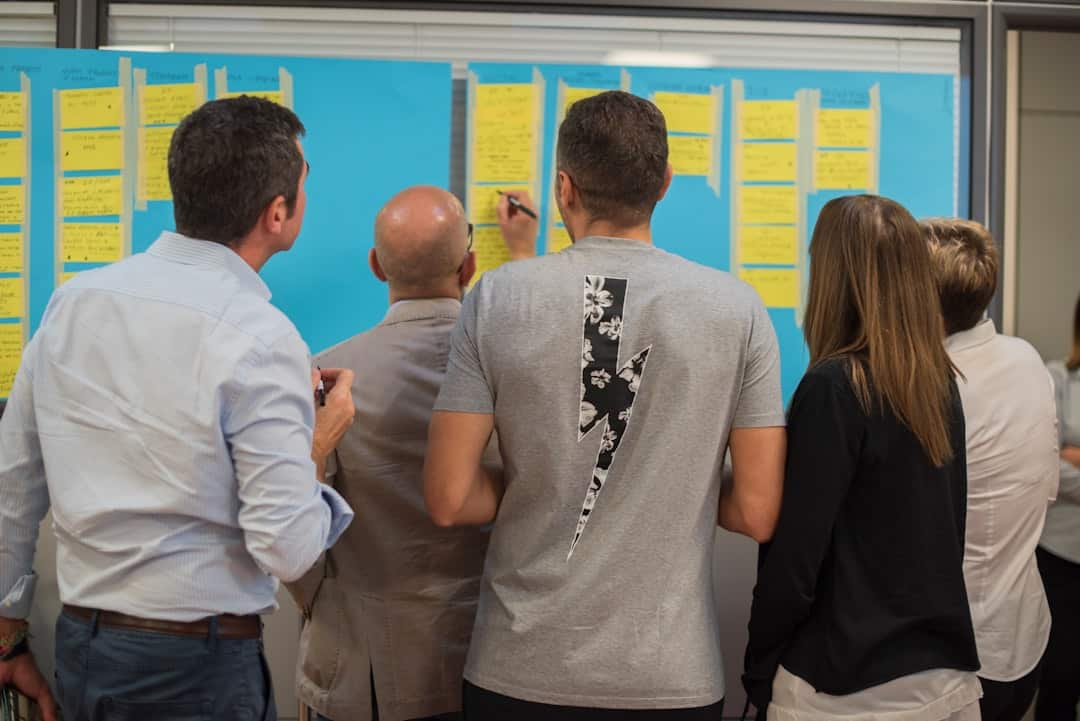
- Dot voting on friction points, so the group prioritizes by visible consensus rather than by whoever spoke last or loudest.
- “How might we” reframing, which turns a vague complaint like “the process is slow” into an actionable design question the group can actually work against.
- Silent brainwriting before group discussion, so junior voices and quieter functions get their ideas on the table before the most senior person in the room anchors the conversation.
If your organization already runs design sprints for product work, you likely already have facilitators who know these exercises. Borrow them. The muscle for good facilitation transfers across topics; it doesn’t need to be reinvented for AI specifically. For a deeper library of specific exercises by workshop phase, this breakdown of design thinking exercises is a solid starting reference.
Common pitfalls that derail these workshops
The workshop has no decision-maker in the room. If the person who can actually authorize budget or headcount isn’t present, the workshop produces a recommendation that dies in someone’s inbox. Get the decision-maker there, even for just the first and last thirty minutes.
The agenda starts with tool selection. Teams that open by comparing AI vendors almost always end the day having skipped the harder question of what problem they’re solving and for whom. Fix the workflow question first.
Facilitation and presentation get confused. A workshop where one person walks through slides for two hours and takes questions at the end is not a workshop. It’s a briefing. The facilitator’s job is to ask questions and manage the room, not to present conclusions.
Nobody owns the follow-through. Workshops generate energy that dissipates within a week if nobody is accountable for the next steps. Assign an owner for follow-up before anyone leaves the room, and put a check-in date on the calendar before the session ends.
The group treats alignment as a single event. A cross-functional AI alignment workshop is a checkpoint, not a finish line. Complex AI initiatives, especially ones tied to broader AI-driven change management efforts, need this kind of alignment repeated at each major milestone, not just once at the start.
The room defaults to the most senior opinion. Without a facilitator actively managing airtime, the conversation tends to converge on whatever the most senior person in the room said first, regardless of whether the frontline data supports it. Structured turn-taking and silent brainwriting exist specifically to counter this pattern, and skipping them tends to produce alignment that is really just deference.
Practical steps for planning your first workshop
If you’re a facilitator or transformation lead planning your first cross-functional AI alignment workshop, a few practical moves make the difference between a productive day and a wasted one. Product leaders managing an AI product management roadmap across multiple teams tend to find these moves matter even more, since a single misaligned assumption early in the roadmap compounds across every downstream release:
- Send a short pre-read, not a long deck. One page describing the problem statement and who’s attending is enough. It lets people arrive already thinking, instead of hearing the framing for the first time in the room.
- Time-box every agenda item and post the times visibly. Vague agendas expand to fill the day; specific ones create useful pressure to decide.
- Bring a visible artifact, like a shared workflow map or whiteboard, so the group is aligning around something concrete rather than abstract opinions.
- Separate the “explore” portion from the “decide” portion of the day. Groups that try to brainstorm and commit in the same breath tend to converge on the safest idea in the room rather than the best one.
- Build the follow-up plan into the agenda itself, not as an afterthought at 4:45pm when everyone is checked out.
Product and engineering leaders managing a broader AI product roadmap often find that a single well-run alignment workshop resolves in one day what would otherwise take three weeks of back-and-forth threads across departments. The AI product manager roadmap only moves as fast as the functions building against it agree on priority, and email threads are a poor substitute for a room.
Closing the workshop so commitments stick
How a workshop ends matters as much as how it’s structured. Weak workshop closing activities let energy dissipate the moment people walk out the door. Strong ones lock in what was decided before anyone leaves. Effective closing activities include a round-robin where each participant states, in one sentence, what they are personally committing to before the next check-in. Pair that with a visible summary, written on the spot and shared with the group before they disperse, listing the agreed next steps, the owners, and the date of the follow-up. Skipping this step is the single fastest way to turn a productive day into a forgotten one.
Bringing it together
A cross-functional AI alignment workshop is not a brainstorm and it is not a status meeting. It is a structured decision-making session that gets the right six to nine people into a room, works through a real problem in a fixed sequence of steps, and closes with named commitments instead of good intentions. The organizations that get real value out of AI initiatives treat this kind of alignment as a repeatable practice, not a one-time event tied to a single launch. If your teams are past the pilot stage and running into the same coordination friction across departments, a facilitated workshop is often the fastest way to unstick it. Book a free intro call with our facilitation team, and we’ll help you design a session built around your actual workflow, not a generic AI strategy template.