Table of contents
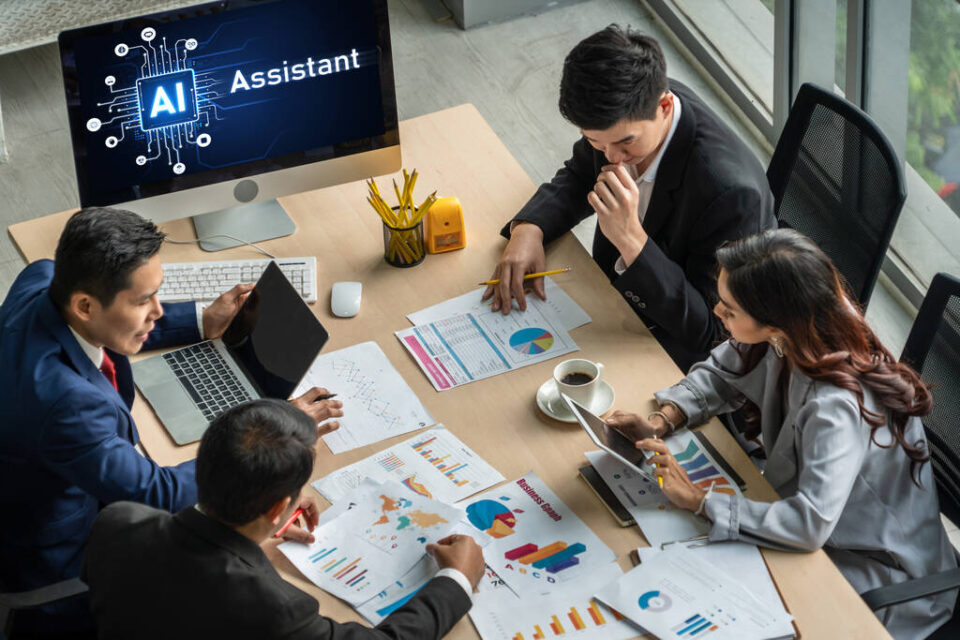
AI now influences how teams plan, decide, and coordinate—not just how individuals work. When artificial intelligence enters shared spaces like meetings, workflows, and cross-functional projects, the biggest challenges tend to be cognitive rather than technical. Teams struggle to interpret AI outputs together, align on responsibility, and decide when trust is warranted.
Human–AI collaboration today spans entire teams and autonomous AI agents, shaping sensemaking and coordination across work. This shift introduces obstacles that affect shared understanding and confidence in AI contributions over time. While 79% of leaders agree AI adoption is critical to stay competitive, nearly half of employees worry it will replace their roles, creating a “trust gap” that is more psychological than functional.
If your teams are using AI but feeling misaligned, this article explores the cognitive challenges behind the friction—and how to address them.
Why Cognitive Challenges Emerge in Human–AI Collaboration
Cognitive challenges surface when AI begins influencing how knowledge work unfolds across a group. AI responses increasingly shape planning, prioritization, and judgment, often moving faster than teams can collectively reflect. Teams must now coordinate around insights produced by machine learning models, reinforcement learning systems, and generative artificial intelligence, while still maintaining shared accountability for decisions.
This pressure intensifies because knowledge itself is no longer stable. Information changes through ongoing data analysis and continuous updates, forcing teams to repeatedly reassess what AI “knows,” how it reasons, and when its outputs deserve scrutiny. Without deliberate alignment, teams risk treating AI outputs as fixed answers rather than evolving signals that require interpretation.
Misaligned Mental Models and Shared Understanding
These pressures quickly expose differences in how team members perceive AI. One of the most persistent obstacles to human-AI collaboration is the absence of shared understanding across a group. Individuals interpret AI outputs through personal experience shaped by role, exposure to AI product development, or prior success with AI tools. Over time, these differences create subtle fractures in how teams assess confidence, relevance, and risk.
The challenge deepens through knowledge representation. AI systems encode patterns rather than meaning, while humans rely on context, intent, and narrative. Research shows that while AI can improve productivity by up to 40% in certain writing tasks, it can also lead to “collective over-reliance,” where teams stop questioning the logic behind a model’s suggestion.
When teams treat AI knowledge products as objective truth, bias in artificial intelligence systems can quietly influence decisions and erode trust. Clear communication rules and collective reflection give teams a way to surface these gaps before they affect outcomes.
Common sources of misalignment include:
- Different assumptions about AI competence learning, and reliability
- Uneven familiarity with how large language models generate responses
- Implicit trust based on past performance rather than current context.
Trust, Autonomy, and System Dependability
Misaligned understanding naturally spills into trust. Trust in automation rarely develops evenly across a team. Some members defer quickly to AI recommendations, while others remain skeptical or disengaged. Both responses distort decision ownership and weaken human autonomy team performance by shifting accountability in unclear ways.
System dependability becomes the anchor for rebuilding trust. Teams gain confidence through transparency, predictable behavior, and shared experience with AI debugging when failures occur. Autonomous AI agents raise the stakes further when actions are triggered without clear human checkpoints. Without explicit agreements around responsibility, accountability blurs, weakening both human-robot collaboration and broader human-robot teaming efforts.
Cultural and Organizational Barriers
Even when teams address trust and understanding, organizational context can reinforce cognitive friction. Cultural adoption resistance often emerges when AI feels imposed rather than integrated into everyday workflows. This resistance grows stronger in environments constrained by legacy IT systems that limit experimentation and slow learning cycles.
Complexity increases inside multiteam systems. Coordination across departments requires alignment around how AI supports shared goals rather than isolated optimization. Without training programs and an active support team, AI usage fragments across the organization, reinforcing silos instead of collaboration.
Organizational obstacles commonly appear as:
- A technology readiness gap between teams
- Inconsistent AI strategy across departments
- Limited integration of AI into shared team workflows.
Ethics, Bias, and Cognitive Load
Alongside coordination challenges, ethical considerations add cognitive weight. Ethical AI behavior demands interpretation and judgment, not just compliance. Teams must apply ethics guidelines for trustworthy AI while balancing deadlines and performance expectations. Privacy concerns, data management practices, and security measures—including details such as Server ID handling—consume attention that would otherwise support collaboration.
Bias in artificial intelligence systems further complicates sensemaking. Outputs can appear reasonable while embedding skewed assumptions that influence marketing research, planning, or evaluation. Addressing bias requires human-centered design practices that invite questioning, shared review, and collective responsibility rather than quiet acceptance.
Learning to Collaborate with AI as a Team
These challenges point toward a common solution: learning together. Overcoming obstacles to human-AI collaboration depends on collective learning rather than individual proficiency. Teams benefit from practicing competence learning as a group, exploring how AI technology behaves across scenarios and decision contexts. Shared experimentation helps calibrate expectations and reduces misinterpretation of AI responses.
Vibe teaming strengthens this process by helping teams tune into shared signals, feedback, and emotional cues during collaboration. Game theory offers an additional lens, framing interactions with AI as strategic exchanges that influence group behavior. Making these dynamics visible improves coordination in complex, high-stakes environments.
Organizations such as Voltage Control support this shift by helping teams develop human-AI interaction capabilities inside real, shared work settings. Rather than treating AI as a personal assistant, this approach embeds AI into collaborative spaces where teams learn, adapt, and align together.
From Tools to Teaming: What Comes Next
Cognitive challenges in human-AI collaboration point to a simple truth: effective AI adoption depends on how teams think together, not just how systems perform. When an AI strategy prioritizes shared understanding, trust, and ethical judgment, collaboration becomes more resilient across human-human-AI collaboration contexts.
If your organization is ready to move beyond isolated AI use and toward true human-AI teaming, Voltage Control helps teams build the skills, workflows, and alignment needed to collaborate with AI—together. Explore how structured facilitation and team-based learning can turn AI from a source of friction into a catalyst for better collaboration.
FAQs
- What are cognitive challenges in human-AI collaboration?
They include misaligned mental models, difficulty interpreting AI responses, bias in artificial intelligence systems, and uneven trust in automation that affects team collaboration.
- How do obstacles to human-AI collaboration affect teams?
Obstacles can disrupt shared understanding, slow decision-making, and reduce human autonomy and team performance, especially in multiteam systems.
- Why does trust in automation vary across human teams?
Trust depends on prior experience, system dependability, transparency, and how often teams engage in AI debugging when errors occur.
- How do legacy IT systems create collaboration barriers?
Legacy IT systems often limit integration with modern AI tools, increasing the technology readiness gap and reinforcing cultural adoption resistance.
- What role do ethics guidelines for trustworthy AI play?
They guide ethical AI behavior, helping teams manage privacy concerns, data management, and security measures while reducing cognitive risk.
- How can teams improve human-AI interaction over time?
Through training programs, shared workflows, reflection on AI product development, and deliberate practice with human-AI teaming in real work contexts.
- Why is generative artificial intelligence challenging for knowledge work?
Its outputs evolve quickly, reflecting the dynamic nature of knowledge, which requires teams to continuously reassess accuracy and relevance.
- How does human-robot collaboration differ from other AI use cases?
Human-robot collaboration often involves physical systems, such as reconfigurable integrated multirobot exploration systems or vision-based hand gesture recognition, raising additional coordination and safety challenges.