Robin Neidorf on Bringing the Body into Facilitation at the 2026 Facilitation Lab Summit
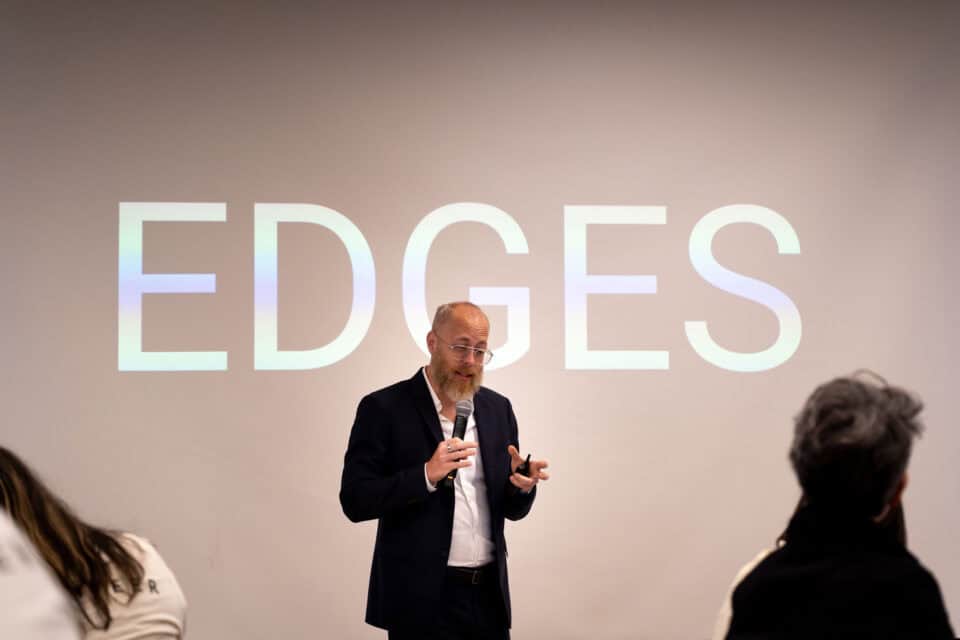
At the 2026 Facilitation Lab Summit, Robin Neidorf did not open with a slide deck. She opened with a song. The entire room stood and sang “Are You Sleeping” in three-part harmony, and by the time the last chord faded, something had already shifted. The vibrations of collective sound, Robin explained, regulate the nervous system and put people quite literally in harmony with one another. It was also a preview of the session’s entire argument: that facilitation is not just a cognitive practice. It is a bodily one. And most of us have been leaving half our instrument behind.
Trying to Help Gravity
Robin came to embodied facilitation the slow way. For nearly 30 years, she has held two parallel practices: facilitation, which she came to accidentally through consulting, and yoga. The two eventually found each other, but not without a lot of resistance. It took her nearly 10 years of yoga practice to learn how to properly do savasana, the pose where you lie flat on your back on the ground. She would lie there with tension still held in her muscles, unconsciously trying to help gravity do its job. It took another five years to learn that leaning into physical discomfort, rather than mentally fleeing it, would produce new knowledge she could not access any other way.
The parallel to facilitation was direct. Too often, Robin said, she enters a room with her head leading, her ego striving, trying to carry everything herself. When she can instead let the body hold her in its strength, something opens. “If I can lean into the discomfort,” she told the room, “perhaps I might be held.” The invitation of the session was to explore what that might look like in practice.
Activating the Body Before You Facilitate
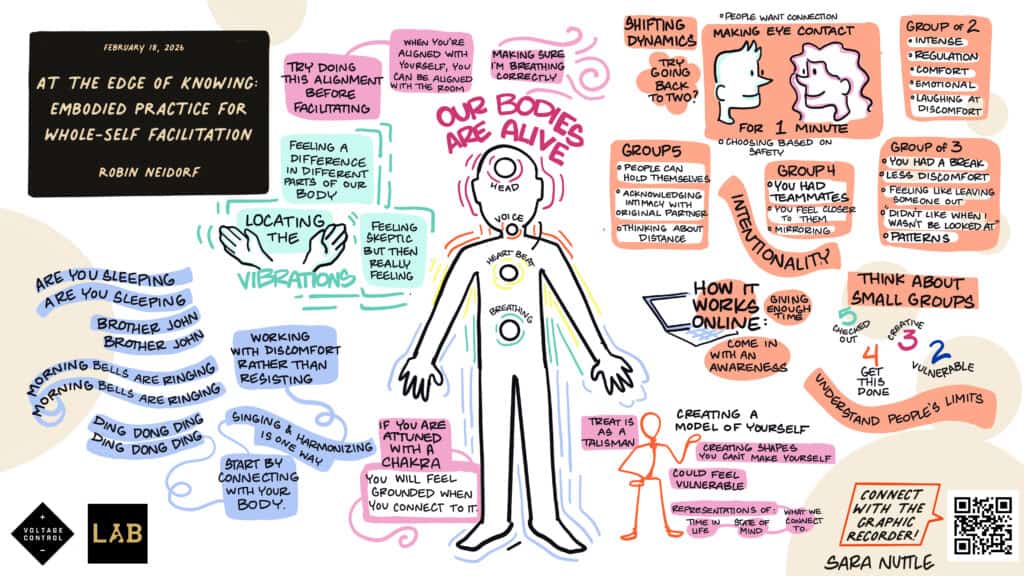
Robin introduced the concept of the body’s energy centers as a practical grounding tool, not as spiritual doctrine but as lived anatomy. Through a partnered exercise in sensing the edge of each other’s energy field, participants discovered which center felt most alive for them: the head (seat of insight), the throat (voice), the heart (connection), or the belly (intuition). One self-described skeptic was visibly surprised to feel a clear tingle at the edge of his partner’s field. Several others described sensing expansion and contraction, warmth, or a shift in the quality of the space between their hands and their partner’s body.
Robin’s point was practical: knowing your strongest energy center gives you a pre-session grounding ritual that actually fits you. Belly people can do belly breathing, feeling the floor press back as the breath drops low. Head people can work the pressure point between the eyes or use scent to activate that space. Throat people can hum or sing. The goal is to arrive with the body already present, because if the facilitator’s body is not in the room, the participants’ bodies will not be either.
What the Numbers Tell You
The session’s most immediately transferable offering was a structured exercise in group size awareness. Robin walked participants through a sequence: make sustained eye contact in a pair, then in a three, then in a four, then in a five. After each stage, she asked what people noticed, and the room was generous with its observations.
Two was consistently described as the most vulnerable configuration. Breathing synchronized, blinking synchronized, and some participants found themselves moved to tears or laughter simply by being fully seen at close range. Robin noted that facilitators should treat pairs with particular care. A minute of sustained eye contact is a deeply personal thing, and an extended pairing activity carries more relational weight than most session designs account for.
Three, by contrast, is a highly creative number. The energy bounces around a triangle in a way that generates ideas, supports brainstorming, and allows participants to find rhythm and mutual support. Four tends toward the functional and decisive: solid, squared off, well suited for sorting through information and reaching conclusions. And five is where Robin observes the first signs of disengagement. The circle grows larger, eye contact becomes intermittent, and it becomes easier for someone to let the group carry the load. That is not always a problem. Sometimes a deliberate five or six gives people who need a mental breath a moment to take one.
The practical takeaway was about intentionality. Most facilitators choose group sizes based on how many people are in the room and how the math works out. This exercise gave participants a felt sense of what each configuration does to the relational field, and the invitation was to let that inform the design choices they make.
Making It Physical
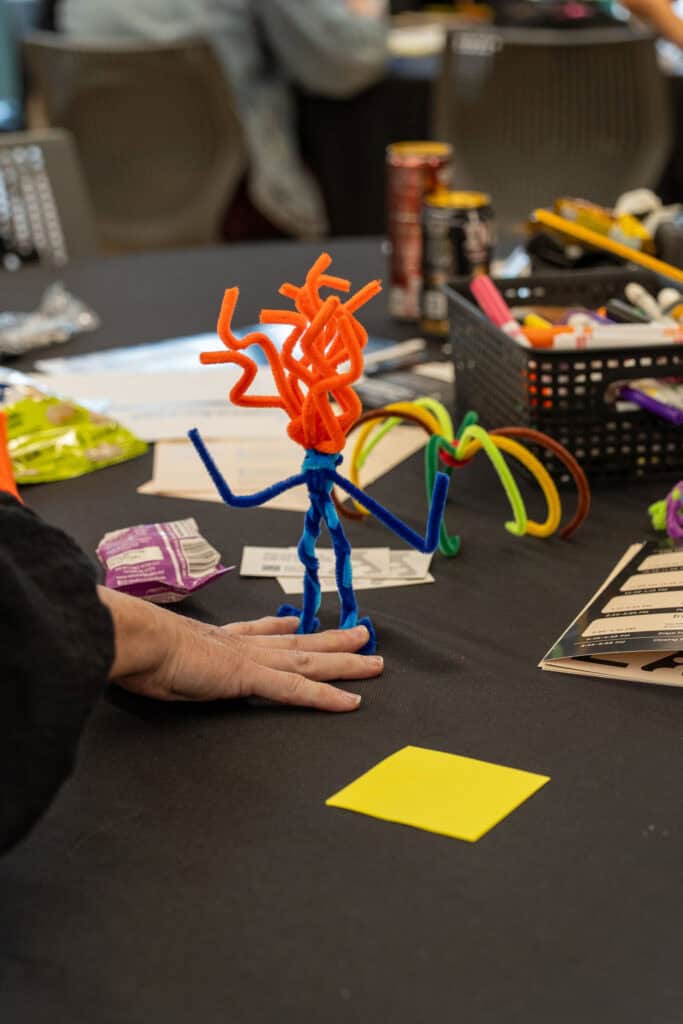
For the session’s final activity, Robin invited participants to build a model of themselves out of pipe cleaners, paper scraps, and whatever else was on the tables. The instruction was not to create something that looked like them, but to create something that expressed how they want to feel when they are facilitating. The result was a room full of quiet, focused construction, followed by small group conversations about what each model meant, and for some, an attempt to physically embody the shape their model suggested.
The exercise pointed to something Robin named directly: that creating a physical object can feel safer than describing a feeling in words. It provides a kind of middle distance. And the act of then trying to move into the shape of the object in your own body awakens something that verbal reflection alone does not reach.
Robin closed the session with a collective om chant, offering it both as a sacred sound and as something purely physical: a vibration that reconnects the body’s electrical field to those around you. For a session that had moved from singing through energy sensing, eye contact exercises, and pipe cleaner sculptures, it was a fitting close. The body, Robin reminded the room, had been present and offering wisdom the entire time. The practice is simply learning to listen.
Watch the full video below:
Transcript of Robin’s Session:
Robin Neidorf:
Thank you so much. I’m so excited to be here and really quite honored to be in such an illustrious company of the speakers that we’ve heard so far. It’s just an honor. I didn’t have a walk-up song because we’re going to make our own music.
So, I’d like everyone to stand up, please. And here’s what we’re… I mean, if you know the song, you can sing it along with me this first round through. If you don’t know the song, I’m sure you’ll pick it up. We’re going to sing it through all together twice. All right? Ready? One, two, three.
MUSIC:
Are you sleeping?
Are you sleeping?
Brother John.
Brother John.
Morning bells are ringing.
Morning bells are ringing.
Ding, dong, ding.
Ding, dong, ding.
Robin Neidorf:
Round two.
MUSIC:
Are you sleeping?
Are you sleeping?
Brother John.
Brother John.
Morning bells are ringing.
Morning bells are ringing.
Ding, dong, ding.
Ding, dong, ding.
Robin Neidorf:
Guess what? We’re going to do harmony now. All right. So, this third of the room here is going to start. This middle chunk here is going to pick up. Do you know your cue, middle chunk? All right. And this chunk, last third over here, is going to be the third group. Again, we’re going to go through it two full times. So, don’t stop after the first one. And if you get lost, just look at your neighbor and smile. All right. Are we ready with group one? One, two, three.
MUSIC:
Are you sleeping?
Are you sleeping?
Brother John.
Are you sleeping?
Brother John.
Are you sleeping?
Brother John.
Morning bells are ringing.
Morning bells are ringing.
Ding, dong, ding.
Are you sleeping?
Ding, dong, ding.
Are you sleeping?
Brother John.
Are you sleeping?
Brother John.
Are you sleeping?
Brother John.
Brother John.
Morning bells are ringing.
Brother John.
Morning bells are ringing.
Ding, dong, ding.
Morning bells are ringing.
Ding, dong, ding.
Robin Neidorf:
Thank you. Thank you all. That was even better than I imagined. So, give yourselves a hand. I wanted to start with a song, and particularly a song in harmony, because of what it does to our bodies. What you’re feeling when you’re singing in a group like that is embodied sound, and the vibrations of the music wake up yourselves, regulate your nervous system and put you quite literally in harmony with those you’re singing with.
Now, why does this matter? As facilitators, we don’t always bring ourselves fully as bodies into the spaces we’re working in, to allow our bodies to be present and fully alive in those spaces. And if we don’t, then participants won’t. And there is so much that happens below the surface of the skin for both individuals and for groups. When I was asked to propose a session for the summit, I knew I wanted to try something that I was not 100% sure I could pull off. So, you can tell me in about 80 minutes how it went.
For nearly 30 years, I’ve had two consistent practices in my life. The first is facilitation, though I haven’t always called it that. I’m also an accidental facilitator. I came to this through consulting, and as many of us do, we find our people. The second practice is yoga. When I’m practicing yoga, I can sometimes achieve a state of radical presence, a full embodiment of my physical, mental, and spiritual self, allowing the innate power and strength of my body to hold me.
On the other hand, when I strive too hard for a pose, when I’m in my ego and straining my muscles, I’m trying to hold myself. It doesn’t work. I sometimes think of it as trying to help gravity, which is crazy. It took me nearly 10 years, 10 years of yoga practice, to figure out how to properly do the pose where you lie flat on your back on the ground. I’m not kidding. I’d lie there and still have tension in my muscles as I was trying to help gravity.
It took me nearly 15 to learn that if I leaned into the physical discomfort of a pose instead of mentally running away from it, new knowledge would awaken. How could I bring these very slow lessons of my yoga practice to my facilitation practice, to find the place where my body holds me in its strength so that I could create that space for others?
As facilitators, there are a number of things that you’re probably already doing to figure out how to get to some of that embodied awareness. A lot of us use breathing exercises, box breathing, breathe in for four, hold for four, out for four. Lots of other breathing exercises work. Grounding exercises where you really plant your feet in the ground and maybe shift your weight back and forth. You might even be doing some reflection on an embodied experience. I was doing some reflection on embodied experience before this, walking around, doing some belly breathing, feeling where my body was.
What I know about myself though is this. Too often when I enter a space to facilitate, it’s my head that’s leading. My ego, my striving, trying to carry it all, trying to help gravity. Whereas if I can lean into the discomfort, perhaps I might be held.
If there’s one thing I hope you take away from this session, it’s this. Please remember, your body is alive. It is full of power, quite literally. It has an electrical field. Regardless of its age or its condition, it can hold you as a facilitator, as a human, in its strength.
Who’s ready to practice a little bit more? All right. So, for this one, we’re going to use a partner. We’re going to go through the instructions on the screen. I’ll go through everything that we’re going to do and then you’ll find a partner and go into it. Stephanie, would you mind if I came up here for just a second? I’d like to show what we’re going to be doing. So, you’re going to find your partner and this is going to be hard with both a clicker and a microphone, but we’re going to try. [inaudible 00:07:27].
Hands near the head and slowly move your hands out until you feel the edge of energy. Then the same thing at chest height. Same thing or sorry. Throat first, then chest, then belly. Move your hands slowly and feel where the edge of that energy is. Thank you.
Stephanie:
You’re welcome.
Robin Neidorf:
So, find a partner and we’re going to do this for as long as it takes to have something to happen. We’re going to get some feedback here. What do you notice? What did you notice about any of the stages about being the sensor or the sensee? What do you notice?
Marco:
At first, I had to make sense of what I was experiencing, but then I felt a very, very clear tingle at the sort of edge of my skin, and it would sort of decrease as I went furthest, and then it would increase if I went at the sort of sweet spot. And then yeah, it was really, really, really clear. And I approached this with an open mind, but as a skeptic, and I felt it.
Robin Neidorf:
Wonderful.
Marco:
Impressive. I mean, I’m totally blown away.
Robin Neidorf:
Somebody get on the bucks. Yeah. What else? What else do you notice?
Speaker 5:
It’s like a horse.
Speaker 6:
Yeah. I just felt that where tension, contraction, and expansion happened in every part of the body. And maybe it’s because I do this work on my own anyways, but I can just really sense what parts of each section was expansive or contracting. Yeah.
Robin Neidorf:
Wonderful. Thank you. How about one more? We got one right here.
Speaker 7:
I was also a little skeptical as the person experiencing the closeness, but as the one who had… using my hands, I felt like a heat sensation at my partner’s head. And then I felt a tingle specifically in my index finger when I went to the belly. And then what was interesting is my partner was like, “Is that the root chakra?” I feel like I have really good root chakra energy.
Robin Neidorf:
You’re jumping ahead of me.
Speaker 7:
Oh, sorry. Sorry.
Robin Neidorf:
That’s great. That’s great. Thank you. Love the skepticism. I love that you experience it. Remember, your body is alive and it has this power. In yoga, we talk about the seven chakras or energy centers. We’ve just experimented with four of them, but you don’t have to be a yogi to understand that your body has this electrical field. Your partner feels the tingle and the weight at the edge of that field. And sometimes even as the person who’s being sensed, you can tell when their hands are a little closer, a little further away. It depends on how you’re dialed in.
I’m curious, how many of you felt the most sense of energy when you were at the head chakra? Just raise your hand, please, if that was you. How about those of you at the throat chakra, the voice? Any chest people? A couple? Great. How about belly? Okay. So, a lot of head people in this room, which is interesting.
The head is the seat of insight. The throat is where you have your voice. We’ve just heard beautifully a lot about voice today. The heart is where you really dial into your heartbeat, and the belly is intuition. When you want to facilitate from your greatest strength, you really want to activate that particular energy center before you go and do your thing, because then you’re bringing your body fully in with you and you’re in partnership with it.
For me, it’s always been the belly center that’s the strongest. So, I was doing belly breathing before this session. If you’re a head person, you can use the pressure point between your eyes and do some pulses there. If you’re a throat person, you can hold your fingers up to your throat and feel the vibrations of your voice. You can sing, you can hum something that activates that center. Belly is a great one for belly breathing. If you’re not dressed nicely, you can lie on the floor and actually breathe into the floor and get that immediate feedback from the floor of the feeling of your belly expanding and contracting.
So, there’s all kinds of ways that we can activate that part of our alive body that helps us most do the thing we want to be able to do. This is something you can add to your practice when you’re designing sessions or add it to pre-session grounding rituals. Some of the ways maybe that you’re already using these types of techniques, I’m curious, is anyone using some body techniques to ground yourself, either breathing or one of the things we’ve just talked about or… Want to share? A couple shares? We got one right here.
Speaker 8:
Yeah. So, belly breathing is something I’ve been taught. I have a music background with chorus and also they teach you in theater, and a lot of people breathe incorrectly, if you think about it. So, belly breathing is something I always try to do to calm down.
Also, really good checks if you ever take a deep breath in and you’re breathing with your shoulders. It’s not really what you’re supposed to do. You’re supposed to breathe through diaphragm. And that’s what Marcos said was my strongest tingly woop-woop.
Robin Neidorf:
Cool.
Speaker 8:
So, I guess I’ve been doing it right.
Robin Neidorf:
Did it make that sound? That’s what I want to know.
Speaker 8:
Yeah, it did.
Robin Neidorf:
Yeah, I love it. I love it. Wonderful. Thank you. Couple more.
Speaker 9:
We got one.
Robin Neidorf:
A couple more?
Darcy:
So, I love that she mentioned singing because sometimes I do singing vocal warmups and then the red leather, yellow… And then the other thing I have is this bell that’s like an energy bell. And I ring it in the room and I ring it around my body, and it just seems to settle me. And I bring it with me when I travel, too.
Robin Neidorf:
That’s great. Wonderful. Renita.
Renita:
I have a combination of things. I’m a woo-woo girly. When I’m facilitating, I make sure to stop and ground myself on the floor. I walk a lot, but when I’m pausing or listening to someone, I’m kind of imagining my feet going into the roots of the earth, so I have another source of energy that’s kind of coming up and keeping me really in my body and present. Then I’m a big smells person. So depending on, I put on different types of oils that mean different things in the morning, and that sets another level of intention in my energy of what I’m bringing into a space.
Robin Neidorf:
Yeah. Smell is another great one if head is your primary energy source. In addition to the pressure point, things that you can smell that really fill your head are another great way to activate that energy source.
So, our bodies give us wisdom as facilitators, but we can also start to think how we can safely tap into the bodies of our participants. This next activity is to create awareness around the impact of your choices for combining people and their bodies in activities in your session. It can direct your thinking when you’re deciding how to put people into groups for activities, discussions, et cetera.
I’ll talk through the full activity and then we’ll try it and then we’ll debrief. So, to start out with, you’re going to find a partner. And for one minute, you’re going to look each other in the eye. Then you’ll find a group of three, and for one minute, make eye contact with the other two people that are in your group. Then we’ll do the same with a group of four, making eye contact with all of the other people in your group. And finally, we’ll do it with a group of five. Question from Chris.
Chris:
Just clarifying question.
Robin Neidorf:
Clarify.
Renita:
Group of three and so on. Is it just one person focusing and then switching or is it…
Robin Neidorf:
However you can make eye contact with all the people around what’s going to be your little triangle or your circle.
Renita:
And everyone’s doing it at once?
Robin Neidorf:
Everyone’s doing it at once.
Renita:
Cool. Thank you.
Robin Neidorf:
Okay. Great question. Great question. All right. Any other questions? Find a partner for the first minute. I’ll warn you, this one’s the hardest. You can stand up, you can stay seated. Standing up is probably a little easier.
So, now form groups of three. And now you have a minute to look the other two people in your group in the eye. Okay, that’s a minute. Find a group of four. You’ve got another minute. Look each other in the eye. All right. Last one. I promise. Last one. Make a group of five.
All right. I want to do some table talk before we do some whole room debriefing. So, with the people at your table, spend… We’ll take five minutes to do this. Just talk about what you noticed. What did you notice in groups of two, three, four, five throughout the entire exercise? What came to mind? What were you thinking maybe even as a facilitator? What does this tell me about facilitation practice? You can have that conversation at your tables for about five minutes.
Let’s talk about what it feels like to be in a group of two. Who’d like to reflect a little bit on what it’s like to be in a pair? No one wants to talk about this experience. Thank you, Paula.
Paula:
Okay. I’m the person who immediately gets emotional, and I feel very overwhelmed with the depth of the person, even if I don’t know them at all.
Robin Neidorf:
Yeah.
Paula:
And then it just goes on and on, and I just can’t stop crying.
Robin Neidorf:
Sometimes I cry at cat food commercials. Yeah. Confession time.
Speaker 9:
All right.
Robin Neidorf:
Another person who wants to reflect on what it felt like to be in a group of two.
Speaker 9:
Right here.
Speaker 14:
I think for me, maybe because I know Jesse, it was just easy. We just dropped into it, but it was very comforting. And then I started noticing… I got into this zen moment and then I noticed like, “Wow, our breathing is even locked in and our blinking.” It was just such a cool vibe, and it happened faster than I thought.
Robin Neidorf:
Thank you for sharing. Yeah. One thing that human bodies are really good at doing is regulating each other. So, when you are in that kind of close dynamic, you will find breathing synchronizing. Yeah. Marco.
Marco:
I just wanted to share that something really surprising happened every time I looked into the eyes of various groups at this point. This is an emotional response, nothing rational about it, but I could see them as children very, very clearly. Yeah, yeah.
Robin Neidorf:
That’s beautiful. Thank you. Thank you. Someone over here. Yeah.
Kristen:
So, we laughed most of the time in our shared discomfort. And so I think this sort of emotion over here, we also bubbled over quite audibly and synced up in our sort of giggles and our laughter and our sort of playfulness, but it was really joyful, I found, and very uncomfortable, both in pairs and then also in fives. Also, I’m really sorry we didn’t know we weren’t supposed to talk until the [inaudible 00:21:45].
Robin Neidorf:
Oh, that’s fine.
Kristen:
Thank you for telling me.
Robin Neidorf:
That was probably less clear than it could have been. Remember the part I said with… I wasn’t sure I could pull this off? Well, that’s an emotion. How about three? What did it feel like to be in a group of three? What did you notice? There’s Amber in the back.
Amber:
One thing that I noticed was you always had a break at some point with the threes, that you weren’t always looking into someone’s eyes. You had a moment to take a breath and like, “Oh, okay. All right. I’m not as uncomfortable at this moment.” And then I’m, “Oh, I’m uncomfortable and I’m okay now.” So, it was kind of interesting to go through this being seen and then having a break and then being seen. Yeah. So, I thought that was interesting.
Robin Neidorf:
Great. Thank you. Thank you. Danny.
Danny:
It’s interesting that you experienced that as having a break. For me, the three was the hardest because it felt like someone always was left out. That’s how I experienced that.
Robin Neidorf:
Thank you.
Danny:
Somebody was always being left out.
Robin Neidorf:
Yeah. I think I heard that conversation over here too as well.
Danny:
And another thing I wanted to call out, just because I think it’s interesting, demographically, whenever you said, “This is what we’re doing,” I immediately looked for a woman to do the first exercise with.
Robin Neidorf:
Oh, thank you.
Danny:
Because it felt safer.
Robin Neidorf:
Understood. And actually, somebody did come up to me earlier and said in the chakra activity, “Why do it on each other and not on ourselves?” And that there’s a sense of safety there. I do want to say that in this particular room on day two of the Facilitation Summit, I felt a little more willing to try things that are perhaps more vulnerable, but it is a really important call out around safety and how people feel.
On the other hand, I’ve also seen this type of exercise build safety, very quickly when people can see each other, really fully see each other as humans and it’s just eye to eye, breath to breath. That is also a way that safety can be explored and multiplied, even. How about more reflections on three people?
Speaker 9:
I have one. So, I’m going to try and make it quick. I have three things. The first one is that one member of our group did not like eye contact, and I noticed that the other member of the group and I were caretaking. We saw that they were uncomfortable and then we started looking at each other, which is cool.
And then, shocker to most of you in the room, I didn’t like when people weren’t looking at me. I think that’s like very human of like, “I’m not in the group, what’s wrong with me? Why am I not being liked?” And the third thing, which is a facilitation takeaway is that I love that you gave us an opportunity to make you the bad guy of…
Robin Neidorf:
My pleasure.
Speaker 9:
Yeah. Of like, “Oh, we got to do this. Isn’t this so weird?” Because people are begging to connect, and we just need an opportunity to. So, this is a question for me and everybody in the room. How can we make ourselves the bad guy in the room so that people can connect? Yeah.
Robin Neidorf:
Something I haven’t thought about. I think that’s a wonderful takeaway. Thank you for that. One more reflection on three.
Speaker 18:
In my group of three, we definitely noticed a pattern. So, we started to create rhythms and patterns, and we talked about that as a table as they started to feel those natural rhythms and then it might break up and we’d say, “Oh,” and kind of start it again. So, that’s when that… certainly in three more than the others.
Robin Neidorf:
Wonderful. Yeah. That’s that mutual regulation that’s happening again. How about four? What does four feel like?
Speaker 19:
Four was kind of fun because you’re pairing up and a little team up, and then you go find a new teammate and then you team up again. So, nice little rhythm to it.
Robin Neidorf:
More rhythm. Love it. How else does four feel? Here’s one over here.
Speaker 20:
This is less a comment about the number of people as much as Antonio here, and I, we were in each other’s group the whole time, right? And I established more comfort eye-gazing with you than the new people that came in.
Robin Neidorf:
Interesting. Thank you for sharing that. One more reflection on four? Yes. Over here.
Speaker 21:
I think as the group gets bigger, then you kind of realize each person has, you are sharing a specific wavelength with… So, with one person, our eye contact is playful, and then another person is very calming and feels like an old friend. And so it was interesting to notice the, I guess, distinct eye contact personalities or dynamics that were coming through as different people contrasted with each other.
Robin Neidorf:
Yeah. You get a lot of personality and relationship just in that. Julie, do you want to add?
Julie:
Yeah, just building on that. I started mirroring. I’m like, someone would breathe in. And then I, “Oh, I should breathe in.” And then I look and they were smiling, I’m like, “Oh.” But I started mirroring my person and I was in sync with them. It was interesting how I followed their patterns.
Robin Neidorf:
Yeah. Deeply human instinct to mirror. Deeply human instinct. All right, let’s talk about five, and then we’ll do some overall reflections on what this might tell us as facilitators. Renita.
Renita:
I think for five, we were talking at the table as well. I was exploring my relationship with equity where at first I was like, “Well, I have to give everybody equal time.” I was like, “You don’t have to give everybody equal time. If you look at some persons more than others, trust them to hold themselves and somebody else has got them. We don’t have to make sure no one’s getting left out. People can hold themselves, and they’re part of the group so that you aren’t being left out. So, just enjoy the experience and kind of naturally be in the flow without feeling like you have to give someone equal time.
Robin Neidorf:
Great. Thank you. One over here?
Speaker 23:
Yep. So, I was going to say one observation I made was it felt like Squid Games, like the Mango Game at first. I was like, “Oh, shoot, we’re going to find somebody.” So, I thought that was kind of fun, but then also a more serious tip. I guess I appreciate the fact that the person I was paired with, Catherine, for the two, we actually stayed together all the way to the fifth group. So, I felt like there was an intimate connection even there looking back and saying, “Wow, we made it through all this together.”
Robin Neidorf:
Yeah, you got a buddy. You got a buddy. Love it.
Speaker 23:
Yeah.
Robin Neidorf:
Someone over here?
Speaker 24:
I noticed when we got to five that it wasn’t just about the eye contact, but the physical distance between us was also increased, and that shifted the experience as well. And it certainly wasn’t as intimate even in the one-on-one, with the exception of maybe the person to my left or right, who was about the same distance as they would’ve been at the beginning.
Robin Neidorf:
Great.
Speaker 24:
I was also curious, I don’t know if this is the first time you’ve done this exercise or not. Have you ever gone back to two to see what that shift is to expand and then come back to the original?
Robin Neidorf:
I haven’t. And I will say that I actually, this isn’t an activity that I use when I’m facilitating for real. I do it with the facilitators, not with people in the wild, because that would be weird. So, I haven’t tried that, but I think it would be a really interesting add-on, especially when we get to the next part of our discussion. So, one more, Brian on five.
Brian:
Yeah. What was interesting is Kristen’s eyes have so much joy that when I started staring at her, we just couldn’t help from being joyful. And it was interesting because when Josh and I started, we were really serious about everything, we were following and everything. And then in our discomfort as introverts, we decided to role play. She was Meryl Streep. I was Arnold Schwarzenegger.
Robin Neidorf:
I love it.
Brian:
And then we realized we weren’t supposed to talk. And then he’s trying to get serious with us. And then Chris came over and the way he was looking at me, it was like… I can’t keep from laughing. And then this other person, I forget what his name was, came over and he was like, “Oh, you’re the skeptics.” And then what we looked over, we’re like, “And you all are all super serious.”
And we were like, “Oh, we’re bad. And then we’re going to disappoint you, Robin, as a facilitator, because we thought we were being unserious.” And so I felt like this range of performance, shame, kind of. So, I was watching how the group was almost dictating to us what we were supposed to be doing. And maybe we projected that, but I’m glad you left it a little bit vague because I watched how a group can influence someone else.
Robin Neidorf:
Right. Thank you. One more, Darcy.
Darcy:
Thank you. For me, when it got to five is when I started feeling insecurities coming up. With the others, I was feeling all the energy and really into it. And maybe it was the fact that in five, you were the most alone for some of that time, right? Because it’s twos and twos and you’re waiting for those two to finish before it comes to you again. So, I had a hard time finding a flow in the five, where with the others, it didn’t seem to matter as much.
Robin Neidorf:
Interesting. Thank you. I’ll tell you, I’ve done this with groups of facilitators before, and it is one of the things I really like doing. We spend more time on it, in part because there’s so much that we do as facilitators that’s about breaking people into smaller groups. And I found that we can talk about that all day long, or we can try it and actually feel in our bodies what happens when we’re in a group of two, when we’re in a group of three, et cetera.
Two, as has been reflected and I think is really the most consistent experience I’ve heard when I’ve done this with facilitators, is, “Two is extremely vulnerable.” So, you want to be extraordinarily careful when you set up pairs for something, especially for an extended period of time. This was just a minute, but it was a minute of looking into each other’s eyes. That’s deeply, deeply personal.
Three is a highly creative number. When I want a group to brainstorm, I often turn to groups of three. Three bounces energy around a circle or a triangle, I guess, really, really nicely. There’s a lot of ways that groups of three find the rhythm, find each other, help each other, support each other in what they need in that moment. And three is a very creative way to go for brainstorming types of things.
My experience of four, and I’m interested that… I didn’t hear this reflected, but I’m going to share it, which is that four is a very much a getting things done number. Four feels like very solid and square, “We’re here to come to a decision. We’re here to sort through all this information and figure out what the most important things are.” At least that’s the way that I’ve experienced four in my practice.
And then in five, I actually find this is a place where a lot of people start to check out. There’s less energy in the circle because you are further away from each other. There’s fewer times that you’re always making eye contact. There’s times where you’re not being looked at. Sorry, Katie. And it can be easier for someone to say, “Okay, well, the rest of the group will hold this. The rest of the group will take care of this.”
So, I’m just very careful about when I use any of these given numbers to create breakouts, whether I’m online or in person. It does make a difference. I’m curious what takeaways you might have as facilitators, how you might use this awareness in thinking differently about maybe it’s an activity that you do regularly, maybe you hadn’t thought about numbers in this way. I’m curious what your takeaways are on this one.
Speaker 26:
I know people had different ways they experienced the odd numbers like, “I’m not being looked at or I’m being left out.” And there’s also an opportunity there to be the person observing other people. So, assigning that role from the outset, if you’re not part of the active conversation, you play a really important role and that is to observe the conversation.
Robin Neidorf:
That’s great.
Speaker 9:
Over here.
Marco:
I would like to build on your point. I could sense that there was something really powerful about what we were experiencing around the potential for using gaze as a port, as a gateway to empathy, as a shortcut to empathy. Empathy is a hard thing, but it’s something everyone is capable of.
So, this is experimental thinking, but maybe in phases of the design process like in user research and in user testing, there is a space where we can use gaze to see if we can more quickly get the person and the problem that we want to try to solve with design.
Robin Neidorf:
I love that. I love that. Something else you were just… I was thinking as you were speaking was that this is also an activity, if you did want to use it with normal people, it doesn’t matter what language people speak. You can have this gaze moment that builds empathy regardless of other barriers that might be in place. Yeah, go ahead.
Speaker 9:
The one over here?
Speaker 27:
Yeah, I think it was over there.
Speaker 28:
It just got me thinking with the two person, so 1B1. It got me thinking when I’m doing interviews and always trying to make eye contact. Now, we were talking about it. I didn’t have that discomfort doing interviews because you’re too busy listening and you’re distracted, but it got me thinking when the person stops talking and is focusing on their answer, I don’t want to distract that answer because of my all of a sudden, “Oh, no one’s talking and I’m staring at your eyes and this is awkward.” I don’t want that to confuse them or get them off their thought track. So, it was enlightening for me.
Robin Neidorf:
Yeah, I love that. Putting it out to another part of the practice, which is interviews is a really important piece. One over here and then one way back in the corner there.
Speaker 29:
I just think it’s interesting. I mean, for people… some of us have been doing these for a long time. We’ve been teaching them and so forth. And I feel like oftentimes the selection of number is more like how many people are at the table or how many people are in the room? Or so forth. It’s much more mechanical. And I think this is interesting because it’s much more intentional for the kind of emotional state you’re trying to create. And so it’s definitely fascinating. Thank you for bringing it up.
Robin Neidorf:
Yeah. Glad you enjoyed it. Thank you. Back here.
Speaker 30:
I think this showed how important it is to build variety in the activities and the people that you’re engaging with. Being in a group and always going back to two and always going back to pairs and doing it over and over again, it can be beneficial, but it’s a bit exhausting and it’s a bit a bit same/same after a while. So, switching it up can lead to much more interesting engagements.
Also, it’s really important with this to design around the energy that people have. If it’s always intense and if it’s continually intense, people are going to just stop disengaging. That’s when people start taking a lot of coffee breaks or a lot of bathroom breaks, and all of a sudden people are not at the tables. There’s only so much energy people have and you have to respect that.
Robin Neidorf:
Right. Great points. And it actually is when I sometimes will deliberately use a five or a six, knowing that that is a place where then people who do need a mental break, can pull back a little bit or take a break or whatever that is they need to do.
And then there’s sometimes the math just don’t math, and you got to do whatever you’ve got to do to make it work. And having this awareness can give you as a facilitator a different sense of what might be happening differently than maybe what your intention was if you have a group of three instead of a group of four or five based on what you’re trying to create. I think that intentionality is really the most important through line here is, how can we be more intentional about the bodies that are in the spaces that we’re facilitating and how we combine them and recombine them. One over here and then we’ll move on.
Speaker 31:
I’m actually holding some curiosity now about when you mentioned virtual facilitation and the consideration of putting people into breakout rooms, and how that energy management kind of can shift because as a virtual facilitator, you hold so much of that or you help to guide so much of that energy without reading the body context cues. So, then thinking about that in the virtual space, I’m just so intrigued. Have you found the numbers to be pretty comparable in the virtual space as they are in the in person space?
Robin Neidorf:
I do find them pretty comparable. I’ve got a longer answer, but I’d actually like to hear from the wisdom of the room. Lots of us do a lot of online facilitation. I’m curious, from what we’ve just discussed, I mean, how might it show up in your virtual practice as well as your in person practice? Anyone? Great.
Speaker 32:
I had to step out… This is not answering your question, so it’s a political answer, “Thanks for asking that question. I’m going to say what I was going to say.” I had to step out-
Robin Neidorf:
Are you in politics?
Speaker 32:
No. I had to step out because I thought I lost my car keys somewhere between here and a parking garage, found them. But when I came back, it was the groups of five. And so I came up the stairs into this room, which was totally silent with 100 whatever people intense… And there was that feeling of being in high school and middle schools like, “I’m the only one left out.” But the energy was just so stable and firm, it was incredible to walk into.
Robin Neidorf:
Thank you for sharing that. Just went over here. There’s one over here.
Speaker 33:
So, to answer your question, also well done on finding your car keys. That is anxiety-producing. I do find that in virtual spaces, how you’re talking about these numbers hold, especially with two, sending folks into groups of two, if you then pull them back in what seems like should be a reasonable amount of time, often they’re like, “We introduced ourselves to each other and maybe got to your first question.” So, that vulnerability feels like it is really turned up, especially because you’re eye contact on Zoom. That’s really very, very present in those screens.
Robin Neidorf:
It’s an excellent point. I don’t know that I ever named it before, but I think I’ve used that in my practice a lot. Very rarely will put people into a breakout of two, unless it’s a group of people that knows each other extremely well. Other thoughts about how this translates to virtual or hybrid even? Hybrid’s just bananas.
So, I can tell you, to answer the question, I mean, most of my facilitation on a weekly basis is probably virtual. So, I spend a lot of time staring at a screen with the Brady Bunch [inaudible 00:42:13] faces up there, and I still find it holds. And even when I’m thinking about the size of my overall group, I’m much happier if I’m facilitating online with up to say, I don’t know, 10 people at most, because they do check out past that point. And so being aware of those dynamics, which I think we all innately are, just if you’ve been doing this for any period of time, you know these things, you notice them. But it is a way of being more deliberate and deliberative about how you want to set up whatever the activity is for the objective that you’re going for.
All right. So, we’re going to do one more activity, and for this one, you get to use the pipe cleaners. You’re going to take the pipe cleaners and any other materials you might have at your table, whether that’s paper or piper clips or empty cans of soda, and create a model of yourself. It doesn’t have to look like you. It doesn’t have to actually even be humanoid. I actually found this one in the bin at my table this morning, and I said, “This is me today. This is what I want to look like today.” So, create a model of yourself and then position the model in a physical expression of how you want to feel when you’re facilitating. Whatever you’d like to do with the pipe cleaners, paper, cans, flame clips, lanyards, whatever you want to create.
Kristen:
I like people that [inaudible 00:44:05].
Robin Neidorf:
All right. Finish up wherever you are. And you can see from my instructions that I had an idea about what size groups to put you all in, but I’d actually like to hear from this group. I want to combine everyone into groups so you can show each other your models and talk about them, and possibly even try to express with your bodies if you feel like it, what that model is. What size group would you propose for this activity?
Speaker 20:
Five.
Speaker 5:
Five.
Robin Neidorf:
Group of five? Three? Okay. Let’s hear from someone who said five. I want to hear your reasoning, please.
Speaker 20:
My take for five?
Robin Neidorf:
Yeah.
Speaker 20:
Sometimes you just need-
Speaker 9:
Hold on.
Speaker 20:
Oh, I’ll shout. I love shouting. Sometimes you just need a good measured amount of chaos.
Robin Neidorf:
All right. Measured chaos. I could go with that. A couple of people said three. Who said three? Who’d like to give your reasoning for three?
Darcy:
Well, you mentioned that it’s very good for brainstorming and creativity. So, if that’s what we’re here for, it felt like the right number.
Robin Neidorf:
Okay. Good question. What’s the purpose? What’s the purpose? Anyone have a vote on something besides three or five?
Marco:
17.
Robin Neidorf:
- We’ll be here all day. Marco. Marco wants a two? Give us your reasoning.
Marco:
It’s my favorite sort of setup in general, in all aspects of the exchange. Yeah.
Robin Neidorf:
Okay. Yeah, okay. I think I’ve been convinced by the five, but you can certainly stay at your tables of whatever size you like. Break into fives, go into fours, go into threes. I’ll let you use your own bodily judgment here on what is going to work. Show each other your models, and talk about why you did what you did, what it makes you feel, how you want to feel while you’re facilitating. And if you feel so moved, try to hit the physical pose that expresses what your pipe cleaner and canned creation suggests.
All right, let’s come on back. So, abstracting from the actual body to the model can feel safer for a lot of people. Having objects that you can ground with, put into shapes, sometimes creating a shape that you couldn’t actually do with your physical body can feel very freeing. And at the same time, taking those abstract shapes that represent how you want to feel, and then trying to create them physically, also awakens a different kind of experience of what that might be. I’d actually like to hear, if this table wouldn’t mind, you guys were all trying each other’s models, weren’t you? I’d love to know what that experience was like.
Speaker 34:
It seemed the obvious thing to do, so we did it.
Robin Neidorf:
How did it feel?
Speaker 34:
It was fun. It was like trying a little lens on or like trying a different costume on or a different perspective. I did find it potentially a little vulnerable, like creating yourself. It felt almost like… I don’t know. It felt like I could see how someone might feel intimidated or a little naked.
Robin Neidorf:
So, maybe altering it slightly to make a representation of how you want to feel. Would that be less vulnerable or is that still…
Speaker 34:
I don’t know. I mean, I didn’t find it super vulnerable, but I thought others might.
Robin Neidorf:
Okay. Fair enough.
Speaker 34:
Did anybody find it that way?
Robin Neidorf:
What else? What else did you notice from either presenting your own model to everyone else or hearing about the models or maybe feeling your body move a little bit as you were talking about the models? Kelly over here.
Kelly:
I don’t know if this is profound or anything, but just an interesting observation. We had three at our table, and one person’s was their mind space, one was our energy, and one was their current state. So, we used different time and levels of our being that we represented.
Robin Neidorf:
I love that. Thank you. What else? What did you notice?
Speaker 18:
Ours were all very different, and so there was some that was just, “This is where my brain took me and I don’t know what it means.” And then some that were very purposeful in symbols and symbolizing what’s important to us. And some that was just like, “This is an explosion of me.”
Robin Neidorf:
Great. Thank you.
Speaker 18:
Yeah. Very different.
Robin Neidorf:
Thank you. One more. Anyone? Noelle.
Noelle:
We also broke the rules and just kept all six of us because we were so curious to see what everyone was going to… What it was. But it just felt like a moment to celebrate each other, whatever it was they chose to share, whether they used 15 pipe cleaners or three. We all took very different approaches, but it was just an opportunity to, whatever they chose to share, just celebrate what it was that they brought into the space.
Robin Neidorf:
Love it. And from the front of the room, I can tell you that was definitely the energy that I felt. It was a lot of mutual celebration. Really, really wonderful. And I just also want to say, Daniella made this one that I found this morning that spoke to me about how I wanted to feel. And having a physical reminder, it can be a talisman for you. So, I made a very deliberate point of bringing it up here and having a chair where I could keep my talisman of how I wanted to feel as I was working with you all this afternoon. So, thank you for that.
We are going to move on. I really want to thank you for your willingness to experiment with me today. I realize that the body work can be really vulnerable. I will tell you for myself… I mean, I told you about how I can’t lie on the floor. I didn’t even used to be able to say the word body. It was so upsetting to me. So, to be at a different place in my relationship with my body, with the word, I think it’s made me a better facilitator over time. And I also know that it’s healthier for me as a human. So, I’m glad to have an opportunity to share that with you.
If you’d like to scan the QR code, we’re going to do this quick close and then I do want to do one final thing before we move on to the break. So, enter the code, and let’s see, “Listen beneath your thoughts. What is your body asking you to take into your facilitation?” Regulation, groundedness, kindness, energy. More of me. Intimacy and love. This is a job, but it’s also shared meaning-making. Beautiful. Gratitude, patience, spirals, my somatic and intuitive knowledge. More eye contact. Wonderful.
All right. We’ll let these continue to scroll up, but what I’d like to invite everyone to participate, if you’re comfortable, in one chance of the mantra om, which is the sacred sound of the universe. If you prefer, it’s just a vibrating sound that connects your electrical feel to the people around you.
It resets your nervous system and it grounds you in your body. You can also simply choose to listen if you don’t want to join us in the chant. Even just listening, you get the benefit of the vibration. So, if anyone would like to join me, you can close your eyes, if that makes it easier. We’ll take one deep breath together and then chant om. Deep breath in. Om. Thank you so much for coming on this journey.