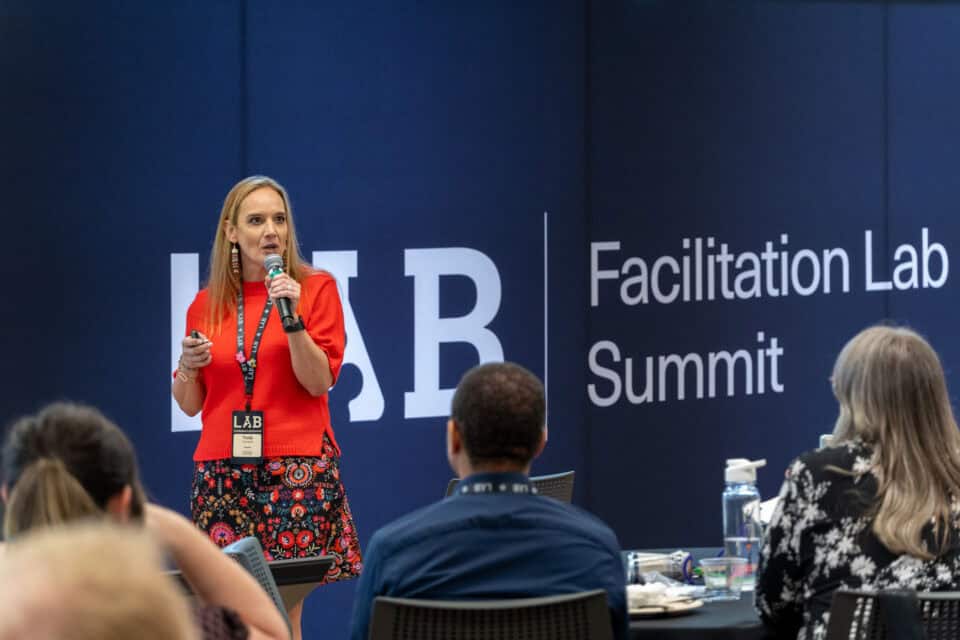
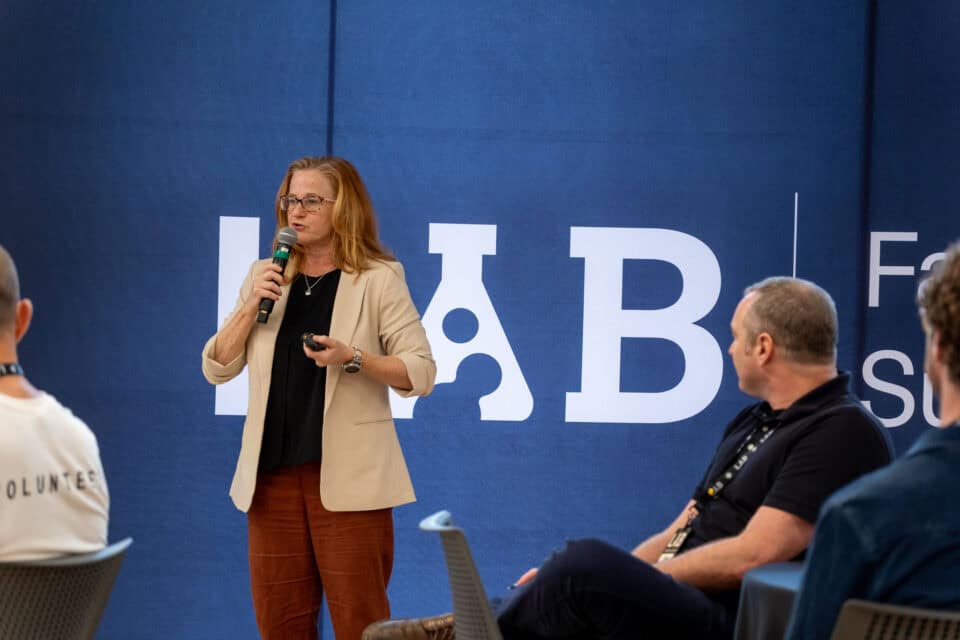
This year’s theme was “Edges” — exploring the moments of tension, uncertainty, and emergence where the most powerful facilitation happens.
Table of contents
Dan Walker
Unlocking Collective Wisdom
In his session “Unlocking Collective Wisdom,” Dan Walker invited participants into a rich conversation about why we facilitate in the first place. Rooted in his foundational belief that the smartest person in the room is the room, Dan guided the group through reflections on collective process, the tension between urgency and long-term change, and how to maintain wellness when the world feels like it is at an edge. Drawing on a personal story of burnout and a transformative conversation with an indigenous elder who offered one word — patience — Dan helped participants explore the difference between the urgent need of now and the generational nature of real change.
The session closed with a practical focus on navigating turbulence in facilitated spaces, surfacing strategies from the room: slow down and let the turbulence be the wisdom that wants to be heard, set clear containers before anyone walks in, and use the Lewis Deep Democracy practice of “finding the no” to honor the full complexity of a group. Participants left with a reminder that discomfort is not danger, and that collective wisdom, given the right conditions, will always find its way through.
Renita Joyce Smith
The Edge of the Room Is the New Center
Renita Joyce Smith’s session challenged facilitators to stop trying to engineer trust with frameworks and checklists, and start asking a more uncomfortable question: how much of you is actually in the room when you facilitate? Opening with her “welcome mat” slide — a belonging-first introduction that traded resume bullet points for honest self-disclosure — Renita modeled the core thesis of her talk: being real enough so the room can be real back. She shared a pivotal story of missing a moment during an executive retreat when a CFO named a trust problem and Renita moved on to the next activity, a choice that defined the rest of her facilitation philosophy.
Through the Hamilton stage metaphor and a three-part framework of notice, name, and invite, Renita gave participants a practical architecture for being present as a full human while still holding the room. The tip exchange that followed surfaced tools from across the group: stuffed elephants for naming the unspeakable, fist-of-five checks done with eyes closed, ten-second pauses, and the reminder that clarity is kindness. Renita’s closing note: we are never finished becoming, and that is not a problem. It is the practice..
Chris Lunney
Navigating the Unknown with Whole Intelligence
Chris Lunney opened with a blank slide and a question: “What did you just experience right there?” It was the first of many moments in his session designed to demonstrate that navigating the unknown requires more than analytical thinking. Through the concept of whole intelligence, Chris introduced a framework for integrating all four sources of knowing: the analytical mind, somatic and emotional awareness, subconscious and imaginal insight, and personal and collective understanding. His central provocation was that when we try to plan the perfect path from Point A to Point B, we almost always end up stuck, because we are using a map without a compass.
The heart of the session was a guided meditation centered on a simple but powerful image: opening a refrigerator in the middle of the night to find the exact feeling your heart desires. Participants emerged from the exercise with words, phrases, and clarity that surprised them, and several noted that their answers converged with reflections from earlier in the day. Chris then introduced a framework for converting those insights into trackable experiments using Anne-Laure Le Cunff’s approach from Tiny Experiments: small, timed commitments that generate information rather than demanding proof. The takeaway was both practical and poetic. Start with the compass, then get out the map.
Shannon Hart
Innovation: Stepping off the Edge and Leaving the Agenda Behind
Shannon Hart drew on five years of facilitating innovation sessions at Shell International — working alongside geoscientists, petrophysicists, and data engineers on complex energy challenges — to make the case that real innovation does not come from a perfect agenda. It comes from creating the right conditions and trusting what emerges. She introduced a three-part framework built around base camp, unmapped terrain, and emergence, framing the facilitator’s role as less tour guide and more Indiana Jones: there is a north star, the right skills are in the room, but there is no pre-drawn map.
A three-circles co-creation exercise gave participants a visceral experience of how ideas evolve through collective contribution — how unfinished sparks become richer when passed between people, and how human brains are wired to find pattern and meaning even in fragments. A walk and talk sent participants into the literal unknown for 15 minutes to explore how ambiguity feels in the body. Shannon closed with a focus on emergence: the signs that real innovation is happening (including the moment when no one is sure whose idea it was anymore), and the warning signs of convergence happening too fast. Her final challenge to the room was to protect the quiet sparks, the voices that get lost in cultures that reward whoever speaks loudest and fastest.
Joe Randel
Last Night a DJ Saved My Life: Finding Your Voice as a Facilitator Through Metaphor
Joe Randel came to facilitation through music — as a roadie, musician, radio DJ, and talent buyer — and his session explored how adopting a metaphor as a lens can help facilitators find their voice and navigate the unknown. The DJ metaphor took shape for Joe during Voltage Control’s core certification program, watching a facilitator lead a room of strangers through a dynamic, collaborative experience and realizing: he’s like a DJ. That lens has guided his practice ever since, and his session invited everyone in the room to identify their own.
Through the Wimbledon exercise — placing participants first as fans, then as the opponent’s coach watching the same match — Joe demonstrated how powerfully a lens changes what you notice. The session then moved through two tracks: finding your voice (built from preparation and interpretation, the patterned choices that make any facilitation distinctly yours) and reading the room to sculpt the journey (transitions, sequencing, arc, and the whole session as an act of co-creation). A live simulation challenged participants to decide in 10 seconds whether to cut, blend, or let it end as a strategy session went sideways and time ran out. Every answer was different, every answer was right, and every answer revealed something about the person who gave it. Journey, Joe reminded the room, is not what we prescribe in advance. It is what we sculpt together.
Brian Buck
At the Edges of Belonging: Presence Illuminator, Practicing a Value-Directed Facilitation Identity
Brian Buck opened not with a framework but with an invitation to close your eyes and remember someone who truly saw you. Not your performance, not your output, but you. That meditation set the tone for a session about what it means to shift identity as a facilitator from someone who brings the fire to someone who ignites it in others. Through the concept of value directions — ongoing orientations that give goals their meaning and never fully end — Brian invited participants to ask what kind of facilitator they are becoming, not just what skills they are acquiring.
His three-part fire model gave that question a practical frame: ember (the internal work of arriving regulated and grounded), kindle (holding the container, the stage most experienced facilitators live in most of the time), and illuminate (seeing others so fully that their own fire gets called forward). The session included a paired exercise in two rounds — first in kindle mode, then shifting into illumination using a reference sheet drawn from David Brooks’ book How to Know a Person — and the contrast was immediate. Participants emerged with clarity on challenges they had been carrying for months. Brian closed with the question he hopes every participant carries forward: what is waiting to be illuminated through your facilitator presence?
Robin Neidorf
At the Edge of Knowing: Embodied Practice for Whole-Self Facilitation
Robin Neidorf opened her session with the entire room standing and singing “Are You Sleeping” in three-part harmony — a deliberate choice, because embodied sound regulates the nervous system and puts people quite literally in harmony with one another before a single concept is introduced. Drawing on nearly 30 years of parallel practice in facilitation and yoga, Robin made the case that facilitators routinely leave half their instrument behind. If the facilitator’s body is not fully present in the room, participants’ bodies will not be either.
The session moved through a partnered energy-sensing exercise that surprised more than a few self-described skeptics, a chakra-based framework for identifying which energy center is each person’s natural access point for grounding before sessions, and an extended eye-contact exercise across groups of two, three, four, and five that gave participants a felt sense of what each group size does to the relational field. Two is deeply vulnerable. Three is highly creative. Four is suited for convergence. Five is where people begin to check out. Robin closed with a pipe cleaner exercise where participants built physical models of how they want to feel when facilitating, and a collective om chant that asked everyone to let the body’s vibration do the final work of integration.
Trudy Townsend
Facilitating at the Edge: Building Trauma-Informed Spaces
Trudy Townsend closed the summit by going, in her own words, “straight at” the topic every other presenter had been circling. Trauma, she told the room plainly, is already present in every group you will ever facilitate. You do not need to do anything to put it there. Drawing on the landmark ACEs study — which found that two-thirds of the population has experienced at least one significant childhood adversity, with profound effects on adult health and wellbeing — Trudy grounded the room in the science before moving to practice. Trauma, she was careful to clarify, is not the event. It is the experience of that event living in the body.
Using Dan Siegel’s hand model of the brain, Trudy walked participants through how the amygdala, hippocampus, and hypothalamus work together to protect us, and how the prefrontal cortex — where learning, reasoning, and connection live — goes offline when the protective response fires. She named five types of safety that facilitators can actively tend: physical, psychological, social, moral, and cultural, while making space for a participant who named clearly that some bodies in the room face threats that go well beyond the discomforts most facilitation training addresses. The session closed with a reframe participants carried out of the room: we cannot guarantee a safe space, but we can invite people into a brave one. Trauma-informed facilitation is not a checklist. It is the sum of everything that has been explored across two days at the edge.
The 2026 Facilitation Lab Summit was a reminder that the most important work in facilitation happens at the edges: the edge of what we know, the edge of who we are, and the edge of what becomes possible when a room full of people truly shows up for one another. We are grateful to every speaker, participant, and volunteer who made this summit possible. We look forward to seeing what emerges from these conversations in the year ahead, and we cannot wait to gather again.
You can read full recaps of each session on our blog. And if you’re looking to keep your practice going, join us at our weekly Facilitation Lab meetups—where the learning never stops.