Joe Randel on Metaphor, Voice, and Reading the Room at the 2026 Facilitation Lab Summit
At the 2026 Facilitation Lab Summit, Joe Randel (roadie, practicing musician, radio DJ, and talent buyer) opened his session with a confession: the talk isn’t really about music. It’s about a way of seeing. When Joe joined Voltage Control’s core certification program, he found himself feeling completely out of his depth within the first 15 minutes. Unfamiliar terms, unfamiliar tools, unfamiliar people. And then he watched Eric facilitate, leading a room of strangers through something dynamic and collaborative, softening when vulnerability entered the space, amplifying when energy rose, and it clicked. “You know what? He’s like a DJ.” That single metaphor gave Joe a lens that has guided his facilitation practice ever since, and his session was an invitation for everyone in the room to find their own.
The Power of a Lens
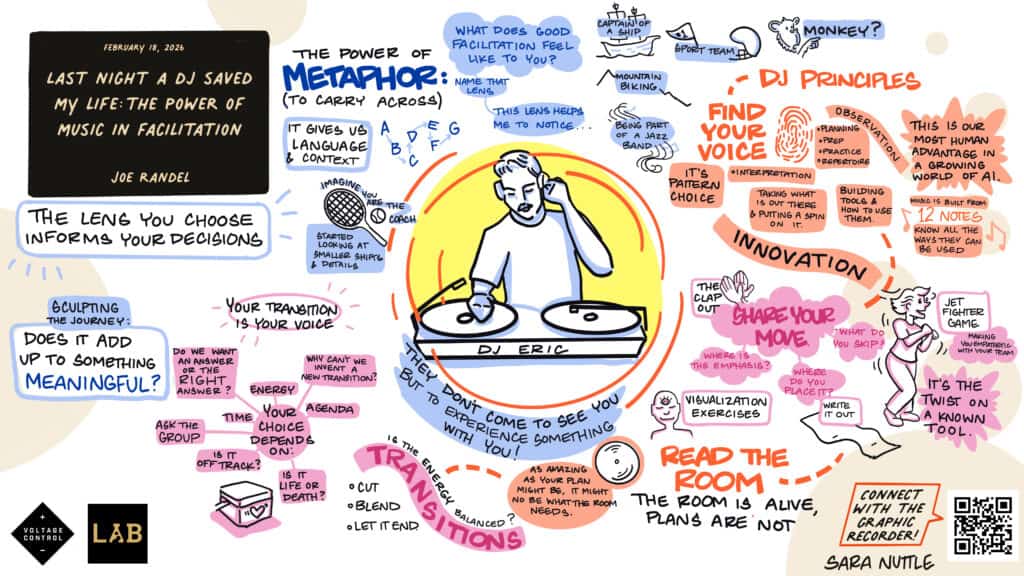
Joe opened with the idea that metaphor isn’t just a literary device; it’s a practical tool. Metaphor literally means to carry across: to transport meaning from one domain to another. When someone says a meeting “went off the rails,” you instantly understand loss of direction, loss of momentum, loss of control. No further explanation needed.
To make this visceral, Joe ran a quick exercise. Participants imagined themselves at Wimbledon, center court, front row, watching their favorite player. Then he asked them to take the same seat, same match, but this time as the coach of the opponent. Same scenario. Completely different experience. One perspective tracked the weather and the crowd; the other was scanning for patterns, weaknesses, and moments of frustration. The point landed cleanly: the lens doesn’t change what’s in front of you. It changes what you notice.
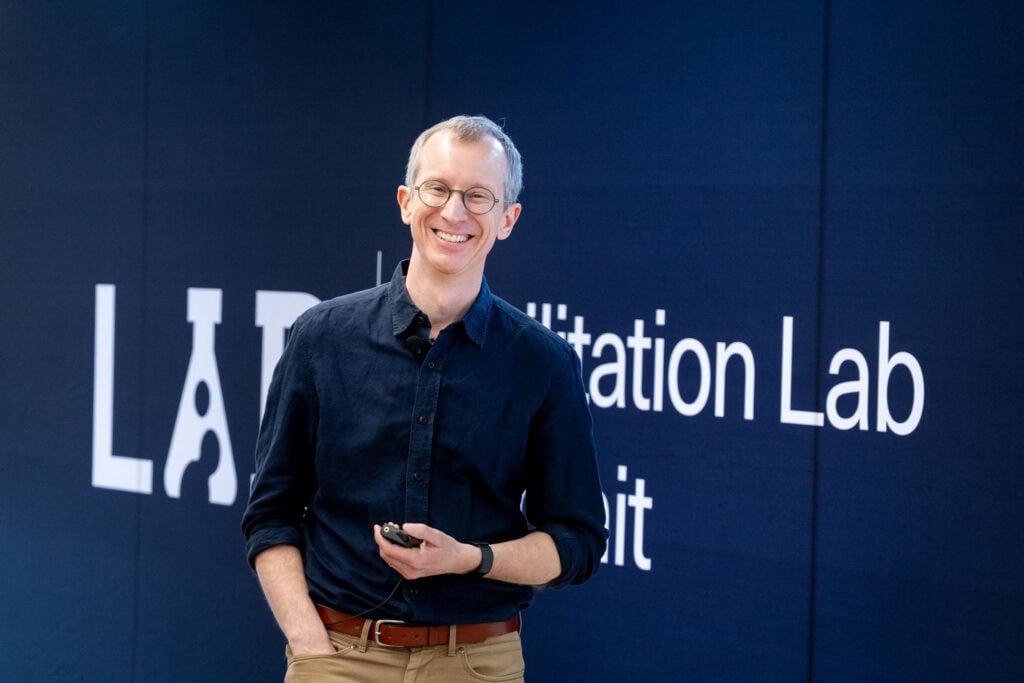
Participants then identified their own lens, the activity or practice that, when they’re facilitating well, it feels like they’re doing. Captain of a ship. A monkey swinging through the jungle, charting its path on the fly. A member of a jazz band, knowing when to come forward and when to fade. A sports metaphor grounded in balance and flow. Each one different, each one a window into how that person understands their work.
Finding Your Voice
Joe introduced the concept of voice through Richard Kneebone’s book Expert: Understanding the Path to Mastery, which identifies voice as the penultimate stage of mastery. Defined through jazz, voice is the unique musical fingerprint that distinguishes one musician from another. It’s why you can tell Miles Davis from Dizzy Gillespie even when they’re both playing the same instrument. It’s why James Earl Jones reading “Twinkle Twinkle Little Star” sounds different from anyone else reading the exact same words.
For DJs, voice is built from two things: preparation and interpretation. Preparation means building an extensive repertoire, not just the hits but the deep cuts, the surprising choices, the things that will delight an audience in unexpected ways. It means observing other DJs, learning how crowds respond, scouting the venue in advance. It means getting the reps in wherever you can find them. Interpretation is where voice actually lives: how you play a track, how you transition between two songs, what order you sequence them in, the choices you make with other people’s tools that somehow become yours. As Joe put it, a DJ can play the same records you could buy at any store and still sound like no one else.
Facilitators have this too. We build repertoire through methodological range, through co-facilitation with more experienced practitioners, through practice playgrounds that let us experiment without high stakes. And we develop interpretation, the patterned choices that make a framework ours, the instinctive adjustments we make in real time, the way we put a particular prompt or activity into the arc of a session in a way that reflects who we are.
Joe gave participants a chance to excavate this in an exercise he called Something Borrowed, Something You: identify a facilitation move you didn’t invent but use often, and articulate what makes it yours. What came back was vivid. A needle-drop checkout where music hits the exact moment the group claps out the session. A coaching-on-a-page handout designed to anchor internal reflection before external output. A visioning exercise that asks participants to imagine sitting next to their company at a dinner party. In every case, the move wasn’t original. The voice was.
Joe was clear that this matters more urgently now than ever. AI can generate an agenda, populate a session plan, suggest activities. What it cannot do is bring a voice. “Your voice is your competitive advantage against AI,” he said, not because the work is oppositional, but because the human fingerprint of how you facilitate is exactly what makes facilitation irreplaceable.
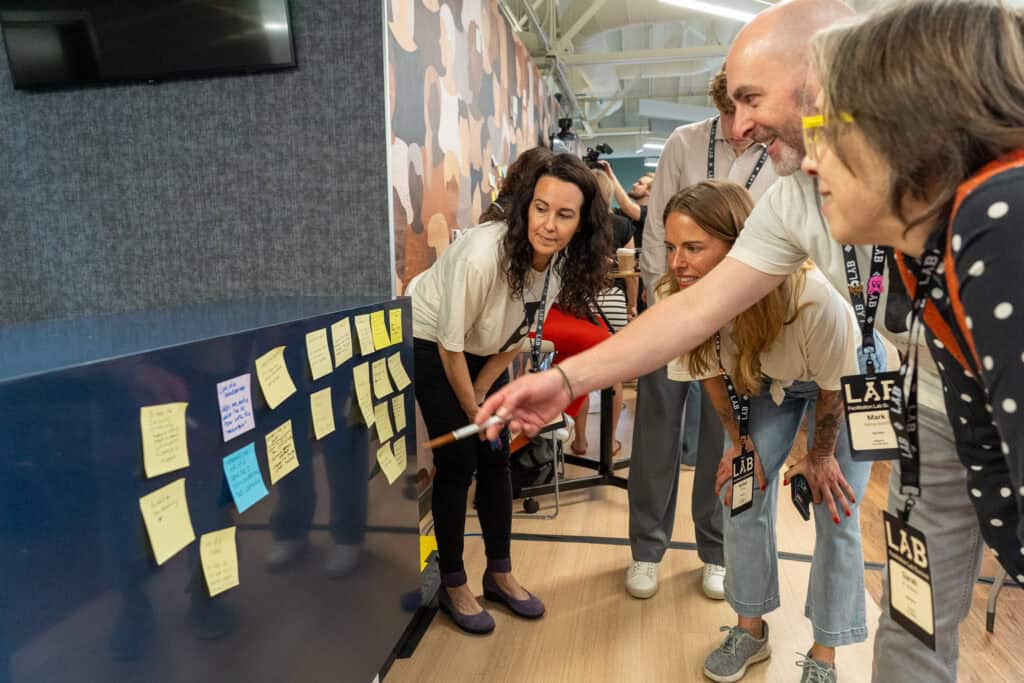
Reading the Room to Sculpt the Journey
Once you have a voice, the work shifts: now you have to learn when to use it, when to soften it, and when to get entirely out of the way. That’s track two, reading the room to sculpt the journey.
Joe used the image of Questlove performing with one earphone on and one earphone off to illustrate what great presence looks like in practice. The ear with the headphone on is listening to what’s cued up next, evaluating whether it’s still the right move. The open ear is listening to the room, sensing the energy and reading what’s actually happening. Preparation gives you the options, Joe noted. Presence is what tells you which one to choose.
For facilitators, this plays out in every transition. Joe offered three moves drawn from the DJ world: cut (intervene and redirect), blend (carry the current energy into the next activity), or let it end (honor what’s happening in the room even when you’re off schedule). He ran the room through a live scenario. A strategy session, 45 minutes in, a cross-functional leadership team in the middle of something real, and then: you’re 10 minutes over time and the client needs a deliverable by end of day. Cut, blend, or let it end. Ten seconds to decide.
The answers split across all three, and every person had a clear, considered reason. One facilitator said she’d blend because cutting would give her too much anxiety. Another said he’d let it end and let the system see itself, then co-design the path forward with the group. Another called for an “aggressive blend.” One participant named a fourth option entirely: divide, breaking into parallel conversations using remote tools, and compared it to a silent disco. What Joe lifted up was that the diversity of answers wasn’t a problem. It was voice in action. The lens you use guides the choice. The choice reveals who you are.
Joe closed by zooming all the way out to the largest unit of time: the journey. Transitions happen in seconds. Sequencing unfolds over minutes. Arc plays out across tens of minutes. Journey is the whole session, and it’s not something you prescribe at the start and hold to. It’s something you co-create and sculpt. And what people take away from it, Joe reminded the room, is never the specific activities or the particular transitions. It’s how they felt. Whether it meant something. Whether they left changed in some way they couldn’t entirely name. That, ultimately, is what facilitators are building, one choice, one lens, one room at a time.
Watch the full video below:
Transcript of Joe’s Session:
Joe Randel (00:00:00):
I say that I know about 10% about a lot of things and a little more than 10% about a handful of things. And one of those handfuls of things is music. As Eric mentioned, I’ve had the opportunity to be a roadie on a tour bus, to be a practicing musician, to be a radio station DJ, to be a talent buyer and a booker for music venues. And really overall, just someone who’s been incredibly fortunate to have my life enriched by music. So I’m really excited to any chance that I get to talk about anything music related. But today is really only indirectly about music and about DJing. It’s about a way of seeing and about what we notice. It’s fundamentally about how adopting a metaphor as a lens, in my case, that of a DJ, really helped me to understand my work, to help me clarify my purpose, and also to help me find my voice as a facilitator.
(00:01:10):
So that’s what we want to dig into today, and I’m really excited to see what comes up for us. So this idea really wasn’t theoretical in nature. It came out of a moment of recognition. In February of 2024, I logged on to Voltage Control’s core certification program. And within about 15 minutes, I was very confused about whether or not I was in the right place. It was an unbelievably welcoming space, but I was hearing terms that I didn’t know. Everyone that introduced themselves had a really interesting job that I’d never heard of, and skills that I was not familiar with, and we were using platforms that I didn’t know anything about. And in short, I really felt like I was out of my depth.
(00:02:07):
And in those moments, as I kind of mentioned yesterday during Chris’s presentation, in moments of uncertainty, I tend to look to humans. And so I zeroed in on Eric and I was observing what he was doing and very quickly was really bowled over. He was leading a group of complete strangers through a shared experience, a very dynamic and collaborative one, with shifts in energy along the way. When somebody would tell a funny story or joke, he would respond in his countenance and in his tone and his volume. He would steward that momentum forward when somebody would offer up a moment of vulnerability, he would soften, he would leave more space, and it was just really remarkable to watch that transpire. And all of a sudden, it kind of dawned on me. I said, “You know what? He’s like a DJ.” I’d been a DJ, I knew a little bit about music, and so instantly I kind of had a lens that helped me to see this work in a different and familiar way.
(00:03:29):
So at any point during that class session and subsequently through the program, and then after I started doing a little bit of facilitation on my own, when I would hit those moments of uncertainty, I found myself asking, “What’s the DJ move here? What’s the DJ doing in moments like this? ” And that’s always provided me with a lens that has given me clarity, has given me support, and really helped open up a lot for me in my journey. So I want to start with this idea of metaphor. Metaphor literally means to carry across. It’s the act of caring meaning from one place, one domain to another.
(00:04:18):
Yesterday, I think someone even used this phrase of something going off the rails. When we hear a meeting goes off the rails, we know that means loss of direction, loss of control, loss of momentum, and you don’t need to say all of those words. That meaning is sort of carried over with that image. I think it’s interesting, we’re introduced oftentimes to the idea of metaphor through an English or a literature class or context in grade school as this sort of flourish, this way to dress up the language, but it’s actually super practical. We use these all the time because they work. So what I want to start with today is exploring a little bit about metaphors that each of us use in our work. So I want to ask you to take a couple of minutes, in the baskets or somewhere on your table will probably be some Post-it notes if you need those, if you’ve got other paper to write down.
(00:05:16):
But I want you to take a moment to reflect individually on when you think about your work as a facilitator, when you’re facilitating and it’s going well, what does it feel like? What does it feel like you’re doing in that moment? Or if you want to think of it another way, if it were another practice or activity that you know well, what would that be? It may be helpful to think of something that you do where you trust your intuition, where intuition guides you. And it could be anything. It could be baking sourdough bread, it could be dancing the tango, it could be editing a film, it could be gardening, anything. But what does it feel like you’re doing when you’re facilitating and it’s going well? So I’m going to give you a couple of minutes to think about that and then we’ll move on. And what I want you to do is take that activity that you’ve just identified and throughout the rest of our session this morning, we’re going to kind of think of that as a lens.
(00:06:35):
And what I want you to do next is to grab a single sticky note, and on that sticky note, I want you to write two things. The first is the name of that lens, in my case, a DJ. And the second, I want you to finish this sentence, which is, “This lens helps me to notice…” Blank. Whatever using that lens in a moment might make more clear to you. So in my case, lens of a DJ, this helps me to notice when the energy in a room shifts. So take a second, write those two things on a single sticky note, and then what I’m going to ask you to do is to take your sticky note, also take a writing utensil and stand up and walk to the back wall, the wall that’s got this beautiful kind of mosaic, human mosaic… Or also it’s kind of like an audience I’m realizing.
(00:07:43):
It’s like you’re facing an audience of people who look about split. Half of them are utterly disinterested in looking the other way and some of them are looking forward at you. I don’t know that I… I wish I hadn’t noticed that until now. But you’re going to go to that wall and what I want you to do is put the sticky notes up on the wall. They don’t need to be thematically grouped in any way, but what I want you to do is to put them in columns, think of it sort of like a spreadsheet or more appropriately, think of them like the display in an eyeglass store where you have rows and rows of frames. Just stick them over there. After you put yours on the wall, take a step back, leave a little bit of space for other folks to get in there because we have a large group.
(00:08:25):
And then after everybody’s put theirs up, I want you to do a little window shopping. I want you to peruse. Look at those different lenses. And when you see one that piques your curiosity, one that’s interesting to you or one that resonates with you as something that you can relate to, that lens, just put a plus mark on it. You can have multiple pluses. It’s not a single one and we’re not voting for a best lens here. It’s just identifying which ones speak to us, which ones feel like there may be a shared language. So take your sticky note, you go onto the back wall. If you fill up all the room there, the overflow area is the blue bar area for where the tech team is set up.
Speaker 2 (00:09:12):
[inaudible 00:09:12].
Joe Randel (00:09:20):
So as we kind of regroup here, I would love to have a couple folks sort of share what comes up for you when you review those, when you look at the variety of responses from your colleagues here.
Speaker 3 (00:09:37):
It’s a little ironic that I chose this because my father-in-law has a sailboat and I do everything I can to avoid being on a sailboat, but I said, “Captain of a ship,” because you’re guiding, you’re steering, you’re navigating, there might be weather that comes up. You maybe need to change course a little bit and you’re heading towards a destination. Maybe you don’t know exactly where it is, but you know the direction. So that’s what came up for me.
Joe Randel (00:10:00):
Right on. Awesome.
Speaker 3 (00:10:01):
Sorry for the sailors in the room.
Joe Randel (00:10:03):
No apology needed. Yeah. What about some other folks? What else came up for you when you looked at all those options of different lenses that were up there?
Speaker 4 (00:10:11):
Hi, I look for inspiration through the metaphor of nature often. And so I was just absolutely tickled by somebody’s sticky that said, “Monkey.” I mean, so wherever you were going with that, I love it. But just like thinking of the behavior of a monkey, like swing through the jungle and pivoting and going from one place to the next, like essentially charting their path as they’re doing it. I just love that visual metaphor.
Joe Randel (00:10:49):
Awesome. Yeah. And see how powerful it is that you can even take a lens that wasn’t yours initially and just having it as an option opens up new ways of thinking about it. Anyone else? Yes.
Speaker 5 (00:11:08):
So being a member of a band, usually in an improv sense like jazz or something, and that… It’s not being the leader and it’s being a member of it and letting the structure hold the space for it. And then it’s that listening, knowing I’m going to come forward and I’m going to fade.
Joe Randel (00:11:25):
Awesome. Awesome. Thank you. Oh, yes.
Speaker 6 (00:11:30):
So I found I was really kind of drawn to the sports type metaphors, which surprised me, but they were all about balance and kind of knowing when you’re in the flow and knowing when you’re kind of off kilter. And I realized for me, that was like one of the things I aspired to as a facilitator. So what you just described about adopting somebody else’s, I’m like, “Thank you, whoever put that out there.”
Joe Randel (00:11:53):
Awesome. Yeah, a metaphor is really powerful for kind of instantly giving us language to understand something unfamiliar. I’m really excited to hear about more options for lenses and to peruse these as well. I want to move on to another exercise real quick. We’re already kind of starting to see this in how people are describing. Everyone has used something completely different. We had captain of a sailboat, we had mountain biking, we had monkey, we had being in a jazz band. This is a pretty broad spectrum of things, but we’re all applying these to the same work that we’re all doing in facilitating groups. To make that even sort of more kind of vivid, when you switch lenses, the point I really want to make is how it helps you to notice different things. So I’m going to give you a scenario and I want you to take in this scenario as yourself, which is you are sitting at center court, front row of the… I always forget, the All England Lawn Tennis and Croquet Club, which is the full name of Wimbledon.
(00:13:03):
And it is the women’s semi-finals and your favorite player is playing. So I want you to take a second. You can close your eyes if you want and just put yourself there and ask yourself, kind of what are you paying attention to? What emotions are present for you? What makes you really happy when you see it happen? Okay. So now that you’ve got that, now I want to take the exact same scenario. You’re in the same seat, still at Wimbledon. It’s an unusually sunny and pleasant day there. But now instead of being yourself, you are now the coach of the professional tennis player who has already won their semi-final match and who will face the winner of the match that you’re watching right now tomorrow.
(00:14:06):
So now you’re the coach of the opponent of the winner of this match. And I want you to ask yourself the same questions. What are you noticing? What are you paying attention to? What are you zooming in on? What are the things that happen that trigger specific emotions for you? What makes you happy when you see it? Right. Okay. So that’s one way that you can kind of see how quickly things shift. For one Voltage Control buck, who can tell me something that they were focused on in the latter role, the coach of the opponent?
Speaker 25 (00:14:58):
The thing that I was focusing on was more of their form, tiny details, whereas when I was myself, I was like, “Oh, the weather,” and, “How’s [inaudible 00:15:09]?” [inaudible 00:15:09] was completely fit and different.
Joe Randel (00:15:12):
Awesome. Awesome. Anybody else?
Speaker 8 (00:15:14):
In the second scenario, I felt that I was looking for patterns and weaknesses and strengths to see where they could be exploited in the next round.
Joe Randel (00:15:31):
Awesome. Absolutely. One more. Sorry. Yeah.
Speaker 9 (00:15:43):
I wrote down that I was noticing their [inaudible 00:15:43], so there are patterns when they’re getting flustered and when they’re getting frustrated, kind of what’s causing that. So using that to my advantage there.
Joe Randel (00:15:54):
Awesome. Yeah. Yeah. So again, the point that I want to drive home, same scenario, same context, same things that are going on in front of you, same activities, but completely changes what you notice, what you pay attention to. Now that we’ve kind of introduced this idea of a metaphor, thinking of it as a lens, I want to return to the lens that I use that was really helpful for me to kind of further demonstrate this, but also maybe open up some different possibilities that for any non-DJs, may resonate as well. So when we think about these lenses that we have, a DJ has a lens too that they’re using to understand their purpose at a particular event, to guide their actions, and to evaluate the things, and to really drive their attention around what they’re going to notice.
(00:16:54):
There’s a lot of different things, but I want to focus on kind of two primary… We’ll call them sort of orienting principles, or in the language of DJs, we’re going to call them two tracks. The first one, track one, is finding your voice, and the second one is reading the room to sculpt the journey. So I want to start with finding your voice. In a book that I really like and really recommend by author, Richard Kneebone, called Expert: Understanding the Path to Mastery, Kneebone talks about six stages of mastery, and the penultimate stage of mastery, he calls voice, and he uses sort of a definition from the world of jazz to explain it. And he defines voice as the unique musical fingerprint that any musician has, no matter what instrument they’re playing. It’s why you can tell the difference between Miles Davis and Dizzy Gillespie, both playing the same instrument.
(00:18:00):
To make it less musical, I could read you the nursery rhyme, Twinkle Twinkle Little Star. I could then play you a recording of James Earl Jones reading it, or Maya Angelou. Something is clearly different. Same words, same order, but there’s something different. And so there’s that unique musical fingerprint that we have. And in all professions, you have a voice. As facilitators, we have those as well. So when I think about finding your voice, there’s sort of two components, two buckets. The first one is preparation, and the second one is interpretation. Under preparation, we’ve got things like repertoire. DJs are sort of known for spending all disposable income and non-disposable income on the acquisition of records, CDs, cassettes, hard drives to house their MP3s.
(00:19:04):
They’re always looking for everything too. They want the hits, the things that they know will bring people onto the dance floor. They also want, in DJ speak, what they call kind of deep cuts, things that will delight, things that will surprise, things that will peak the audience curiosity, things they haven’t heard before. So they’re always working to build that repertoire and to invest in that. Observation. They are the quintessential students of the game. DJs go and see other DJs perform. They watch how audiences respond to them. They watch how DJs respond to different things that occur in the audience, what songs they play, what order they play them in, how people respond to that.
(00:19:49):
They also plan, and we’re going to dig a little deeper into this idea of planning in a minute as well, but DJs have to plan both for the setting in which they’re going to be operating, but also for the experience that they’re anticipating their audience looking for. So they go to the club the night before to see, “Do they have turntables there or do I need to bring my own? Do they have a CD player? Do I need to bring my own? Where am I going to be seated? Where is the DJ platform? What can I see from there? How do people move around in that space? Where’s the bar? Where’s the exit? Where are the tables?” They’re observing to get a sense as part of this preparation. And then obviously practice, get the reps in. DJs start out wanting to send everyone and their mother playlists that they make.
(00:20:39):
Then they offer to DJ your backyard barbecue or to throw a barbecue at your house. And eventually, they get booked to come perform at a festival or in a club or something like that. So they’re working really hard to make sure that they get the opportunities to practice and put these things into play. The other component of that is interpretation. This is the one that has always really fascinated me. This is how they DJ. When they choose to play a particular song, how they choose to play it, how they might edit it, how they might remix it, how they might connect two songs, the transitions between them. If you think about how unique this is, a DJ is playing records that some other artists made of a song that some other artist wrote and recorded. It’s not their own… The singing, the track itself is not theirs. And not only is it someone else’s, most of the time it’s the same one that you and I could go buy, if it were the ’90s, at Tower Records.
(00:21:54):
So there’s a way that even when you’re using sort of the idea of found objects and other people’s tools, that your voice can still really appear. So the interpretation part of it also includes sort of an unspoken thing about DJs, but also about artists more broadly, that there’s an innate empowerment to innovate. DJs always see themselves as standing on the shoulders of giants, being influenced by someone that got them wanting to do this, and then trying to figure out what they’re going to do to take this further. Where are they going to find that unique fingerprint, that unique voice that they’re seeking? So they take the tools that they’re given and they don’t feel restricted. They don’t feel like they can’t change the order they play them in. They don’t feel like they can’t change the rhythms. They don’t feel like they can’t put Neil Diamond’s Sweet Caroline back-to-back with Bad Bunny.
(00:22:53):
And so that empowerment to innovate is a critical part of this interpretation. Now, these concepts obviously should feel quite familiar to us as facilitators because I would argue facilitators also have a voice and it’s made up of the same things, preparation, our repertoire. By the way, this is one of the things I love about Voltage Control, the kind of methodological agnosticism. That’s on camera, right? I’m on. This idea that the more tools you have, the more prepared you are for any given situation. It doesn’t mean that liberating structures won’t cover you, but you may need something from Gamestorming. You may need from a different school of thought. So like a DJ, we as facilitators are constantly building our repertoire of frameworks, of warmups, of icebreakers.
(00:23:58):
And in addition to that sort of preparation, the component of repertoire, there’s observation. I think one of the most powerful things about the culture and the community of Voltage Control is you get the opportunity to observe other facilitators applying their craft. And another great way that we get to do this is to co-facilitate with other folks. And so you get a chance to see how other people, more experienced folks, do things and to sort of take the pieces that resonate with you and incorporate them into your own style. Planning as well. We’ve got great tools like SessionLab, great facilitators, plan the presentation. They’ve got their Miro board built, they’ve got their SessionLab, they’ve got their boxes of sticky notes, they’ve got kind of everything there so that they go into a space, which they also have researched.
(00:24:52):
It’s always a great idea to go to the room you’re going to facilitate the day before and understand where the power outlets are, “Does it have a projection? What’s the wifi like? Am I going to be able to zoom people in or not?” I think a favorite is, “Do sticky notes stick to these walls? What is the surface?” So that’s kind of this preparation element. And then again, we talk about planning and then talking about practice, right? Same thing. The practice playgrounds that I think are so fantastic that Voltage Control puts together. You want to get the reps in. You want to figure out, “How does this stuff work? Where can I make some modifications? How do I make this particular device sort of my own?”
(00:25:41):
I think the other thing when we think about… If we flip over to interpretation, I think this is something that as facilitators, we don’t do inherently, but I think it’s important that we think through the same lens. And that’s that idea of the empowerment to innovate. We’re going to dig into this, in an activity in just a second, but anybody can go on liberating structures, can ask ChatGPT, can get the instructions for a lot of the devices that we use, and they can read and follow those directions explicitly. And it’ll work. But the reason that people hire facilitators is this voice. It’s the human element of what we do. It’s the way we adjust those frameworks in different ways that suit the needs of the room and suit our voice as a facilitator.
(00:26:31):
So that value that we bring is really, really critical. And so I want to encourage folks, as we think more about this idea of voice, how you lean into that, because it’s a really powerful thing. I mean, once you find your voice, it gives you that tool that you can call on when something sudden, surprising, happens in your session, and you’re trying to dig deep and figure out how you’re going to respond to it. Now, I would argue that obviously voice has always been a critical component, but for me, this feels so important in our current moment of technological change where artificial intelligence is rapidly revising on what seems like almost a momentary basis, the roles and responsibilities, the interaction between human and machine.
(00:27:23):
And your voice, I would argue, is your competitive advantage against AI. And I don’t mean to set that up in an oppositional way, but in terms of the differentiation, it’s your voice because we’ve probably all done this. You can go to ChatGPT and say, “I’m running a workshop with these people,” and it will spit out the agenda. It will give you the activities. It will give you all those things. Voice is really somewhere that I think in the present and the future of facilitation, we’ve really got to lean very heavily into that because I think it’s the most human quality of our work and that, which makes it essential.
(00:28:00):
So I want to do a little bit of an exercise in finding your voice. I’m reminded a little bit of… There’s a great quote from the legendary record producer, Quincy Jones, that relates to voice and how he was finding his voice as an arranger, as a composer, and then as a producer. And he took piano lessons from a legendary French composer and piano instructor, Nadia Boulanger, and she famously said to him, “Quincy, there are only 12 notes, and until God gives us 13, I want you to know what everybody did with those 12 notes. Bach, Beethoven, Bo Diddley, same 12 notes.” For me, it was very intimidating initially this idea of, “Everybody’s got these same tools. How do I do that?” And the lens of a DJ and finding your voice was really what kind of helped me to do that.
(00:29:00):
So what I want to do now is kind of dig into this a little bit at our individual sort of voice level with something… I’m going to call this Something Borrowed, Something You. And I want you to take a moment, individually. We’re going to pair up in a little bit and get to share more with folks at our table, but I want you to think about a facilitation move that you have. It’s something that you use often, something that you didn’t invent necessarily. A move in this setting can be a prompt, it can be a framework, it can be an icebreaker, it can be an artifact or a technology tool or a prop or something like that, but it’s something that you use often as a facilitator, one of your kind of go to moves, so to speak.
(00:29:46):
So take a minute and think about… Identify one of those in your work. And if it helps you in thinking through this aspect of what you do differently, think of it as, what are the instructions that you might alter? What’s an element that you might soften in the description of how you might implement this? Where’s the place that you always instinctively put it into the overall arc of your facilitation? Okay. So once you’ve got your facilitation move, I want you to turn to the person to your left and I want you to share your move with them.
(00:30:30):
You can literally get up and demonstrate it if you want. And I want you to tell them how you use it differently specifically. So I want you to tell them what move you wrote down and then what it is about that move that makes it yours and how you might use it differently that feels like something that you own. Okay? So take a minute, turn to the person to your left and share.
(00:31:11):
All right folks, clap once if you can hear the sound of my voice. Clap twice if you can hear the sound of my voice. Clap three times if you can hear the sound of my voice. Clap four times if you want some Voltage Control bucks. All right. Awesome. So I’d love to hear from some folks, how that went. What came up for you in those conversations? Yeah.
Speaker 10 (00:31:48):
Thanks, Mark. I can’t wait to hear other people’s things because I’m like, “Oh, this is a wealth of knowledge in this room.” But I was sharing an example that related back to what you were talking about with the power of music and being a DJ and that sometimes in a in-person environment, I’ll have everyone do a one word checkout and then I’ll lead us in a clap out. So I’ll be like, “Hey, Anna, Sarah’s going to count us out. She’s going to go one, two, three. We’re all going to clap. This gathering will have concluded. We’ll see you at the happy hour.” And then so we’ll do the clap out and then as soon as the clap hits, the needle drops on whatever song it is. And then we all just go into the happy hour. So otherwise there’s that awkward like, “Oh, there’s no music happening.” But we love a needle drop moment. Thank you.
Joe Randel (00:32:40):
Spitting straight gold right there. Awesome. Who else?
Speaker 11 (00:32:48):
[inaudible 00:32:48] got something.
Renita (00:32:52):
Fantastic exercise. I love this. What this made me do is actually think about my framework more. And I came to… I’m a queen of a handout, as y’all saw yesterday, but it made me crystallize that I do coaching on a page. So it’s the way of bringing people internal first before they go external because folks like to bypass the self-reflection. So anchoring them on paper first has been so great in the results of then producing the outcomes as the collective too. And I’m going to pass this to Jordan because she had a really good one too.
Joe Randel (00:33:21):
Awesome.
Jordan (00:33:23):
Thank you, Renita. I loved this exercise because it made me reflect in a new way on my practice and try to find a through line in exercises that I love that I find have the best outcomes. So the first thing that came to mind was a dinner party exercise I do for a brand visioning workshop. So before we get into company values and anything, I get into a visioning exercise first where I ask people to imagine they’re sitting next to the company at a dinner party. What do they look like? What are they wearing? Who are they talking to? How do they act? And it just… What I found is that it brings up things that are really unexpected for people and sparks really interesting conversations that then leads into that visioning, values, exercises. So what I found is that visioning exercises, kind of like we did with Chris yesterday, are my through line. So thanks, Renita.
Joe Randel (00:34:20):
Awesome. And let’s see, both of you for collaboration.
Renita (00:34:26):
Yes.
Joe Randel (00:34:26):
Well done. Well done. Who else?
Speaker 14 (00:34:35):
One of the things that I talk about when I speak is communication, the power of relationships and connection and confidence. So I have this little game that I play. It’s called the Jet Fighter Game. And it works super well in all kinds of spaces. So everybody gets like a random coded piece of paper, whether they are A, B, C, D, E, or the messenger… Has anybody heard of this game before? Okay. So it’s a little long. I’m sorry. I’m going to talk fast. So you get this random piece of paper, you’re split into groups. We put the chairs kind of like a plane and the A is the very lead person. And B is the messenger in between them. They’re the only person that can pass notes. You need a lot of Post-its. And then C, D and E in the back are like… Everyone’s given a signal that they’ve got to figure out what signal everyone has in order to land the plane.
(00:35:19):
But C, D and E, all they can do, they can’t talk to each other, they can only talk to B. So suite B is just like this huge mess of Post-it notes. A thinks that they’re the driver and C, D and E are like, “What the hell’s happening?” And you have this messenger who can pass the notes. And if you don’t write your note right, the messenger throws it away, which can be very frustrating. What’s cool about this is one, it makes you work together without knowing all of the pieces of the puzzle. Two, the directions aren’t real clear, so you see who gets irate real fast. And fun fact, I’ve had high school and junior high kids figure it out, and then CEOs of huge corporations get pissed and quit. And the truth is that it links to how we feel when we aren’t in the right seat in the plane, how we feel when we know the answer and we wish other people knew the answer, how you feel when you can’t empower others when that’s what you’re used to doing.
(00:36:11):
So it makes you think through other people’s shoes a tad, and it makes you just walk through the communication and how we could build relationships a little more kind with a little more grace and then just like don’t let your confidence tank just because it’s one thing that you don’t understand. But a friend of mine said that he’s done that before and he said that HR got real mad at him. So beware. Okay.
Joe Randel (00:36:32):
Awesome. Awesome.
Speaker 14 (00:36:34):
Thank you.
Joe Randel (00:36:38):
So a follow-up question for you. So when you were sharing with your partner and your partner was telling you about their move, what’d you notice in them when they were describing their move and telling you about it? Did you notice anything about… Did they change at all in how they spoke or…
Speaker 15 (00:37:02):
[inaudible 00:37:02] share what their experience was… Oh, I need a microphone. They were both very enthusiastic about sharing what they knew, what their experiences were, and how they made things different. And it was great to feel that energy that they had.
Joe Randel (00:37:23):
Yeah, absolutely. And for bouncing two mics, you get $4. Yeah. Yeah. So I want to lift up a couple things. One, this last observation of what it does for people when you allow them to speak in the language that resonates the most for them, and particularly one that can kind of bridge between the two. The other thing I want to lift up is a lot of what you’re hearing are not new inventions. They’re different ways of running existing frameworks. Talk about a checkout, for example. But it’s that twist. It’s that unique way that you approach it. And I want to really lift up the idea that what we’re talking about here is patterned choice. You’re making choices about how to use, what device to use, what the move is, and how you’re going to use it.
(00:38:18):
And so I kind of want to wrap your voice up with this idea of it’s patterned choice. When you start to see the lens as opening up the choices and guiding the choices that you make, it can really unlock a lot. So your voice is patterned choice and it’s made up of a combination of your preparation and your interpretation. It’s really exciting. As I said earlier, when you find that voice, it has a lot of professional value to you. It can become your branding. It can become your professional reputation, but there’s a tension there. A lot of times when we find our voice, we just want to use it all the time. And as a DJ, you must remember, the audience did not come for you. They came to experience something with you.
(00:39:14):
When I go back to Richard Kneebone’s book, he talks about, “Finding your voice needs to balance your emerging identity as an expert with a constant awareness of who your work is for. Finding your voice needs to balance your emerging identity as an expert with a constant awareness of who your work is for.” Once you have a voice, that’s when the work really begins, because now you have to decide when to use it, when to soften it, when to get out of the way entirely with it. And so that brings us to track two, just to read the room, to sculpt the journey. Because if we think about track one as who you are, track two is really about how we listen. And if you listen well enough, a journey will take shape in the room.
(00:40:12):
Let’s start with this idea of reading the room. Why does it matter? Mike Tyson told us why it matters, because everybody has a plan until you get punched in the face. Usually the plan isn’t the problem. The problem is that the room and the audience is alive and plans aren’t. Now, I want to be clear that great DJs are not necessarily Jedis that use the force to guide every moment and just wing everything. But a great DJ comes in with a detailed plan and also a complete lack of attachment to that plan and a willingness to throw it out the window if it’s no longer serving the audience.
(00:41:04):
DJs are very observant of these things. And so when we talk about read the room, I like… I often think of images like this. In fact, for many people when they hear the word DJ today, something like this comes up. This particular example is Ahmir Thompson, otherwise known as Questlove, the drummer in The Roots, and a really influential everything, but an amazing DJ. But I want to call your attention to something specific about this photo, and it’s his headphones. How many of you wear your headphones with one ear on and one ear off? I’m so intrigued to understand. In the case of a DJ, this is part of something called queuing, and I think it’s a really great visualization of what great DJs do and also what great facilitators do.
(00:42:08):
In queuing, you have one earpiece on, and that is listening to what’s happening next. That’s the next track that you’ve cued up. You’re listening to it to see if it’s at the right spot where you want to start it. It’s at the right speed, so it’s going to sync up well with what you’re playing, and you’re also evaluating it because with the other ear, you’re listening to the room, and you’re listening to and sensing the energy that’s in the room and what’s going on around you. And you’re evaluating whether or not this thing that’s playing in your right ear is still the right thing to play based on what you’re hearing in your left ear.
(00:42:47):
Because if you can have this really unbelievably rare, James Brown, obscure single that you know will drive every human being onto the dance floor, as soon as they hear it, and you’ve spent 10 years trying to find this record and you found it in an estate sale, and you got to gig this Friday, and these folks are going to witness this song. And right before you play it, miss cue and the dance floor scatters, and you realize, “I’m not sure. I’m not sure about this.” A great DJ can abandon that plan in the moment and say, “What does this room need right now?” If I’ve just sent everyone to their corners, I need to rebuild something. Is it trust? Is the audience’s trust of me stewarding the dance experience that they’re having? I need to rebuild this in some way, and I need to think in a split second, what is the tool that I have that’s going to do that?
(00:43:55):
So really this idea of reading the room is about the idea of presence, right? And I would argue that preparation gives you the options. We talked about planning, but presence is what tells you which one of them to choose. It guides you to know how to respond to those moments. Preparation matters as a DJ. You don’t want to show up with a crate of records and they only have a CD player. You don’t want to show up at a hip hop festival with nothing but Waylon Jennings records, but it’s your presence that’s really going to save you.
(00:44:35):
If you think about how this applies to us as facilitators, again, same thing. We also are observant. We also sense those energy shifts that go on in the room. And it feels incredible when you’ve planned something out, the agenda’s holding, people are coming right along with you. They’re right where you thought they were, but has already come up multiple times during the conference, that doesn’t always happen. And so in that moment, figuring out how you’re going to respond. As facilitators, sometimes we improvise, but we don’t really know why we chose what we did. We just take an action. Sometimes we feel that shift and we hesitate and the room goes off in another direction.
(00:45:25):
This is where presence is really critical. And where I would argue having a lens, having a metaphor can be one of those things that in that moment you draw on, that you go to. How would I, if I were doing X, approach this? In sensing those shifts, sometimes it’s helpful to think about the four elements that… I call them elements that a DJ uses. You think of them as sort of four different knobs and they’re like different sort of units of time that go into putting together a DJ set and the four elements are transitions, sequencing, arc, and journey.
(00:46:12):
So talk about transitions first. So these are the smallest, most kind of atomic units. This is where really an audience instantly senses whether you are playing from a playlist or whether you’re co-creating something with them in that moment. These are the choices that a DJ has to make between every song that they play. How are they going to move from one song to the next? When you’re listening to a record at home, one song fades out or ends and there’s a little beat or two of silence and then the next one starts. But you think about when you go out to an event, that doesn’t happen. It doesn’t happen on the radio.
(00:46:48):
There’s intentional choices that a DJ is making all along the way of, “Do I let the current track fade out and then do I fade in the next one? Do I start the next track?” And they’re sitting on top of each other in this kind of moment of chaos and tension, and then the first track fades out and you’re left with the new one. Sometimes they may actually want a hard break. I mean, I don’t know if anyone’s been in a concert or a DJ session before where all of a sudden the DJ drops the song out and you realize you’re in a room with 100, 1,000, 10,000, 100,000 people singing in unison with a bunch of other humans at one moment. It’s an unbelievably powerful experience, but these are the choices. These are the transitions that a DJ is kind of wrestling with as they figure out how they’re going to move from one song to the next.
(00:47:40):
Now, there’s a lot of ways you can do this, but what I want to talk about today are kind of three generic ways that you can do these transitions and how they apply to DJing, but also how we might apply them to our work. And these are cut, blend, or let it end. Cutting, in a simple sense, you intervene, you stop the conversation because you’re over time or it’s going in a direction that you don’t want, or et cetera, et cetera. Blend, you figure out how you’re going to take the energy that’s coming out of this current conversation and steer it into the next move, the next session, or let it end. You’re totally off schedule. You’re not going to make your agenda, but what’s happening in the room is important and it needs to happen. So you’re going to let it end.
(00:48:41):
So I want to slow this down a little bit and give us as a room a chance to sort of mess around with these toys a little bit because I think this is something we all know, we’ve been talking about a lot, but it’s not something we practice explicitly and it can be kind of hard to practice. So what I’m going to do is I’m going to give you a scenario, and at your tables, you’re going to talk through a prompt in response to this scenario and then I’m going to layer on a few additional questions as we go. So the scenario is this. You’re facilitating a strategy session with a cross-functional leadership team and you’re about 45 minutes in. And the purpose of this is to identify two to three strategic priorities for the organization that they’re going to prioritize in the next quarter. Priorities they’re going to prioritize from the Department of Redundancy Department.
(00:49:43):
You’ve just run a small group session that is surfacing some tensions and trade-offs. It seems like it’s going well. You’re noticing that people are leaning in, heads are nodding, notes are being taken, multiple voices are participating. Someone, not some, just said, “I hadn’t thought of it that way before.” So what I want you to do at your tables is kind of go around one at a time and answer this question of, if everything keeps going as is, what would you plan to do? And you can use those three choices of cut, blend, or let it end. Based on what you know here, what would you plan to do next? So I’m going to ask you guys at the table, maybe one person who… Whoever has the most bucks. No, you don’t have to do that. Somebody volunteer to start off and then just go clockwise around the table and offer to the group what you would do based on what you know here.
Speaker 2 (00:50:43):
[inaudible 00:50:43].
Joe Randel (00:50:58):
Okay. Can I have everybody’s attention? Can I have everybody’s attention? Can I get folks attention here? I’ve got some additional information that I want to layer on here for y’all. Can I get everybody’s attention? So as you’re facilitating this and you’re leading the room, you’re also starting to notice some more things. And now one of the things you notice is there’s one person at the table who hasn’t spoken yet. And as you look back, you realize that your initial read that the energy is high was correct, but it’s actually uneven. It’s not evenly distributed among the room. You know that the next activity that you were planning was designed to produce something the group needs in order to make a final decision later in the day and to add the additional detail and nuance a lot of us have sort of alluded to that the client has explicitly asked for and is expecting you to deliver. So please resume your conversations with those details and go back around and revisit your answers and see if it changes anything for you. And then we’ll reconvene in a minute.
Speaker 2 (00:52:08):
[inaudible 00:52:08].
Joe Randel (00:52:08):
Okay. Okay. Can I have everybody’s attention, please? Can I have your attention, please? If you can hold your conversations for a second. I’ve got an important announcement. You realize now as a facilitator that you glanced down at your watch and you were actually supposed to have transitioned to the next activity 10 minutes ago. The next activity directly feeds into the final decision the group has to make by the end of the session today. You now have 10 seconds individually to decide, cut, blend, or let it end to yourselves. 10, 9, 8, 7, 6, 5, 4, 3, 2, 1. Okay. Pause. Hold your decision. Show of hands. Cut. Who votes cut? Okay. Come on, Eric. Commit.
Eric (00:53:30):
We’ve invented the cleaned method.
Joe Randel (00:53:37):
Full circle moment. Eric is a brilliant DJ. Innovation. Okay, so cut. Okay. Blend. Show me the blenders. A lot of blenders. Nice. All right. Who says, “Let it end”? Okay. Okay. All right. Well, so let’s hear from a few folks. Who wants to tell us what you picked and why?
Speaker 11 (00:54:15):
Keep your hand raised.
Speaker 17 (00:54:21):
This is not that brilliant, but if we’re already 10 minutes in, I can’t do the thing I was planning to do well like, “Let’s just keep going and I’ll get there another way.”
Joe Randel (00:54:27):
Okay.
Speaker 17 (00:54:41):
I’m not going to force the agenda.
Joe Randel (00:54:41):
Okay. Who else?
Speaker 11 (00:54:41):
All right. Who’s next? Okay.
Speaker 18 (00:54:41):
So one of the things that Amber and I were actually just talking about is instinctively when I read this and the has is like all in caps, which terrifies me. So instinctively, I’m like, “Cut, cut. We got to cut this.” But then Amber and I were just talking and we were like, “Okay, but what does have to really mean?” Is it really something that’s life or death? Because if it’s not, and I realize 10 seconds is still… It’s a very short amount of time, but what is the risk of editing that all caps has to? And I think obviously a lot of factors are at play there, but if it’s something that potentially could be super beneficial to the team to let it go, then it might be worth editing that.
Speaker 11 (00:55:34):
Okay.
Joe Randel (00:55:36):
By the way-
Speaker 11 (00:55:36):
You have one over here.
Joe Randel (00:55:37):
I’m the Federal Reserve and I’m responsible for the flow of money and money supply and I’m not doing well right now. So you get one preemptively.
Speaker 11 (00:55:48):
Yeah. All right, go ahead.
Speaker 19 (00:55:49):
I chose blend mostly because I feel like that’s what you just did. You kind of like blended in front of our eyes as we started our table discussion and then you said, “All right, show of hands.” We still got the point across of we’re making a decision, but we’re moving along in the programming a little quicker. So sometimes you need a piece of it as you’re DJing. You need to play that song, that track, to get the crowd to kind of nod their heads in a certain way, but it could be part of the move to something else. So I hear you.
Joe Randel (00:56:27):
Awesome. Who else? Yeah. Oh, this is like a power participating table right there.
Speaker 20 (00:56:35):
Hi. So I said an aggressive blend because you do need to move it along, but you’re saying we’re only 10 minutes off schedule? Only 10? Hear me out. I can deal with that. Count your blessings, only 10. So it’s time. It’s not off track. So you don’t need to cut. You don’t need to yank them from a direction. You need to turn that direction into your final deliverable. So an aggressive blend.
Joe Randel (00:57:00):
I love aggressive blend. It’s kind of like the knob on the blender. It’s like, “Crush, liquify, blend smoothly.” So lot of choices.
Speaker 21 (00:57:07):
Yeah. So this table is definitely team blend and we talked a lot about it. And as I’m hearing other people talk, what I realized is you can help the group help make that decision too. And that’s something we didn’t talk about here as a group, but if you’re only 10 minutes off and you can let them decide, then it’s even more powerful.
Renita (00:57:29):
And I think I want to double down on the has to, everything is negotiable. And so definitely bringing in the room of like, “Hey, we can either have this have an answer or we can have the right answer. So what do we want to do here?” I can give you an answer by the end of the 10 minutes, but that’s not what you’re paying for. You’re paying to get the right one that’s in the room. So if we can all collectively agree to slow this down, but saying that out loud and let everyone be able to be a part of it, versus just like, “I have to get this done because time said so. ” We made it all up so we can be flexible. I’m a chaos gobbling. So yeah, that is like, “Let’s get to the right thing here and slow down unless there’s a heart in a cooler somewhere,” but outside of that…
Joe Randel (00:58:14):
Wow. Wait, a heart in a cooler or a heart in a refrigerator. I’m giving myself a dollar for that one. Yeah. Yeah. All right. Who else? Who else?
Speaker 22 (00:58:36):
Real quick, I just think whether it’s a cut or a blend, it’s about the transition. So they might look very similar. So it’s the facilitator’s job. Which either one you do, there has to be a smooth transition between whatever it was you’re doing and what you need to get done.
Joe Randel (00:58:59):
Yeah. Yeah. Oh, perfect.
Speaker 23 (00:59:00):
Yeah. So building off a little bit on that, but also reflecting on what you’ve been sharing, I think it also matters how I feel in the situation. And I think to cut would give me a lot of anxiety, but blending would leave me feeling in control. Like I am projecting where we are moving together. I feel confident about it. We don’t have to be rushed about it. And so just reflecting on like what your strengths are as a facilitator, how you are going to be comfortable moving the group forward in addition to all of the other dynamics that are playing out in the people in the room.
Joe Randel (00:59:39):
Yeah. It sounds like you got to be authentic to your voice as a facilitator.
Speaker 24 (00:59:48):
I don’t know about you, but my favorite DJs are also always inventing new transitions. So I’m going to call out a new transition, which could be divide, and with remote tools, we have this ability to break people out into different rooms. So if there’s momentum and you can see the momentum of a particular group, but you still have an activity that could drive towards another outcome, potentially, you could divide the group if you’re in a remote session and just calling out. Those tools are awesome and they do allow these things that in person collaboration doesn’t often always allow or makes it harder. So just thinking about the tension between those two things as well.
Joe Randel (01:00:27):
Love it.
Speaker 24 (01:00:29):
And the analogy would be silent discos where you can have multiple streams going at the same time.
Joe Randel (01:00:37):
Right on.
Speaker 11 (01:00:37):
Right here.
Joe Randel (01:00:38):
Sorry. Yeah.
Speaker 6 (01:00:41):
I just wanted to add to that comment about comfort. So yesterday there was a session we were talking a little bit about trying things out for size and experimenting. So I think also there’s a potential to… If you’re in that moment and you know your go to is cut like I would be, potentially trying something else and see what happens.
Joe Randel (01:01:04):
Love that idea of trying on something different. Trying on a different lens, different tool.
Speaker 25 (01:01:09):
Yeah. I was one of the controversial hands that said, “Let it end.” As an embodied disruptor, that felt really good to me. And for me, part of it was in that scenario, my preference is always going to be, “Let the system see itself.” And so in that scenario, I would want to like let it end and like let the system see where it gets stuck from ideation or convergence or whatever, towards action. And then they’re going to help me design the path forward. So I would want to let them kind of sit in the tension of, “Here we are. What are we going to do now?” Because I’m super comfortable in that chaos intention and I can hold it for a while.
Joe Randel (01:01:57):
No, that’s awesome. So I want to kind of double click on something. Something I notice with each of you sharing is everyone has a reason why they chose it. And I feel the same confidence and rationale from each person of their decision that I was hearing when I was walking around earlier and people talking about their move, right? That this is actually playing out your voice because if you look at that metaphor and you look at the voice that you’re developing that you’ve built as a facilitator, it shows up in these choices, right? Because the metaphor may guide you into which of these transitions you choose, but also to the point that you made, there’s also a how you do each one of these.
(01:02:48):
So thank you for indulging me on that one. Didn’t mean to necessarily get everybody’s heart racing too early in the morning. So yeah, these are not the only types of transitions that a DJ uses, but they’re pretty common. And having that framework from the DJ lens helped me in those moments to kind of determine how I was going to respond in the room. And so we’ve kind of talked about what each one of these means, but again, in the contributions from the room, you heard that multiple people might have said cut or blend or let it in, but what that meant to them, there were nuances to it. So here’s just some examples of these are not the only way that you can do it, but the way the language that you might use to deploy any one of these.
(01:03:41):
So I want to ask a question layered on top of the choice that you made. First, I want you to think about what happened in your body when I said, “You’ve got 10 seconds to make this decision.” And then I want to ask what you were optimizing for in the choice that you made. Were you optimizing for time, for the energy in the room, for equity, for the outcome? You were probably ultimately being guided by some lens, one of those in the choice that you made. And so it’s just another way to think about how the lens that you choose may lead you down a path, may give you that way to see this, so that you can make the choice that’s authentic to who you are, that’s reflective of the voice that you’ve built as a facilitator. Obviously, I don’t think I have to say, there’s no right or wrong answer to how you do this.
(01:04:49):
This is where voice really kind of shows up. So as we’re moving towards the end of our time, we’ve really kind of zoomed in here into this micro level of transition. But as I mentioned before, there are actually multiple sort of timescale devices and frameworks that a DJ may use. We talked about the transition, we talked about the sequencing… Or we mentioned sequencing, arc and journey. The DJs are constructing all of those in real time by asking the same questions that we do as facilitators. What does the room need now? What’s already happened that I need to honor? And where does this need to land emotionally for folks? And every time that you do this, you’re doing more than just managing time. You’re ultimately sculpting this journey.
(01:05:42):
So just quickly, if we think about those four elements, transitions may happen in seconds. You have seconds to decide them, they occur, you got to make that decision. Sequencing is something that’s over more of like a timescale of minutes. These are the activities in the order that you put them in. The question there is, what comes next? The arc of a session or a DJ set is something more in the kind of tens of minutes. Are we in a moment of building? Are we releasing? Are we grounding? Are we opening? Are we converging? Are we diverging? And then journey is really something that the unit is the whole session. And like a DJ, a facilitator, what you’re really asking is, “Does all of this stuff that we did together today, does it add up to something meaningful?” And that’s where journey is. Journey is not something that we prescribe on the front end and have to hold to all the way through. It’s something that’s co-created in the moment. It’s something that we sculpt.
(01:06:45):
I think it’s important with journey to remember the fact that people don’t remember in a DJ set, all the songs that were played. They don’t remember the additional… The details of which kind of transition the DJ made. What they remember is how they felt. And we’re doing the same thing as facilitators. They don’t come out of our session going, “That was the best troika consulting I’ve ever experienced.” They’re thinking about whether it meant something, whether they learned something, whether they felt that sense of connection. So I want to kind of wrap up today by really zooming all the way out to this idea of journey. And I want to ask you to take a minute to reflect individually on an upcoming session that you have and ask yourself two questions. If somebody described that session the day after, what would I hope they would say? And once you identify that, ask yourself, “What choice can you make today that would most influence that outcome?”
Speaker 26 (01:07:59):
Joe, while people are thinking, thank you so much for a thought-provoking session. I have a 10-year-old daughter who is a wannabe DJ and she would be furious with me if I don’t take the opportunity to ask you this question.
Joe Randel (01:08:14):
I don’t want a furious 10-year-old.
Speaker 26 (01:08:15):
Yeah, me neither. When she saw the email that said I was going to attend a session, it was called DJ Save My Life, she was very jealous. She wants to be here. Here’s the question. Which DJ-
Joe Randel (01:08:29):
Will I come to her birthday party?
Speaker 26 (01:08:30):
Oh, yes, please. Which DJ comes to your mind that best reflects facilitation?
Joe Randel (01:08:37):
Oh gosh. Great conversation for the break. Yeah, so many of them. I’d love to have that conversation. So to wrap us up, just summarizing where we’ve been today. What I’d like you to take away from this is the idea that metaphor can change how you see, can change what you notice. Metaphor can lead you to finding your voice, which sees how you… That helps to shape what your voice is and choice… That the voice shapes the choices that you make. So I’m hopeful that you got some value out of this today. You thought a little bit about a lens that may help you, and the next time that you’re in one of those moments where you don’t know what to do, you can either ask yourself, “What’s the DJ move here,” or what is the given lens that you’ve identified, what’s that move? And it’ll help you to find your way. Thank you so much, y’all. brilliant people with amazing ideas who often in our hyper Western-focused, the loudest voice in the room wins culture, they’re often overlooked. So it’s not just, “Hey, did I make sure so-and-so had a chance to talk?” But am I embedding in the immersion space, emergent space, weighs other methods for people who have a harder time speaking out? So are we using Post-it Notes? Are we in Miro? It’s a round-robin. Everybody’s going to talk. So how am I managing those expectations to help protect the quiet sparks?
(51:30):
And then of course, as challenging as that space is, that’s where the magic happens is keeping that integration space open longer. So today hasn’t really been a laundry list of tips and techniques, but it’s really about that space between people where co-creation, collaboration, true innovation actually happens and how we can create, rather than control, we create the conditions that enable that to happen. So it only happens if we’re willing to hold that space. So the hold the container, trust the process, and allow for that, guide that emergence. All right, that’s the work. And I think you guys are ready for it. So there we go. I’ll leave it there. Thank you.